Soggy farmers weather another storm Millions in crops buried under snow-covered fields, as harvest goes from wet to worse
Read this article for free:
or
Already have an account? Log in here »
To continue reading, please subscribe:
Digital Subscription
One year of digital access for only $75*
- Enjoy unlimited reading on winnipegfreepress.com
- Read the E-Edition, our digital replica newspaper
- Access News Break, our award-winning app
- Play interactive puzzles
*Billed as $5.77 plus GST every four weeks. After 52 weeks, price increases to the regular rate of $19.95 plus GST every four weeks. Offer available to new and qualified returning subscribers only. Cancel any time.
Monthly Digital Subscription
$4.99/week*
- Enjoy unlimited reading on winnipegfreepress.com
- Read the E-Edition, our digital replica newspaper
- Access News Break, our award-winning app
- Play interactive puzzles
*Billed as $19.95 plus GST every four weeks. Cancel any time.
To continue reading, please subscribe:
Add Free Press access to your Brandon Sun subscription for only an additional
$1 for the first 4 weeks*
- Enjoy unlimited reading on winnipegfreepress.com
- Read the E-Edition, our digital replica newspaper
- Access News Break, our award-winning app
- Play interactive puzzles
*Your next Brandon Sun subscription payment will increase by $1.00 and you will be charged $17.95 plus GST for four weeks. After four weeks, your payment will increase to $24.95 plus GST every four weeks.
Read unlimited articles for free today:
or
Already have an account? Log in here »
Hey there, time traveller!
This article was published 10/10/2019 (2556 days ago), so information in it may no longer be current.
Chuck Fossay has over 700 acres of soybeans on his farm near Starbuck, Man., but he has yet to reap any of what he’s sown.
Fossay, the president of the Manitoba Canola Growers Association, isn’t the only one: last week’s crop report said only 14 per cent of the province’s 1.5 million acres of soybeans had been harvested as of Oct. 6, putting already-hard-working farmers in overdrive as they attempted to beat the elements and salvage whatever’s left out in the field.
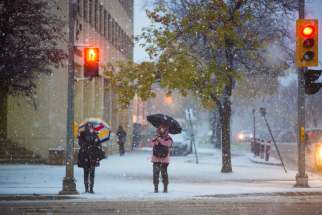
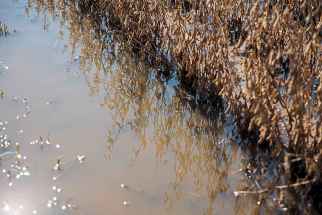
Typically, by now, the soybean crop would be mostly off the fields and in the process of being stored. But extreme levels of rain in September put a damper on production, and with snow falling Thursday and expected to accumulate as high as 15 centimetres, matters for producers of late-season crops like soybeans, corn and potatoes have gotten even worse than one of the wettest falls on record had already predicted.
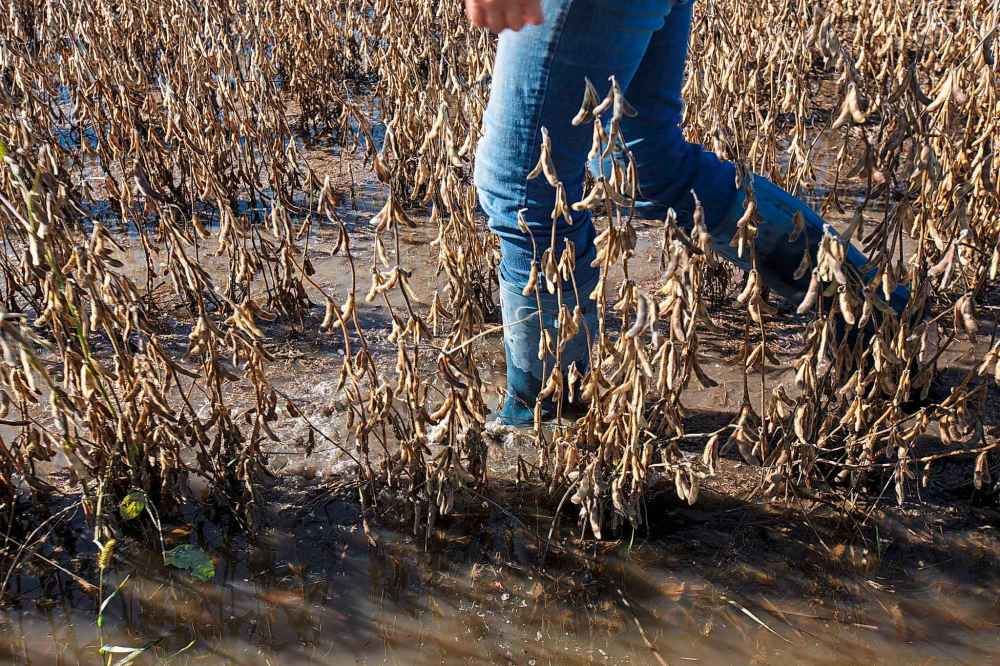
“We are a late-season crop, this year, we’re later than usual, and this nice weather we’re having isn’t helping any, ” said Francois Labelle, the executive director of the Manitoba Pulse and Soybean Growers Association. “We are still behind normal, but it is not a total disaster looking at the time frame.”
After all, seasoned farmers have been around, and know to expect rough weather and early snowfalls. But even experience and preparation can’t completely combat farmers hoping for a routine harvest. “You can’t foretell this kind of weather,” said Wes Martens, who’s farmed in Altona for 45 years. At his farm, about 1,000 acres of soybean and corn remain in his field, representing about half of his crop and thus half his income. Normally, he’d be done between 80 and 100 per cent of his crops and preparing his land for spring.
“I’ve seen snow in October before, that’s not unprecedented,” he said. “But it’s probably unprecedented to have this amount of acreage not done.”
‘I’ve seen snow in October before, that’s not unprecedented. But it’s probably unprecedented to have this amount of acreage not done.’
— Wes Martens, who’s farmed in Altona for 45 years.
Rain in September and October not only made crops more moist than preferred, decreasing their grade and quality, it also meant the soil itself was constantly wet. Heavy machinery needed to harvest creates ruts in those scenarios, and it compacts and degrades the soil. Not only does that make this year’s harvest somewhat of a mess, it could have negative impacts on production in future years. This puts farmers between a rock and a hard place, and snow can mean even more difficult realities ahead.
“We have to hope for a quick melt, and warm dry weather,” Martens said.
For Manitoban potato growers, the harvest is typically over by now, too, says Dan Sawatzky, the manager of the Keystone Potato Producers Association, based in Portage la Prairie. But as is the case with soybeans, this year has been anything but typical.
“As far as the potato harvest goes, we are not in a very good situation right now,” he said. Of the 70,000 acres of potatoes seeded in Manitoba, some 35 per cent have yet to be harvested. The moisture has been challenging, Sawatzky said, and any reprieve from precipitation would be welcome. Otherwise, potato growers could be in the midst of their second consecutive down year.
In 2018, only two growers reached their contracted volume amount, leading to a shortfall amounting to $36.8 million, Sawatzky said. If the weather doesn’t co-operate, and a dryer stretch isn’t on its way, potato losses could be just as high or higher in 2019.
As for corn, harvests usually begin in the first week of October, says Morgan Cott, the field agronomist for the Manitoba Corn Growers Association. But a late spring and cooler growing season have largely been delayed. “We shouldn’t be harvesting for another two weeks or so,” she said. The weather in the growing season is anticipated to have a negative effect on overall quality, Cott said, and bushel weights are expected to be lower than the ideal 56 pounds, though that all varies depending on conditions in different locations
The snow fall isn’t too detrimental, she said, but ideally, there would be a good killing frost to enable the wet grain to dry down.
At least for the short term, the weather is predicted to stay wet, according to Environment and Climate Change Canada. Southern Manitoba can expect a Colorado low system to bring with it a mix of wet snow and rain this weekend, taking away even more drying time than farmers have already lost as temperatures continue to dip toward and below freezing. And though crop insurance covers some of the costs associated with growing, it doesn’t account for the loss in profits, both Fossay and Martens agree.
Aside from delaying the harvest for this year, potentially threatening millions of dollars of crops, the weather also delays work farmers need to do to prepare their fields for the spring, said Walter Smith, who farms just outside Pilot Mound, Man.
Smith is one of the lucky ones: about 98.5 per cent of his crops have been safely harvested already, with the remainder composed of soybeans. Even so, he’s still concerned about getting enough time to put fertilizer down this fall. Normally, Smith and his family would do that over a three-week period in October and November, but it appears much of that work will need to be done when the snow melts.
“Growers will be concerned if they can’t get their crop off, but I’d say most growers are eternal optimists themselves,” said Labelle of the soybean association.
“I don’t know what we’re going to have to do in spring,” Smith said. But, he added, “I will say it’s not over yet.”
For now, Fossay isn’t too stressed over what he can’t control, he said.
“We’re just going to have to hold tough,” he said.
ben.waldman@freepress.mb.ca

Ben Waldman is a National Newspaper Award-nominated reporter on the Arts & Life desk at the Free Press. Born and raised in Winnipeg, Ben completed three internships with the Free Press while earning his degree at Ryerson University’s (now Toronto Metropolitan University’s) School of Journalism before joining the newsroom full-time in 2019. Read more about Ben.
Every piece of reporting Ben produces is reviewed by an editing team before it is posted online or published in print — part of the Free Press‘s tradition, since 1872, of producing reliable independent journalism. Read more about Free Press’s history and mandate, and learn how our newsroom operates.
Our newsroom depends on a growing audience of readers to power our journalism. If you are not a paid reader, please consider becoming a subscriber.
Our newsroom depends on its audience of readers to power our journalism. Thank you for your support.
Related Articles
Ditching the beach for a winter city





History
Updated on Thursday, October 10, 2019 7:18 PM CDT: Edits photo caption