When the dogs had their day Looking back on the 1972-73 Portage Terriers and the team’s wilder-than-fiction run to national junior A hockey glory
Read this article for free:
or
Already have an account? Log in here »
To continue reading, please subscribe:
Digital Subscription
One year of digital access for only $75*
- Enjoy unlimited reading on winnipegfreepress.com
- Read the E-Edition, our digital replica newspaper
- Access News Break, our award-winning app
- Play interactive puzzles
*Billed as $5.77 plus GST every four weeks. After 52 weeks, price increases to the regular rate of $19.95 plus GST every four weeks. Offer available to new and qualified returning subscribers only. Cancel any time.
Monthly Digital Subscription
$4.99/week*
- Enjoy unlimited reading on winnipegfreepress.com
- Read the E-Edition, our digital replica newspaper
- Access News Break, our award-winning app
- Play interactive puzzles
*Billed as $19.95 plus GST every four weeks. Cancel any time.
To continue reading, please subscribe:
Add Free Press access to your Brandon Sun subscription for only an additional
$1 for the first 4 weeks*
- Enjoy unlimited reading on winnipegfreepress.com
- Read the E-Edition, our digital replica newspaper
- Access News Break, our award-winning app
- Play interactive puzzles
*Your next Brandon Sun subscription payment will increase by $1.00 and you will be charged $17.95 plus GST for four weeks. After four weeks, your payment will increase to $24.95 plus GST every four weeks.
Read unlimited articles for free today:
or
Already have an account? Log in here »
Hey there, time traveller!
This article was published 05/05/2023 (1272 days ago), so information in it may no longer be current.
The commemorative leather jackets the players were issued after that storied season are now looking worn and are a snug fit.
It was 50 years ago, after all.
The memories are what’s important now. Their stories, from an era in hockey sometimes described as more blood sport than a game, could fill a book or inspire a movie.
It was real-life Slap Shot before there was the fictional movie Slap Shot.
A finger partially chomped off in a melée. Players charged with on-ice assault and fans spending the night in jail. An opponent too afraid to show up. A championship celebration held behind prison bars where tough-as-nails players mixed with equally tough-as-nails inmates.
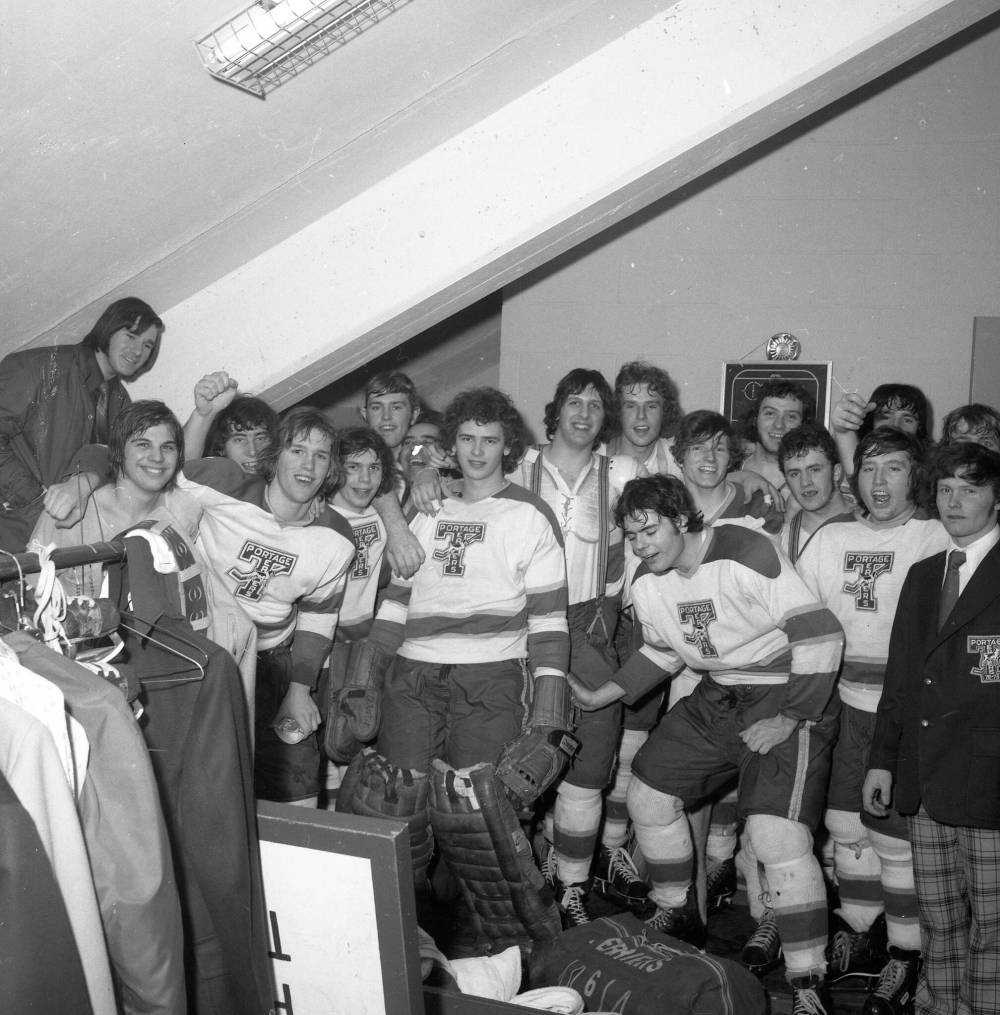
In Manitoba hockey lore, there are few teams that can match up to the 1972-73 Portage Terriers — the perfect amalgam of leadership, skill and toughness.
Next week, almost 50 years to the day they ruled junior A hockey in Canada, the legendary Terriers will regroup at the site of the latest edition of the Centennial Cup to toast their past achievement — an equal mix of blood, mayhem and glory.
It was the summer of ’72 and Grant Farncombe had other plans.
He had been summoned to the home of Knowlson McDermid in Portage la Prairie, but McDermid was vague about the need for a conference — “I want you to meet someone,” the member of the Terriers executive had told him — and so he went, dutifully.
Ushered into the basement of McDermid’s house, Farncombe heard a gravelly voice emerge from the dark. “I’m Muzz MacPherson,” the man said, pumping Farncombe’s hand enthusiastically.
Five decades later, that meeting has assumed mystical overtones.
Farncombe, who had grown up in nearby High Bluff — a speck on the map northeast of Portage — was intending to return to Brandon to play that fall for the Western Canada Hockey League’s Wheat Kings, where he had finished the 1971-72 season.
Unbeknownst to the 19-year-old left-winger, MacPherson had been appointed the new general manager and head coach of the Manitoba Junior Hockey League’s Portage Terriers.
MacPherson desperately wanted Farncombe back in a Terriers uniform — he had played in Portage for most of the previous two seasons — to serve as the foundation of the team.
“I was there for about an hour and a half and by the time I left he had persuaded me that we were going to win a championship, I was going to be the captain and I wasn’t going to Brandon,” remembers Farncombe. “He was a very persuasive person.”
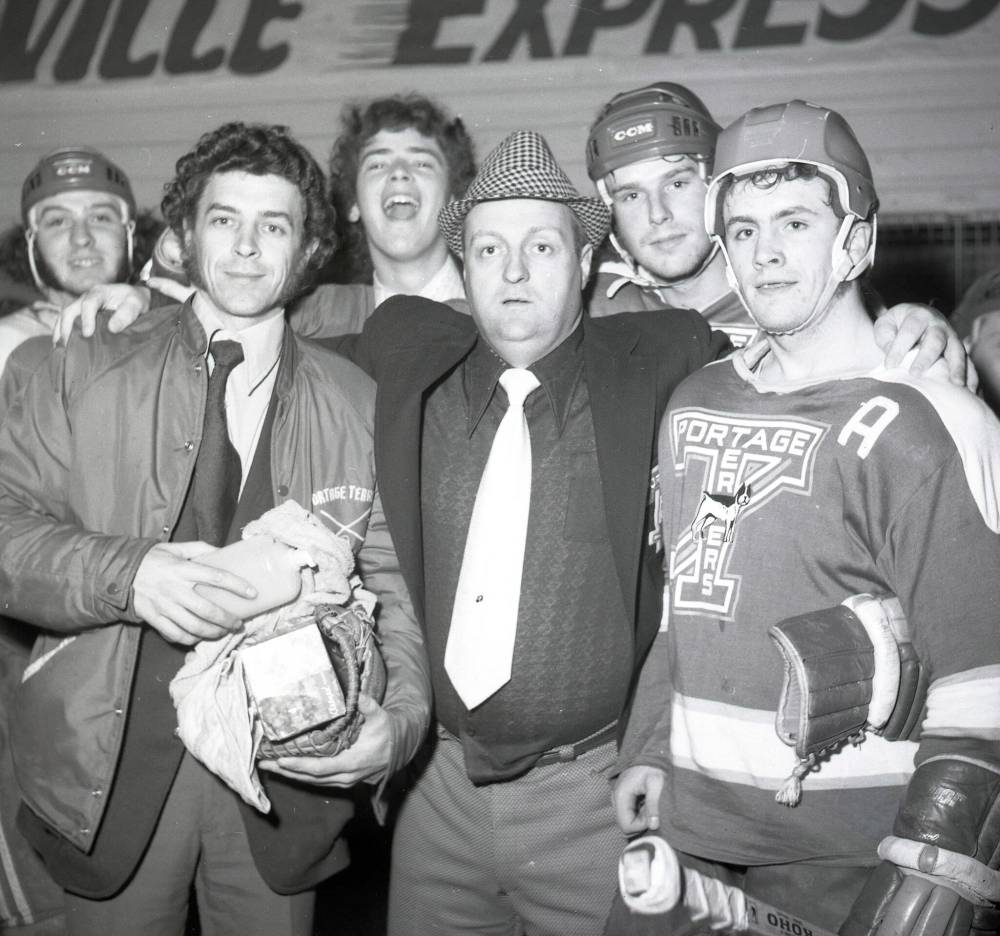
It was bold talk for a city that hadn’t won anything since capturing the 1942 Memorial Cup, but MacPherson, a pudgy ex-minor-league goalie and the son of famed Winnipeg broadcaster Stewart MacPherson, was a skilful communicator and motivator.
He also had a made-in-Manitoba blueprint for a championship season.
Convincing Farncombe to stick around was the first step. Other returnees such as forwards Randy Hextall (Poplar Point), Bill Calder (Portage la Prairie) and Doug Wood (Manitou), goaltender John Memryk (Strathclair), brothers Glenn (a forward) and George Miller (a defenceman) from Elm Creek, and blue-liners Bill Robertson (Winnipeg) and John Hewitt (Portage la Prairie) provided a solid veteran base.
In the intervening weeks, MacPherson also added forwards Dean Magnus (Winnipeg) and Don Arthur (Winnipeg), defenceman Warren Remple (Winnipeg), acquired forwards Scott Hetherington (Carman) and Bob Miller (Glenn and George’s cousin) for $500 each from the MJHL’s Dauphin Kings, and Frank Leswick (Winnipeg) and Randy Penner (Steinbach) from the WCHL’s Wheat Kings. Forward Al Hilton (Winnipeg) would join the team in January after starting the season with the University of Manitoba Bisons.
The Terriers had finished second a year earlier under the direction of head coach Ron McEachern and MacPherson, and buoyed by the new additions they often referenced winning a championship.
“He never quit saying it, either,” says George Miller.
The revamped Terriers adapted grudgingly to MacPherson’s work demands.
“He didn’t seem mad that often but he had times where he would kick the garbage can over,” says Leswick. “He was a stickler for the rules. If practice was starting at 7 o’clock, you had to be on the ice and the boys would be taking half their equipment onto the ice. He’d start talking and you’d finish putting on your elbow pads and shoulder pads.”
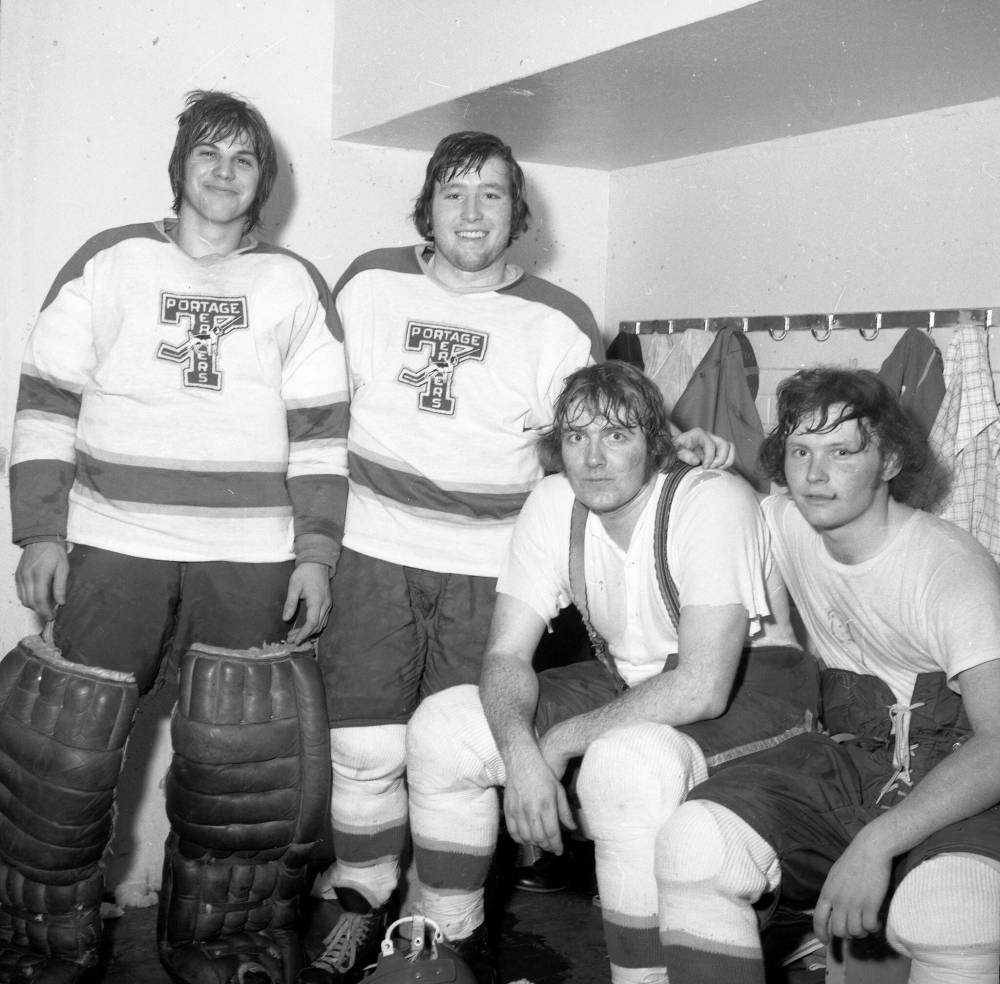
The Terriers began the season on a hot streak, winning nine straight and 14 of their first 15 regular-season games.
The line of Penner, Magnus and Leswick was producing at a steady pace, second only to Kenora’s vaunted top line led by future NHL star Charlie Simmer.
The unit of Farncombe, playing alongside centre Hextall and right-winger Calder, wasn’t far behind.
The wild, rugged tone of the season was cemented during a game against the St. Boniface Saints at the Maginot Arena on Oct. 15.
A bench-clearing brawl with three minutes left in the game, won 8-4 by the Terriers, resulted in a $100 fine and a four-game suspension for MacPherson.
MJHL boss Bill Addison was convinced Muzz was primarily responsible. With no assistant coach on staff, club executive Ron Horner stepped behind the bench during MacPherson’s banishment.
“I’m watching Muzz get interviewed on TV and (the reporter) says, ‘Muzz, you’ve only played two or three games and you’re suspended already,’ ” remembers forward Dan Bonar, who was playing for the Portage midget and juvenile teams after a training camp tryout with the Terriers.
“‘What do you have to say about your suspension?’ He goes, ‘I’d have given me more.’
“I saw this on TV as a 16-year-old and thought, this is gonna be a fun year.”
Bonar, who went on to play three seasons in the NHL, would rejoin the Terriers for their playoff run and provided versatile help when inserted into the lineup due to injuries or suspensions.
MacPherson, nattily attired in a houndstooth fedora, wanted a rough and ruthless approach from his team and they loved him for it.
“Every one of our guys would have gone through a brick wall for him,” says Robertson. “And he treated everyone different. Some guys needed a pat on the back, some guys needed a kick in the pants. Some guys you could scream at and it would just run off their backs and other guys, he would encourage them more. He treated everybody the way they needed to be.”
MacPherson, legendary for his manipulation of referees, used stagecraft to influence his players, too.
“Randy Hextall was one of the guys Muzz would pick on. I don’t know if Muzz talked to him beforehand to tell him he was going to be a target. Randy was a fiery guy and a great teammate but it would just help motivate the guys. If we weren’t playing well, he would tear a strip off Hextall and Hextall would yell back and away we’d go,” Magnus says with a laugh.
”Some guys needed a pat on the back, some guys needed a kick in the pants… He treated everybody the way they needed to be.”–Bill Robertson
“I remember once he needled me and then later said to me, ‘Is that how I get you going — to get you mad?’ He was just a great motivator.”
Defenceman Hewitt, a local product who racked up 302 penalty minutes while scoring 13 goals and 36 points in 38 regular-season games, was a fan favourite and a revered teammate.
“They were physical, they were aggressive and yet they were skilled,” says Barry Moroz, who was a 20-year-old play-by-play announcer on Portage radio station CFRY. “They could play the game any way. And these guys wouldn’t back down. I mean, John Hewitt was probably one of the toughest guys in the league at the time. (Future NHLer) Paul Baxter (of the Winnipeg Monarchs) was a tough player, but he was no match for John.”
MacPherson’s tactics were on-point for Bill Robertson, who formed an intimidating defensive pairing with Remple. George Miller and Hewitt were the other shutdown pair.
“Muzz was getting told he didn’t have control of the bench and he said, ‘I beg to differ. Not one of my players left the bench until I told them to,’ ” Robertson says.
“He was an old-school hockey coach, right? None of his teams ever got pushed around. One of his favourite sayings was, ‘They don’t ask you how you won; they ask you, did you win?’”
”One of his favourite sayings was, ‘They don’t ask you how you won; they ask you, did you win?'”–Bill Robertson
MacPherson was also keen to give the impression his team was slightly unhinged.
In arenas such as Dauphin and Kenora, where dressing rooms for both teams shared a hallway and exit to the ice surface, Memryk would guard the door during pre-game, leaving it open just wide enough to see when the Kings or Muskies were emerging from their dressing rooms.
“Memryk was sitting by the door and Muzz would ask him, ‘Are you ready?’ And he looked down the hallway and said, ‘No, not yet.’ He asks him again, ‘Are you ready?’ and he says, ‘Yeah,’ and he goes down there running and hits the first guy he sees,” says Leswick.
“It was a lot of pushing and shoving and it usually got broken up pretty quick.”
The Terriers cooled off slightly after Christmas, finishing the 48-game regular season with a 32-16-0 record, which was good for first overall in the league with a plus-93 goal differential.
Portage maintained its dominance in the league playoffs, posting four-game sweeps of the Kenora Muskies in the semifinal and St. James Canadians in the final to set the stage for a memorable spring.
After winning the Turnbull Cup as MJHL champions, the Terriers were allowed to add a goaltender for the remainder of their post-season run and MacPherson chose veteran Ty Langton from Dauphin, the league’s worst club.
Langton, arguably the MJHL’s finest puckstopper, joined Memryk in a steady rotation, relegating backup Richard Christie to the stands for the duration.
“I think I played probably 80 per cent of the games that year,” says Memryk, 68. “And if one guy goes down — you do get hurt and we had a few suspensions, too — it didn’t bother me at all. I knew he was a good goalkeeper and I was happy. We split games through the whole thing.”
Next up were the Humboldt Broncos, the Saskatchewan champs, in a series that will live in infamy.
Smith fought Hewitt in a tussle that Smith ended by gnawing on the middle finger of Hewitt’s right hand.
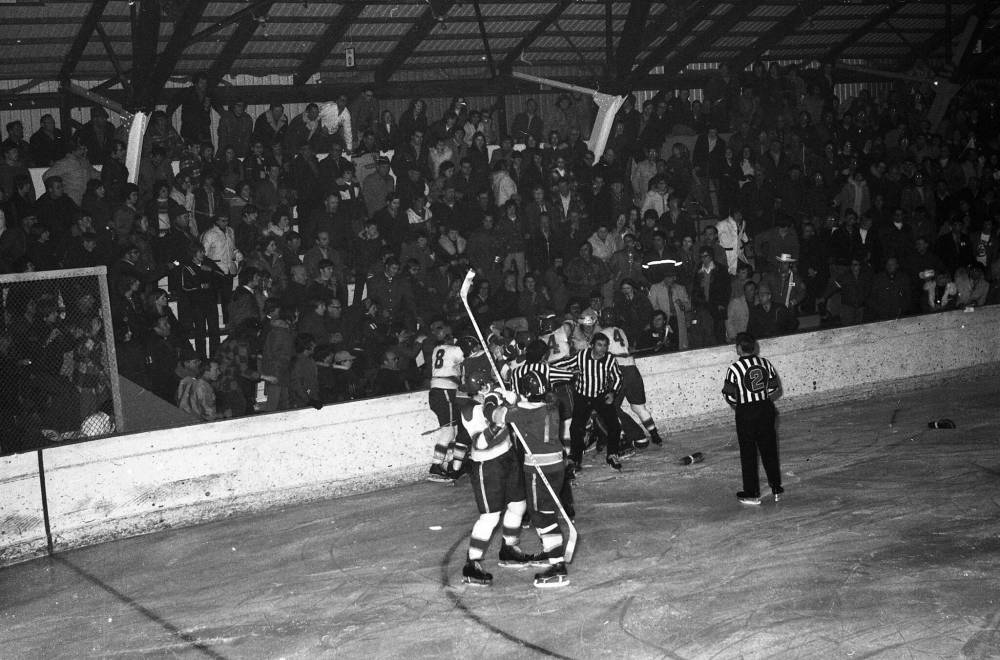
The Terriers lost the opening game 4-2 to the Broncos but rebounded in Game 2, unloading 68 shots in a 5-1 triumph that was interrupted late in the middle frame when Humboldt winger Randy Smith steamrolled Memryk lunging for a loose puck, sparking a donnybrook that resulted in the ejection of six players including the Portage goaltender.
Later in the game, Smith fought Hewitt in a tussle that Smith ended by gnawing on the middle finger of Hewitt’s right hand. The finger was a bloody mess and required freezing prior to each game, and it was wrapped in tape and gauze for the rest of the playoffs. The tough-as-nails Hewitt would play on despite limited use of his right hand.
With the series tied 1-1, games 3, 4 and 5 were scheduled for Humboldt. The anthem had just finished prior to Game 3 when MacPherson turned up the heat with some pre-meditated gamesmanship.
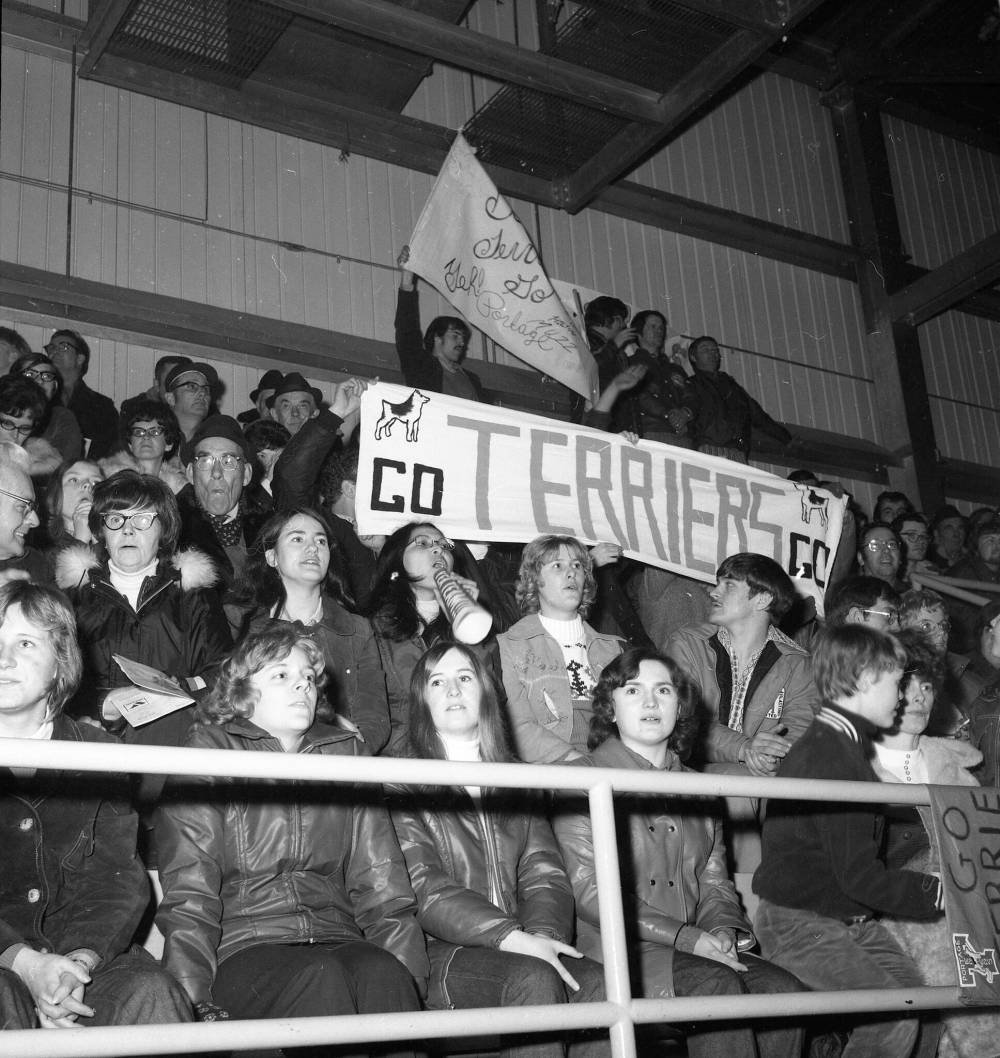
He was annoyed after spying a banner reading ‘The Broncoville Express will derail the Terriers’ plastered to the wall in one end zone.
“Muzz said, ‘We’re gonna own this rink and before the game starts, Remple and Robertson, you go in there’ — they had this banner up there… and he says, ‘Tear that down before the drop of the puck,’ and so we did it.,” recalls Robertson.
“We thought they’d all come after us but they didn’t. The crowd went wild but the players didn’t. After that, we thought we were going to own them.”
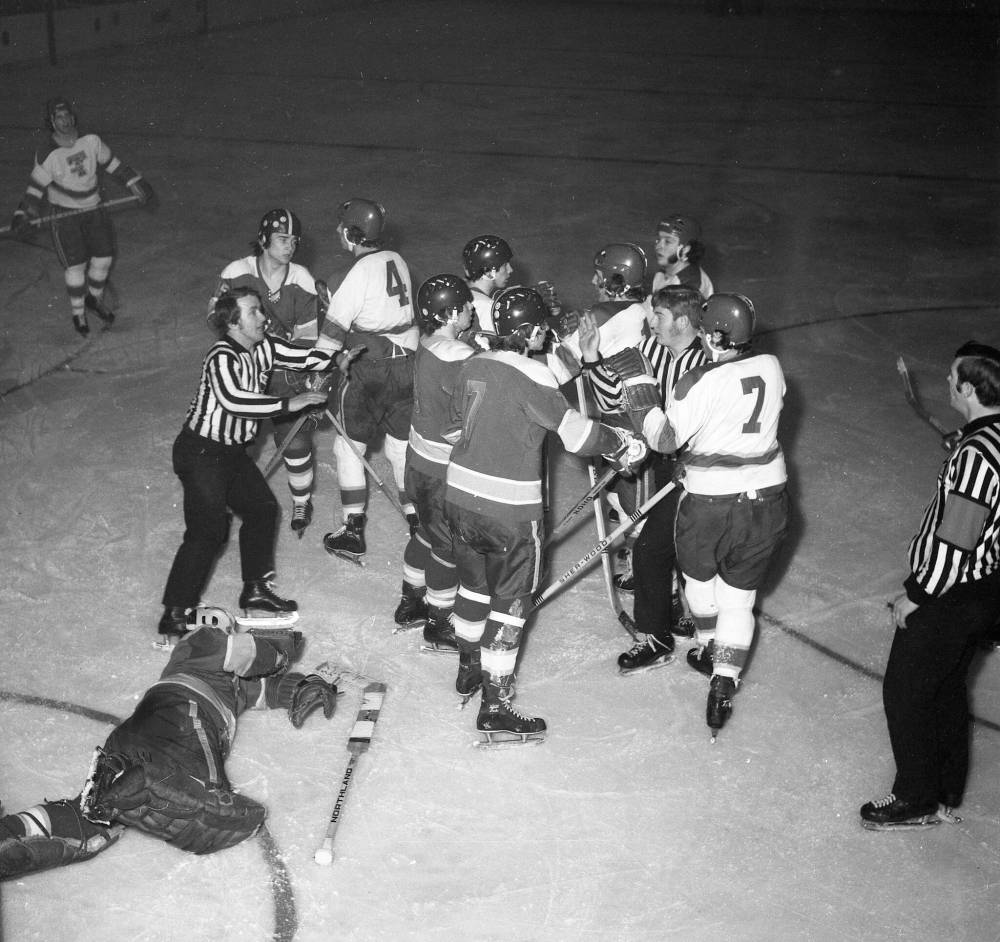
Portage won games 3 and 4 by scores of 7-4 and 8-5. Facing elimination, the Broncos fought back to post a 7-4 win in Game 5, although the game was marred by a brawl with nine seconds left in the third period.
Triggered when Portage’s Bob Miller speared Humboldt’s John Rooney, the ensuing fracas, with two Terriers fans spending the night in jail after the game, must have resembled a scene from Slap Shot, which arrived in movie theatres four years later. Forty-four penalties were called and five RCMP officers were called on to break up the fights.
“(Ty Langdon) chopped somebody down with a goal stick and so did (Al Hilton) and they ended up going back in the off-season for court,” says Leswick.
“A brawl started with Bill Robertson in the penalty box and me and Randy (Hextall) were on the ice… Billy threw a punch at the guy in the penalty box and we had that going and the next thing you know I had their goalie jump me and the Mounties were on the ice breaking up the fight.”
”Billy threw a punch at the guy in the penalty box and… the next thing you know I had their goalie jump me and the Mounties were on the ice breaking up the fight.”–Frank Leswick
Following Game 5, the series was supposed to move to Portage for games 6 and 7 but Broncos coach Terry Henning and GM Gerald Rooney elected not to make the return trip to Manitoba, citing the Terriers’ brutish tactics.
“The problem was that they were so dirty,” John Rooney told the Saskatoon StarPhoenix in 2008. “When you’re that dirty and there are really no consequences, guys get a little worried.”
The Terriers, who took a warm-up on home ice before Humboldt forfeited Game 6 and the series, were flabbergasted the Broncos didn’t make an appearance.
“My feeling about it was I couldn’t believe a hockey team wouldn’t come back and finish the series, right?” says Farncombe. “It wasn’t that bad. Sure, a couple of the guys were charged and did have to go to court later on… They called us goons but I wouldn’t say we were goons. We were a very tough team; we finished our checks and if somebody got in trouble there were four other guys on the ice to help them out.”
”They called us goons but I wouldn’t say we were goons. We were a very tough team.”–Grant Farncombe
A week later, Henning and Gerald Rooney were suspended by the Canadian Amateur Hockey Association. Langdon and Hilton would eventually appear in court to face assault charges, with Langdon being fined $400 and Hilton receiving an absolute discharge.
After the mayhem of the Manitoba-Saskatchewan series, the bottom fell out for the Terriers to start their Abbott Cup Western Canadian Championship against the Penticton Broncos.
Penticton, led by sharp-shooting forward Bob Nicholson (current chairman of the NHL’s Edmonton Oilers and former CEO of Hockey Canada), won games 1 and 2 on home ice and dropped Game 3 in Portage before taking a 3-1 lead in the best-of-seven series with a 5-3 win at the Winnipeg Arena in Game 4. The Terriers regained their composure after that, reeling off 6-3, 5-3 and 6-2 wins back on home ice in games 5, 6, 7, respectively.
Memryk was sensational in the clinching win, stopping 37 shots.
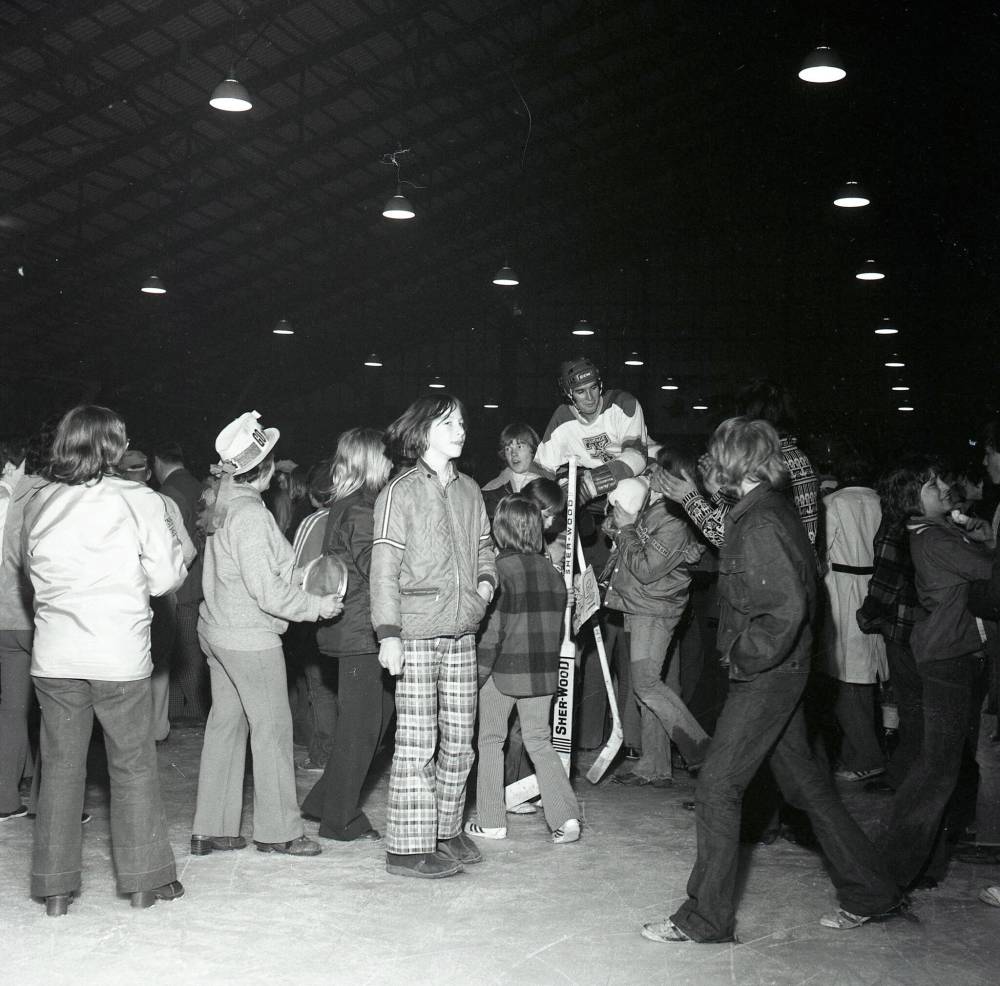
The Terriers had flattened their toughest foe and they would face the Pembroke Lumber Kings in the national final, and due to the competition’s annual rotation, the Terriers would host all the games in Manitoba.
It was fitting scenario because the Terriers often thought of themselves as Manitoba’s team.
“We were all Manitoba boys and we all could relate to each other,” says Bill Robertson, who grew up in Winnipeg and Shilo. “Some guys were raised on a farm, some guys are raised in the city but on that team everybody kind of got along.
“There were some people that were best friends with some teammates, but everybody got along. And Muzz was great. He was a great motivator but he was also one of these guys that, man, if you met Muzz for five minutes, you thought he was a lifetime friend.”

Portage made quick work of the eastern champs, beating Pembroke three times at Brandon’s brand new Keystone Centre, including a 7-5 overtime win in Game 1 on the strength of Randy Penner’s heroics.
“Randy Penner got five goals that night,” says Magnus. “We ended regulation tied and then we found out it wasn’t sudden victory in overtime. It was a 10-minute overtime. Penner was tired and he went off the ice and Muzz left Leswick and I out there and sent out Glenn Miller… I remember going over to (Glenn) and saying, ‘Look, the left wing on this line has five goals so far. See what you can do. And he scored 15 or 20 seconds later. We went ahead 6-5 and won that game 7-5.”
The Lumber Kings battled back in Game 4, winning 6-4 before 8,962 fans at the Winnipeg Arena, but Game 5 belonged to the Terriers and Penner, who scored three times — finishing with 11 goals in the series and 34 in 25 post-season games — in a fitting 4-2 win to clinch the championship before 4,192 at the old arena.
“We had a victory song. After every game, it was arm-and-arm, shoulder-to-shoulder in a big circle in the dressing room,” says Magnus. “We won a lot of hockey games that year but after the last game at Winnipeg Arena, we did the victory song at centre ice.”

The championship celebration to follow unleashed a wave of emotion 31 years after the city last’s national junior hockey title.
Mayor Lloyd Henderson declared the day after Game 5 — May 15 — to be a civic holiday. A parade down Saskatchewan Avenue came to a halt as as schoolchildren, let out at noon, mobbed the motorcade. Hetherington lost his tie and several teammates had their clothing torn by adoring fans.

“The guys that weren’t from in and around Portage stayed about 10 extra days,” says Robertson. “It was all a haze. But it was a good time.”
In keeping with their outlaw image, the Terriers complied with an unusual request days after their title win, visiting Stony Mountain Institution. Previously unknown to the players, they had a devoted following at the federal prison where inmates kept track of the team’s exploits by listening to games on the radio.
“We walked through the gates and into the gymnasium and we were up on the stage as they introduced us,” says Leswick. “They allowed us to mingle and then all they wanted to know was ‘How much can you bench press?’
“It was very intimidating to do that.”
The ’72-73 Terriers have held reunions over the intervening years, highlighted by a public celebration during the 2015 national championship held at Stride Place. In their hockey heyday, they packed the 1,200-seat Portage Centennial Arena.
But next week’s gathering will be short four members: MacPherson, who left the Terriers to scout for an NHL expansion team, the Kansas City Scouts, after his one season in Portage, died in 1997 while Remple (2009), Hextall (2019) and Hewitt (2020) will also be sorely missed.
They’ll mourn their old friends but celebrate a team to remember.

— with photo archives assistance from James Kostuchuk in Portage la Prairie
mike.sawatzky@freepress.mb.ca Twitter: @sawa14