

Reining in right to rally not a good look

Advertisement
Read this article for free:
or
Already have an account? Log in here »
To continue reading, please subscribe:
Digital Subscription
One year of digital access for only $75*
- Enjoy unlimited reading on winnipegfreepress.com
- Read the E-Edition, our digital replica newspaper
- Access News Break, our award-winning app
- Play interactive puzzles
*Billed as $5.77 plus GST every four weeks. After 52 weeks, price increases to the regular rate of $19.95 plus GST every four weeks. Offer available to new and qualified returning subscribers only. Cancel any time.
Monthly Digital Subscription
$4.99/week*
- Enjoy unlimited reading on winnipegfreepress.com
- Read the E-Edition, our digital replica newspaper
- Access News Break, our award-winning app
- Play interactive puzzles
*Billed as $19.95 plus GST every four weeks. Cancel any time.
To continue reading, please subscribe:
Add Free Press access to your Brandon Sun subscription for only an additional
$1 for the first 4 weeks*
- Enjoy unlimited reading on winnipegfreepress.com
- Read the E-Edition, our digital replica newspaper
- Access News Break, our award-winning app
- Play interactive puzzles
*Your next Brandon Sun subscription payment will increase by $1.00 and you will be charged $17.95 plus GST for four weeks. After four weeks, your payment will increase to $24.95 plus GST every four weeks.
Read unlimited articles for free today:
or
Already have an account? Log in here »
Hey there, time traveller!
This article was published 14/02/2026 (232 days ago), so information in it may no longer be current.
The thing about living in a relatively free society is that it can be messy. There’s no way around it, and there doesn’t have to be. It’s a glorious mess, our community, one that is both gift and challenge: thousands of people with differing backgrounds, differing beliefs, all sharing the same community, debating what’s right and how to move forward.
Nowhere is the breadth of that glorious mess more publicly visible than at a protest.
Protest is many things. It can be beautiful, creative, uniting, inspiring. It can also be chaotic, tense and discomfiting; and it can certainly be annoying, especially if you don’t happen to agree with the stance of the protesters. Above all, it’s one of the most powerful levers by which the public can raise their voice and hold power to account.
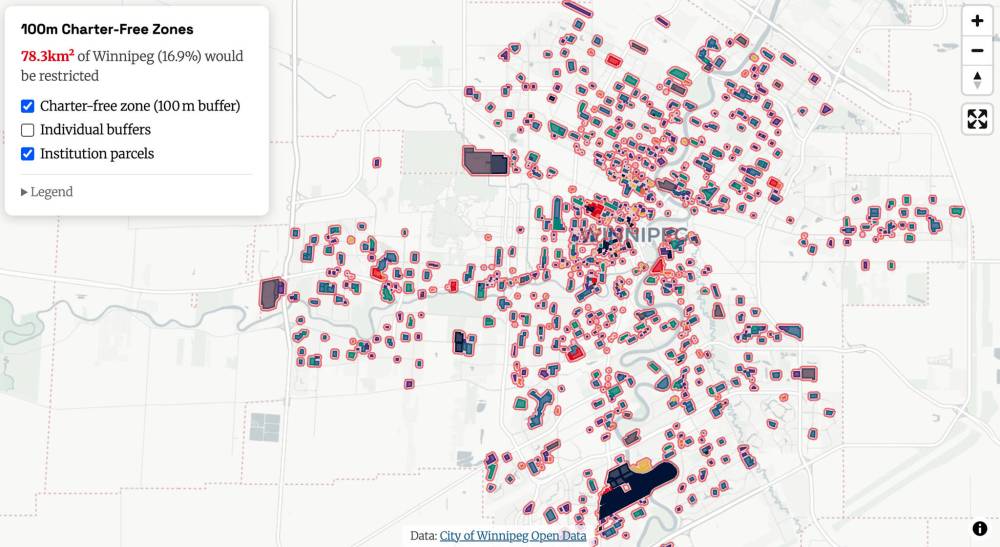
An online map, developed by Buck Doyle and available at chromatin.ca, shows that much of downtown and central Winnipeg would fall into a buffer zone.
For that reason, it is a right enshrined in our Charter of Rights and Freedoms and must remain diligently guarded.
Yet now, a new proposed Winnipeg bylaw may chip away at that right. On Tuesday, city hall’s executive policy committee will consider a draft bylaw, championed by Charleswood-Tuxedo-Westwood councillor Evan Duncan, aimed at restricting so-called “nuisance” protests around a swath of facilities and institutions.
The scope of the draft bylaw is sweeping, in a way that civil liberties groups have decried as overly broad. The new rules would apply 100-metre buffer zones around an array of places, including community centres, city-run cemeteries, cultural centres, health-care facilities, libraries, rehab homes, places of worship and all educational institutions, including universities.
In these buffer zones, the bylaw would prohibit protests expressing objection “by any means” — written, drawn or spoken — towards “an idea, action, person or group” based on a wide variety of characteristics: these include many Charter-protected categories, such as gender, race and sexual orientation, but also, strangely, “source of income.” The definition also includes demonstrations that block vehicles or use microphones without a permit.
The proposed fines for participating in such a protest would be $500 for the first offence, $1,000 for the second and $5,000 thereafter. These aren’t massive sums (a similar effort in Vaughan, Ont., lays out fines up to $100,000; that bylaw is currently facing a constitutional challenge). But they would be sufficient to prevent many from exercising their right to protest.
If the executive policy committee approves at its Feb. 17 meeting, the bylaw will go to a council vote on Feb. 26. Folks with concerns about the proposed bylaw plan to rally at City Hall on Tuesday, Feb. 17 at 8:45 a.m., in advance of the EPC meeting.
Here, one thing must be stressed: Winnipeggers deserve to feel safe in their neighbourhoods. There’s no question that some locations are more sensitive, and more core to that sense of safety and belonging, than others. Most people who organize and attend protests are also mindful of those concerns; it’s good to keep discussing where to strike a balance.
But there are already many regulations by which we’re all protected from acts that go beyond the right of protest. As the draft bylaw notes, demonstrations that promote hatred, violence or terrorism are already prohibited; and criminal laws cover guarantees for the public’s physical safety just as much during protests as at any other time and place.
Meanwhile, the scope of the facilities covered, combined with the 100-metre limit, would make large swaths of Winnipeg, including key government locations, off-limits for unsanctioned protest “at any time.” An online map, developed by Buck Doyle and available at chromatin.ca, shows that much of downtown and central Winnipeg would fall into a buffer zone.
This includes much of Portage Avenue, the area around city hall, and even Premier Wab Kinew’s constituency office. The Manitoba legislature is neighbour to two churches, which means a piece of Memorial Park and the northeast corner of the legislature grounds — natural, common locations for protest — would now be considered part of the buffer.
Consider a hypothetical implication of all of these definitions and included spaces. If, some day, a prominent civic figure is found to have obtained income from an objectionable source, would Winnipeggers be able to freely voice their displeasure outside city hall — with microphones — without fear of being fined?
Also alarming is that all universities and colleges would be included. It’s one thing to consider how to handle hypothetical protests at schools where children are present. It’s quite another to apply the same standard to post-secondary institutions, where adult students are expected to be ready to navigate the public tensions of the wider world.
In an open letter to council this week, many professors, instructors and academic librarians from Winnipeg post-secondary institutions signed on to those concerns.
“Freedom of expression is essential for the mission of post-secondary educational institutions,” the letter states. “Free debate and discussion — including peaceful acts of protest — allow for the exchange of ideas that is required for the discovery, preservation, and dissemination of knowledge.
“Restrictions on protest also limit the university’s ability to prepare students to engage in public debate and respond to intellectual challenges. The proposed bylaw would undermine this freedom of expression in a way that would compromise the core missions of the university.”
In a radio interview this week, Duncan referred to the “chaos” south of the border as something this bylaw aims to prevent. It wasn’t clear what he was referring to; but if it was the protests against the ICE occupation of Minneapolis, it seems he’s taken exactly the wrong lesson from what has unfolded there.
In Minneapolis, ordinary residents have organized for nearly two months to resist an unjust and oppressive assault on their neighbourhoods. They have done this in a wide variety of ways, including loud protest. Had they been even more limited in where and how they could respond, they would have been far more vulnerable to abuse by federal agents.
Sometimes, that type of response can be tense. Sometimes, it can get messy. But we need to trust, as a society, that we can navigate those tensions and conflicts as part and parcel of our community’s public debate. Winnipeggers deserve to feel safe; but over the long run, curtailing our rights in the name of safety makes us less so.
melissa.martin@freepress.mb.ca
Melissa Martin
Reporter-at-large
Melissa Martin reports and opines for the Winnipeg Free Press.
Every piece of reporting Melissa produces is reviewed by an editing team before it is posted online or published in print — part of the Free Press‘s tradition, since 1872, of producing reliable independent journalism. Read more about Free Press’s history and mandate, and learn how our newsroom operates.
Our newsroom depends on a growing audience of readers to power our journalism. If you are not a paid reader, please consider becoming a subscriber.
Our newsroom depends on its audience of readers to power our journalism. Thank you for your support.
Melissa Martin
Reporter-at-large
Melissa Martin reports and opines for the Winnipeg Free Press.
Every piece of reporting Melissa produces is reviewed by an editing team before it is posted online or published in print — part of the Free Press‘s tradition, since 1872, of producing reliable independent journalism. Read more about Free Press’s history and mandate, and learn how our newsroom operates.
Our newsroom depends on a growing audience of readers to power our journalism. If you are not a paid reader, please consider becoming a subscriber.
Our newsroom depends on its audience of readers to power our journalism. Thank you for your support.
Related Articles
Jewish leaders support limits on ‘nuisance’ protests, others voice concerns




Advertisement Advertise With Us
Advertisement Advertise With Us