Lighting way to healing in wake of mass tragedy
Read this article for free:
or
Already have an account? Log in here »
To continue reading, please subscribe:
Digital Subscription
One year of digital access for only $75*
- Enjoy unlimited reading on winnipegfreepress.com
- Read the E-Edition, our digital replica newspaper
- Access News Break, our award-winning app
- Play interactive puzzles
*Billed as $5.77 plus GST every four weeks. After 52 weeks, price increases to the regular rate of $19.95 plus GST every four weeks. Offer available to new and qualified returning subscribers only. Cancel any time.
Monthly Digital Subscription
$4.99/week*
- Enjoy unlimited reading on winnipegfreepress.com
- Read the E-Edition, our digital replica newspaper
- Access News Break, our award-winning app
- Play interactive puzzles
*Billed as $19.95 plus GST every four weeks. Cancel any time.
To continue reading, please subscribe:
Add Free Press access to your Brandon Sun subscription for only an additional
$1 for the first 4 weeks*
- Enjoy unlimited reading on winnipegfreepress.com
- Read the E-Edition, our digital replica newspaper
- Access News Break, our award-winning app
- Play interactive puzzles
*Your next Brandon Sun subscription payment will increase by $1.00 and you will be charged $17.95 plus GST for four weeks. After four weeks, your payment will increase to $24.95 plus GST every four weeks.
Read unlimited articles for free today:
or
Already have an account? Log in here »
Hey there, time traveller!
This article was published 09/09/2022 (1495 days ago), so information in it may no longer be current.
While the eyes of the world turned from the tragedy in Saskatchewan to the death of the Queen, a remarkable spark was lit in the darkness.
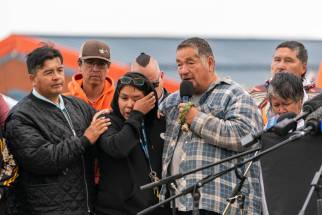
At a news conference Thursday on James Smith Cree Nation — the place where two Cree men charged in a recent series of heinous crimes were raised — Darryl Burns (brother of homicide victim Gloria Burns) embraced the wife of Damien Sanderson.
“I have a young lady here, her husband is one of the accused,” Burns said, hugging the sobbing woman. “This woman shouldn’t have to bear that kind of guilt and shame and responsibility.”
HEYWOOD YU / THE CANADIAN PRESS Darryl Burns, brother of victim Gloria Burns, shares an embrace during a Federation of Sovereign Indigenous Nations event where leaders provided statements about the mass stabbing incident that happened at James Smith Cree Nation and Weldon, Sask.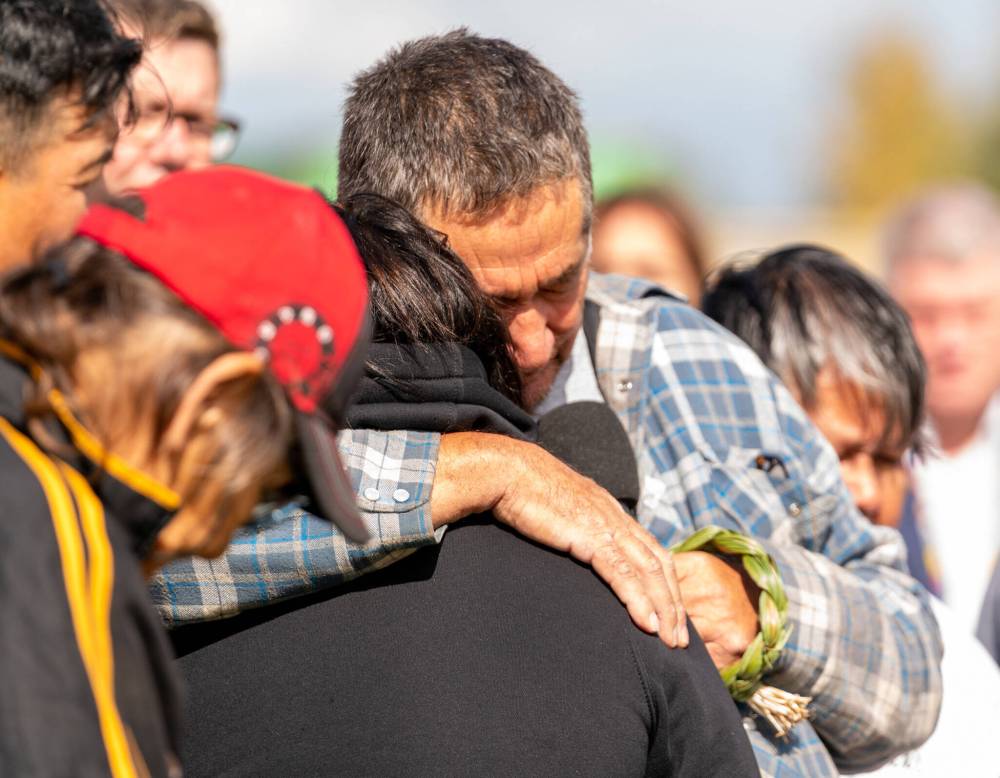
Myles Sanderson, 32, and brother Damien Sanderson, 31, were charged with murder in a string of stabbing attacks that left 10 dead and 18 injured. Damien was found dead on the reserve east of Prince Albert; Myles died days later, shortly after being taken into police custody.
In the wake, many have looked for something or someone to blame.
Most blame addiction. A popular headline this week screamed: “Past drug, alcohol use caused murderer to lose mind.”
Some blame the Parole Board of Canada or the psychologist who approved the release of Myles Sanderson into the community — despite the disagreement of his parole supervisor. Others blame brain damage due to past violence.
There is one common denominator: trauma, the darkness in Indigenous lives.
Every single Indigenous person carries trauma in this country, whether it be from poverty, bigotry, displacement or living under the Indian Act.
There is one common denominator: trauma, the darkness in Indigenous lives.
All are residential school survivors in one shape or another, whether it be experiencing that nightmarish system first hand or intergenerationally.
As a result, many do not know our clans or communities, where our families and histories come from or speak our traditional languages.
It instills a pain that manifests itself in shame, self-harm and legacies of silence.
Frequently, this turns into addiction. Too many times, this turns into violence.
Trauma is not an excuse but a fact of Indigenous life.
The Sanderson brothers were born into trauma.
Trauma is not an excuse but a fact of Indigenous life.
In a Parole Board report, investigators wrote they “grew up in an urban centre in an environment involving physical abuse, domestic violence and instability.” The report identifies this was caused by the “intergenerational impacts of residential schools.”
To cope with the pain, Myles Sanderson began to drink alcohol and smoke marijuana at 12. Two years later, he began to use cocaine. Soon after, he became an absent father. Then, he started lashing out and coming into contact with the law.
Myles Sanderson would eventually father six children, alongside 59 convictions, many of them for violent offenses. He robbed and was abusive of women. He assaulted a police officer.
Damien Sanderson has been described as a “loving, caring, funny family man,” but clearly had similar experiences to his brother.
Everyone in the Indigenous community knows guys like this. They are our cousins, brothers or uncles. This is what makes the past week so difficult.
It is also what makes this situation so complicated for those outside our community to understand.
Bearing the brunt of the violence were Indigenous victims, but this experience showed residential schools, racism and violence against Indigenous children impact Canadians, too.
What was perpetrated last week was a product of Canada’s history of mistreatment of Indigenous peoples. A genocide that returned home.
Bearing the brunt of the violence were Indigenous victims, but this experience showed residential schools, racism and violence against Indigenous children impact Canadians, too.
It wasn’t just Indigenous-held cellphones screaming alerts this past week.
Trauma is never solved with more trauma, though.
This is why the solution will not be found in more police, jails or blaming First Nations.
The solution is found in supporting mental health for traumatized Indigenous communities and families — particularly children.
The best way to do that is to support the rebuilding of Indigenous ceremonies, language revitalization and Indigenous-led organizations and governments.
HEYWOOD YU / THE CANADIAN PRESS “Who are we as people?” Burns announced, holding the wife of Damien Sanderson in his arms. “We’re standing here talking about forgiveness.”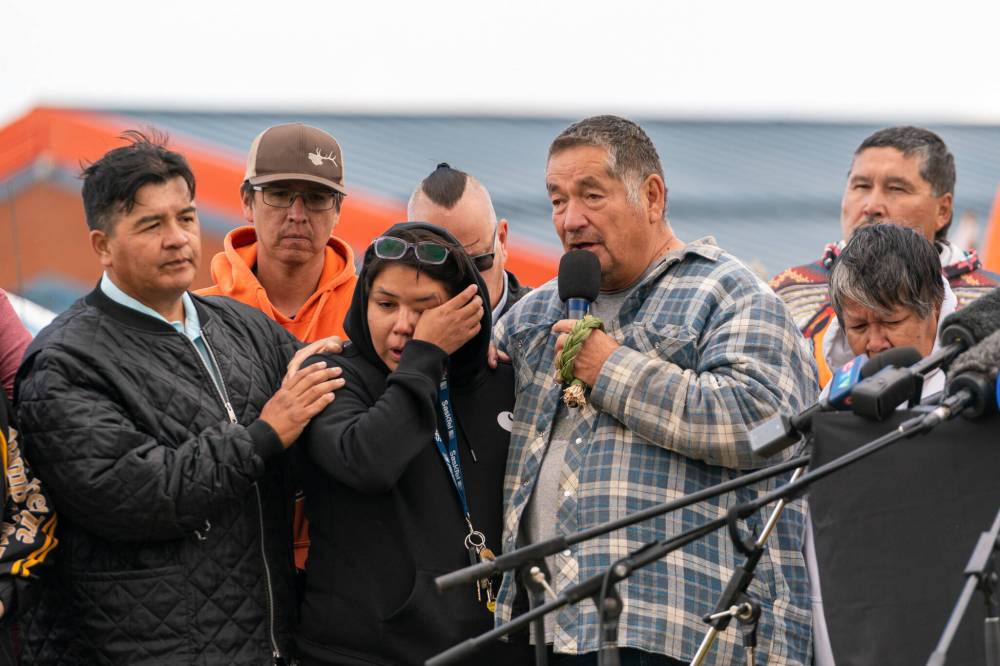
An equal amount of energy must be put into restoring Indigenous nations as was spent harming them.
On Thursday, for whomever was watching, two Indigenous people in Saskatchewan showed Canada how to move forward.
In the midst of a heinous tragedy, full of pain and suffering, two individuals deeply harmed by trauma came together. They hugged and committed to a path of compassion, generosity and love.
“Who are we as people?” Burns announced, holding the wife of Damien Sanderson in his arms. “We’re standing here talking about forgiveness.”
His words, a spark of love, seeking to ignite a long-needed fire.
niigaan.sinclair@freepress.mb.ca

Niigaan Sinclair is Anishinaabe and is a columnist at the Winnipeg Free Press.
Our newsroom depends on a growing audience of readers to power our journalism. If you are not a paid reader, please consider becoming a subscriber.
Our newsroom depends on its audience of readers to power our journalism. Thank you for your support.