

New energy for truth, reconciliation
First Nations hopeful as Hydro’s first Indigenous chair eyes reversing years of enmity

Advertisement
Read this article for free:
or
Already have an account? Log in here »
To continue reading, please subscribe:
Digital Subscription
One year of digital access for only $75*
- Enjoy unlimited reading on winnipegfreepress.com
- Read the E-Edition, our digital replica newspaper
- Access News Break, our award-winning app
- Play interactive puzzles
*Billed as $5.77 plus GST every four weeks. After 52 weeks, price increases to the regular rate of $19.95 plus GST every four weeks. Offer available to new and qualified returning subscribers only. Cancel any time.
Monthly Digital Subscription
$4.99/week*
- Enjoy unlimited reading on winnipegfreepress.com
- Read the E-Edition, our digital replica newspaper
- Access News Break, our award-winning app
- Play interactive puzzles
*Billed as $19.95 plus GST every four weeks. Cancel any time.
To continue reading, please subscribe:
Add Free Press access to your Brandon Sun subscription for only an additional
$1 for the first 4 weeks*
- Enjoy unlimited reading on winnipegfreepress.com
- Read the E-Edition, our digital replica newspaper
- Access News Break, our award-winning app
- Play interactive puzzles
*Your next Brandon Sun subscription payment will increase by $1.00 and you will be charged $17.95 plus GST for four weeks. After four weeks, your payment will increase to $24.95 plus GST every four weeks.
Read unlimited articles for free today:
or
Already have an account? Log in here »
Hey there, time traveller!
This article was published 24/02/2026 (245 days ago), so information in it may no longer be current.
Manitoba Hydro’s first Indigenous board chair says he has reconciliation on his mind as First Nations-driven lawsuits pile up against the Crown corporation and two of its major project licences are set to expire.
“I think there’s a lot of opportunity on the reconciliation side in Manitoba,” said Jamie Wilson, 58, a former treaty commissioner. “The more you understand the history, the more you understand the opportunity.”
Wilson, a member of Opaskwayak Cree Nation, grew up on a farm in The Pas. He remembered neighbours worked at Hydro but didn’t think much about the public utility — just enough to know it kept the house warm in the winter.
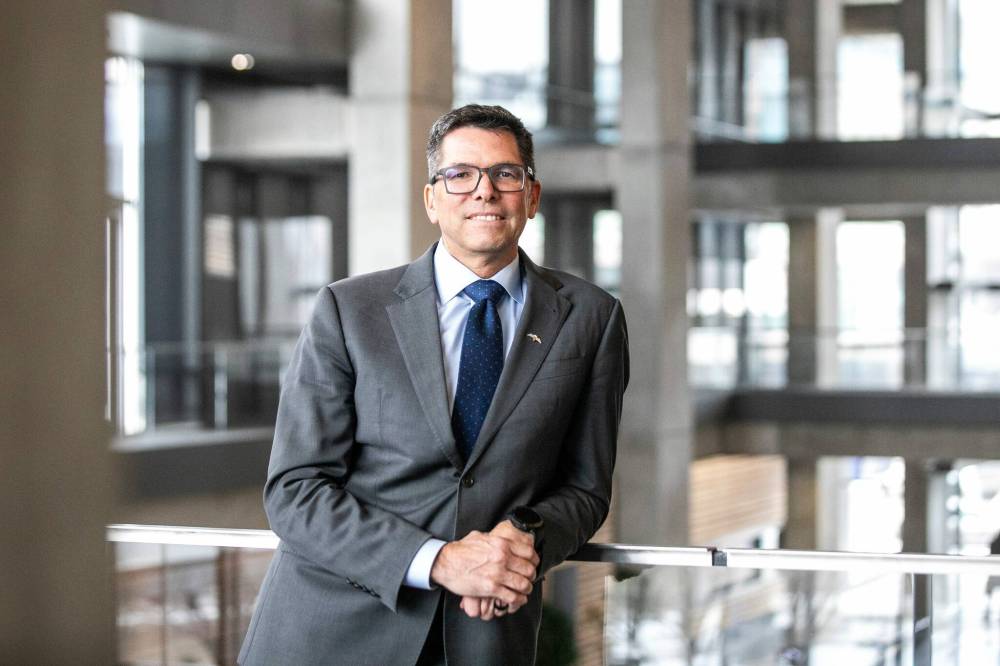
MIKAELA MACKENZIE / FREE PRESS
Jamie Wilson, Manitoba Hydro’s first Indigenous board chair, plans to meet First Nations chiefs in person this year, saying he wants to work in tandem with communities, not against them.
Opaskwayak recently took Ottawa to court over a Grand Rapids hydro dam and its impact on band members, CBC reported.
His home First Nation is hardly the only one; Manitoba Hydro has faced lawsuits from Norway House, Black River, Berens River, Dakota Tipi, Canupawakpa Dakota and York Factory over the past year.
Claims include harm stemming from a Lake Winnipeg regulation project and Hydro operating on territory communities hadn’t agreed to cede.
“From my outside eye, it’s clear that Manitoba Hydro can’t continue with business as usual,” said Byron Williams, a lawyer from the Public Interest Law Centre who works on Hydro-related files.
Williams pointed to two major licences needing renewal this year — the Churchill River Diversion and Lake Winnipeg regulation.
The Churchill River Diversion, operational in 1976, directs water to five generating stations that account for roughly 75 per cent of Manitoba’s power generation.
The Lake Winnipeg regulation project also began operating in 1976. It manipulates the lake’s water levels for power generation. Hydro’s licences for the two projects expire in September and August, respectively.
Manitoba may be in a “constitutional pinch” with the licence renewals, Williams said, adding the government should conduct a thorough consultation process with affected First Nations. Last November, Hydro applied for short-term licence extensions; the province has indicated it’s working with communities on new licence renewal guidelines, a Hydro spokesperson said.
Williams applauded the Crown corporation’s move to appoint an Indigenous board chair.
“It suggests that Manitoba Hydro is perhaps belatedly coming to the understanding that a core aspect of its future is better relations with First Nations and with Métis people,” Williams said.
Lawsuits from First Nations will happen, he said.
“There’s Canadian jurisprudence and there’s Canadian processes that I think have to play themselves out,” he said. “Even while that’s going on, I think it’s important to invest in relationships on both sides (Hydro and First Nations).”
Wilson plans to meet chiefs in person and is lining up travel dates for the summer, he said. Simultaneously, he’s working as Red River College Polytechnic’s vice-president of Indigenous strategy, research and business development.
He was commissioner of the Treaty Relations Commission of Manitoba from 2010 to 2016. In 2016, he was named deputy minister of growth, enterprise and trade under Brian Pallister’s government.
Wilson said he’s already heard from First Nations leadership wanting to work with Manitoba Hydro. He cited “creating a sense of entrepreneurship” as part of the reconciliation journey.
“Our people were business leaders for hundreds of years in the North,” Wilson said. “How do we replicate that mindset as we’re going and talking to different entities?
“It’s… working together towards a future versus working independently towards a future and battle.”
Procuring from Indigenous businesses is part of the strategy, Wilson said. Manitoba Hydro’s 10-year plan highlights power generation from Indigenous majority-owned wind projects.

John Woods / The Canadian Press Files
Pimicikamak Cree Nation Chief David Monias (left), whose community suffered a devastating four-day power outage in December, calls Wilson’s appointment ‘a good sign for reconciliation.’
Hydro must address an “unequal standard of reliability” where northern communities don’t have the backup resources southern areas do, Wilson said.
Pimicikamak Cree Nation experienced a four-day power outage that started Dec. 28 in which thousands of residents had to leave.
Chief David Monias characterized his community’s dealings with Manitoba Hydro as “not such a good relationship” Monday. He has a special interest in the soon-to-expire Lake Winnipeg regulation licence, saying water fluctuations have negatively impacted locals and the environment.
He said Pimicikamak wouldn’t agree with a new licence until promises made through the Northern Flood Agreement are fulfilled.
The 1977 agreement outlines responsibilities governments and Manitoba Hydro have to communities affected by the Lake Winnipeg regulation and the Churchill River Diversion project.
“Our benefits and entitlements become like a hot potato,” Monias said. “Manitoba Hydro will throw to Canada (and) say that’s Canada’s responsibility. Canada will throw it back to Manitoba Hydro.”
He’d like investment into Pimicikamak, including for education, housing and a general store the community can run. He’s considering legal action over how the Northern Flood Agreement has played out.
Manitoba Hydro is continually engaging with affected First Nations, spokesman Peter Chura said.
Wilson’s appointment is “a good sign for reconciliation,” Monias said, adding he’d like to meet the chair in person: “I’m hoping (Wilson) will start to make changes or propose changes.”
Adrien Sala, the minister responsible for Manitoba Hydro, called Wilson a “visionary leader.”
“(He’ll) help Hydro to continue improving their working relationships with First Nations while it maintains a continued focus on improving reliability and affordability,” said Sala.
Wilson said he’s confident in Hydro staff who are working to avoid projected energy deficits in 2030.
“We look forward to working with (Wilson) and the board to continue providing Manitobans with safe, reliable and affordable energy,” Chura wrote in a statement.
— with files from Erik Pindera
gabrielle.piche@winnipegfreepress.com
Gabrielle Piché reports on business for the Free Press. She interned at the Free Press and worked for its sister outlet, Canstar Community News, before entering the business beat in 2021. Read more about Gabrielle.
Every piece of reporting Gabrielle produces is reviewed by an editing team before it is posted online or published in print — part of the Free Press‘s tradition, since 1872, of producing reliable independent journalism. Read more about Free Press’s history and mandate, and learn how our newsroom operates.
Our newsroom depends on a growing audience of readers to power our journalism. If you are not a paid reader, please consider becoming a subscriber.
Our newsroom depends on its audience of readers to power our journalism. Thank you for your support.
Gabrielle Piché reports on business for the Free Press. She interned at the Free Press and worked for its sister outlet, Canstar Community News, before entering the business beat in 2021. Read more about Gabrielle.
Every piece of reporting Gabrielle produces is reviewed by an editing team before it is posted online or published in print — part of the Free Press‘s tradition, since 1872, of producing reliable independent journalism. Read more about Free Press’s history and mandate, and learn how our newsroom operates.
Our newsroom depends on a growing audience of readers to power our journalism. If you are not a paid reader, please consider becoming a subscriber.
Our newsroom depends on its audience of readers to power our journalism. Thank you for your support.
Related Articles
Norway House files suit against Hydro, governments over Lake Winnipeg





Advertisement Advertise With Us
Advertisement Advertise With Us
History
Updated on Tuesday, February 24, 2026 7:41 AM CST: Adds Jamie Wilson's full name