Judge lets convicted killer walk, says victim started high school fight
Read this article for free:
or
Already have an account? Log in here »
To continue reading, please subscribe:
Digital Subscription
One year of digital access for only $75*
- Enjoy unlimited reading on winnipegfreepress.com
- Read the E-Edition, our digital replica newspaper
- Access News Break, our award-winning app
- Play interactive puzzles
*Billed as $5.77 plus GST every four weeks. After 52 weeks, price increases to the regular rate of $19.95 plus GST every four weeks. Offer available to new and qualified returning subscribers only. Cancel any time.
Monthly Digital Subscription
$4.99/week*
- Enjoy unlimited reading on winnipegfreepress.com
- Read the E-Edition, our digital replica newspaper
- Access News Break, our award-winning app
- Play interactive puzzles
*Billed as $19.95 plus GST every four weeks. Cancel any time.
To continue reading, please subscribe:
Add Free Press access to your Brandon Sun subscription for only an additional
$1 for the first 4 weeks*
- Enjoy unlimited reading on winnipegfreepress.com
- Read the E-Edition, our digital replica newspaper
- Access News Break, our award-winning app
- Play interactive puzzles
*Your next Brandon Sun subscription payment will increase by $1.00 and you will be charged $17.95 plus GST for four weeks. After four weeks, your payment will increase to $24.95 plus GST every four weeks.
Read unlimited articles for free today:
or
Already have an account? Log in here »
Hey there, time traveller!
This article was published 06/06/2018 (3060 days ago), so information in it may no longer be current.
Just days after the third anniversary of a deadly school stabbing, a convicted killer walked out of court in his suit and tie, and with the certainty he won’t go to jail.
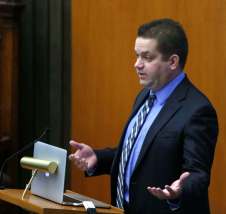
In the marble hallway outside the Winnipeg courtroom where Justice Brenda Keyser delivered her decision in less than five minutes Wednesday morning, some of the young man’s supporters applauded defence lawyer Greg Brodsky.
Brodsky successfully argued the now-20-year-old man doesn’t need time behind bars to know he shouldn’t have used a knife in a schoolyard fight.

He was only three months away from his 18th birthday when he fatally stabbed 17-year-old Brett Bourne at Kelvin High School on June 2, 2015. A jury convicted him of manslaughter last fall.
His name, protected from public release under the Youth Criminal Justice Act, now joins a select list of other young convicted killers in Manitoba who have been spared jail time over the years.
The young man is under a year-long court order to live with his parents and follow certain conditions, including completing 100 hours of community service work, not to possess any restricted weapons, and submit a sample of his DNA to authorities. He said he plans to earn a computer science degree and keep working on an app he designed for students to anonymously report safety threats — something he wouldn’t have been able to do if Keyser had agreed with Crown prosecutors’ bid to send him to an adult prison for five years.
Keyser decided not to sentence the young man as an adult. She didn’t give reasons for her decision when she spoke in court, but in her written decision, she noted Bourne started the fight and the convicted killer believed Bourne was carrying a weapon (he wasn’t). The killer, who had no criminal record, showed remorse afterward and still has panic attacks when using kitchen knives.
“Taking into consideration the fact that (the convicted youth) did not initiate the confrontation and has been found to be a very low risk to reoffend, I am satisfied that it would not be in the public interest to further incarcerate him,” Keyser wrote.
Although this case is relatively unusual, the decision to keep a youth out of jail is not, said University of Manitoba law Prof. David Milward, who reviewed Keyser’s 15-page decision Wednesday.
“It’s unusual in the sense that, on the one hand, you do have a manslaughter, but at the same time, you do really have somebody who, even after what happened, has now become a very solid candidate and is getting back on the right path,” he said.
“In the kind of circumstances and the facts that I read, this would be almost an expected outcome.”
Canada’s youth criminal justice system focuses on the needs of individual young offenders rather than deterring the public generally. Under the law, youth-court judges are urged to use custody only when necessary. If the now-20-year-old had been sentenced as an adult, he’d face a much harsher sentence, Milward said.
“Even if an adult offender is a low risk to reoffend, there’s still that component of sending a message publicly. And that is very much a part of adult sentencing. That’s not so much a part of youth justice, where custody tends to be (part of the sentence) when the youth judge thinks it’s necessary to protect the public,” he said, adding he believes Keyser correctly applied the legal youth-sentencing principles in her decision.
Other Manitoba teens have received similar sentences after being convicted of manslaughter, including a 2008 case in which Keyser sentenced a boy to a two-year custody and supervision order that involved four months of open custody. In that case, which she noted was more “disturbing” than Bourne’s death, a 15-year-old boy kicked and beat a defenceless youth, removed the other boy’s clothes and left him to die while he and other co-accused partied.
In his legal arguments, Brodsky referenced two other Manitoba cases in which teen boys stabbed someone to death, pleaded guilty to manslaughter, and were spared jail time because they weren’t a risk to the public.
Jamie Bourne, the victim’s mother, declined to comment Wednesday. She indicated she was surprised by the judge’s decision.
At the killer’s sentencing hearing in April, she tearfully read aloud a victim-impact statement, saying her life has been a nightmare since the day Bourne was killed. She and the victim’s brother told court their lives will never be the same.
“What gave you the right to take my son’s life? His future? Our future?” Jamie Bourne asked the killer. “You had many opportunities to stop. You chose to continue.”
The killer was 17 when he intervened in a lunch-hour fight between Bourne and another boy, who had been dating Bourne’s ex-girlfriend. The couple had broken up about a week earlier, unbeknownst to Bourne, who was a former Kelvin student.
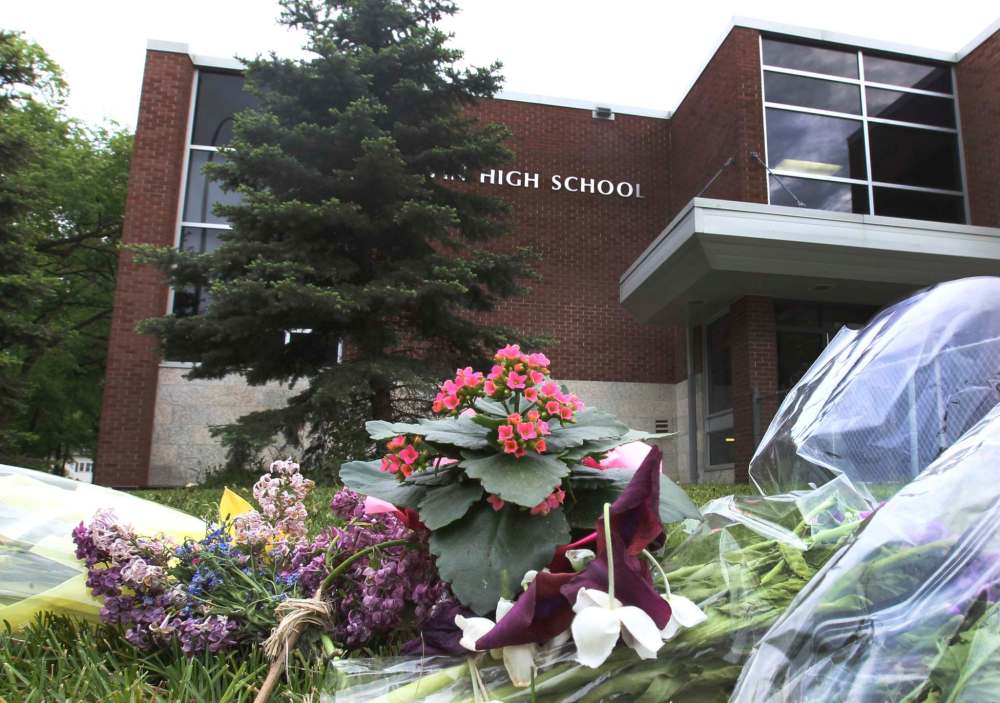
Bourne rode his bike past the school on June 2, 2015, spotted the boy he believed was dating his ex-girlfriend, and tried to start a fight, chasing him into the school. The convicted killer testified at his trial he armed himself with a knife to protect his friend because he thought Bourne had a knife.
He stabbed Bourne once, then fled the scene. He cut his own arm with a different knife and told his mother he was the one who’d been stabbed. He stuck to the lie for hours when he was initially questioned by police, even though investigators discovered Bourne was unarmed.
Several students witnessed the fight, and Bourne’s death shook the school community. It prompted his mother to sue the Winnipeg School Division, and launch a petition to have metal detectors installed in city high schools.
Speaking outside the courtroom Wednesday, Brodsky emphasized his client had been trying to help a friend when he stabbed Bourne.
“He’s going to university and he hopes to continue with that,” the lawyer said. “He wants to move on with his life.”
During a sentencing hearing in April, Brodsky argued his client had learned his lesson and now understands he should have gone to get help or called police instead of arming himself. The young man’s mother put forward a bail plan that would bar her son from using social media sites. He was on bail under house arrest for about two years leading up to his trial, after spending the equivalent of nine months in custody.
“He doesn’t need any more time. This is an awful thing that’s happened. He has learned,” Brodsky argued in April.
Crown attorney Erika Dolcetti disagreed.
“Somebody cannot bring a knife to a fistfight, especially at a school, stab an unarmed man and then go on probation,” she argued at the time.
Brodsky clarified he wasn’t seeking probation, and Keyser seemed to agree the young man didn’t need to be supervised by a probation officer.
“He seems overwhelmingly rehabilitated and a low risk to reoffend,” the judge said at the April court appearance. Keyser rejected the Crown’s alternate suggestion to sentence the young man as an adult to two years less a day in jail followed by three years of probation.
katie.may@freepress.mb.ca
Twitter: @thatkatiemay

Katie May is a multimedia producer for the Free Press.
Our newsroom depends on a growing audience of readers to power our journalism. If you are not a paid reader, please consider becoming a subscriber.
Our newsroom depends on its audience of readers to power our journalism. Thank you for your support.
History
Updated on Wednesday, June 6, 2018 1:32 PM CDT: updates story, adds photo
Updated on Wednesday, June 6, 2018 6:28 PM CDT: Writethrough
Updated on Thursday, June 7, 2018 10:13 AM CDT: Photo captions fixed.