

Remote reserves demand end to wildfire ‘cycle of failure’

Advertisement
Read this article for free:
or
Already have an account? Log in here »
To continue reading, please subscribe:
Digital Subscription
One year of digital access for only $75*
- Enjoy unlimited reading on winnipegfreepress.com
- Read the E-Edition, our digital replica newspaper
- Access News Break, our award-winning app
- Play interactive puzzles
*Billed as $5.77 plus GST every four weeks. After 52 weeks, price increases to the regular rate of $19.95 plus GST every four weeks. Offer available to new and qualified returning subscribers only. Cancel any time.
Monthly Digital Subscription
$4.99/week*
- Enjoy unlimited reading on winnipegfreepress.com
- Read the E-Edition, our digital replica newspaper
- Access News Break, our award-winning app
- Play interactive puzzles
*Billed as $19.95 plus GST every four weeks. Cancel any time.
To continue reading, please subscribe:
Add Free Press access to your Brandon Sun subscription for only an additional
$1 for the first 4 weeks*
- Enjoy unlimited reading on winnipegfreepress.com
- Read the E-Edition, our digital replica newspaper
- Access News Break, our award-winning app
- Play interactive puzzles
*Your next Brandon Sun subscription payment will increase by $1.00 and you will be charged $17.95 plus GST for four weeks. After four weeks, your payment will increase to $24.95 plus GST every four weeks.
Read unlimited articles for free today:
or
Already have an account? Log in here »
Hey there, time traveller!
This article was published 08/08/2025 (420 days ago), so information in it may no longer be current.
Four remote, wildfire-affected First Nations in northern Manitoba urged the federal and provincial governments Friday to do more prevention work to avoid future mass evacuations or airlifts.
More than 6,000 evacuees from the fly-in Island Lake region — composed of Garden Hill, Red Sucker Lake, St. Theresa Point and Wasagamack Anisininew nations — have been out of their homes since July.
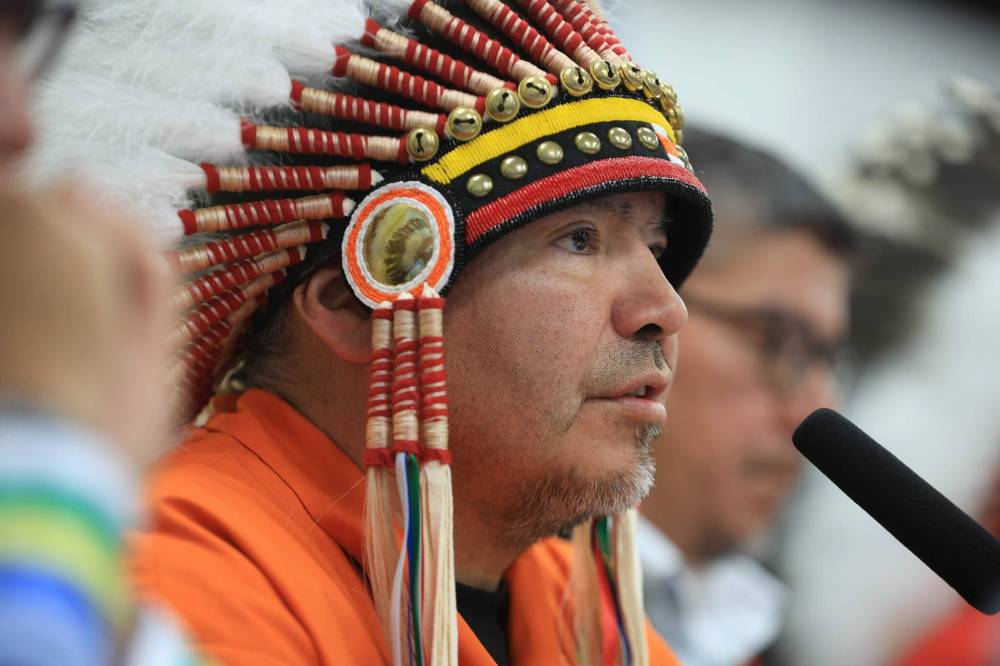
“This could have been all prevented… if we tackled the fire right away,” Garden Hill Chief Dino Flett said of his community’s full evacuation, which involved military planes.
Ruth Bonneville / Free Press
Garden Hill Chief Dino Flett said the community alerted the province when smoke was spotted five days before the blaze spread close to the First Nation and forced everyone to leave.
Flett said Garden Hill alerted the province when smoke was spotted five days before the blaze spread close to the First Nation and forced everyone to leave.
He said Garden Hill lacks the trained firefighters and equipment to respond to such emergencies on its own.
The Island Lake chiefs cited a report by Canada’s auditor general, which said Indigenous Services Canada spent 3.5 times more money ($646 million) on emergency response and recovery than it did to help First Nations prevent or prepare for them between 2018 and 2022.
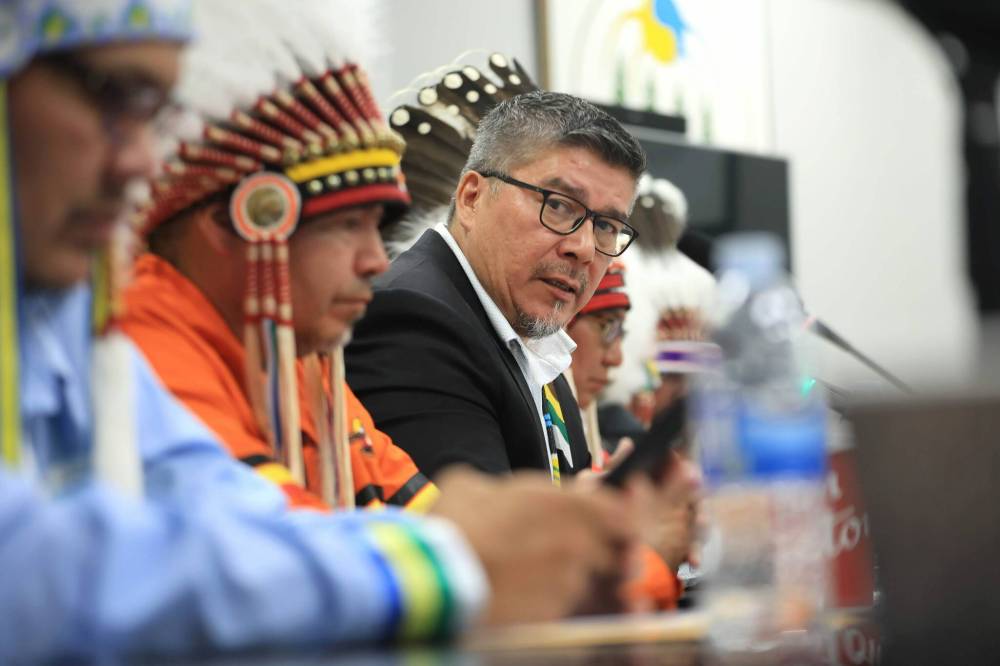
Alex McDougall, grand chief of Aninew Okimawin, a council that represents the Island Lake communities, said Ottawa would save money and there would be less disruption to lives if it spent more on planning and prevention.
“This is a cycle of failure. Our chiefs in Anisininew nations are saying to Canada, ‘The cycle ends now,’” McDougall said.
The chiefs said Island Lake communities need wildland firefighting teams and fire breaks for protection.
The chiefs backed calls for Indigenous-led emergency response systems and greater collaboration with Ottawa and Manitoba, alongside demands for regional evacuation and national Indigenous fire strategies, and respect for Anisininew leadership.
Island Lake is accessible by air and winter road. The chiefs called on governments to fund a proposed $512-million, 252-kilometre all-season road, which they said would reduce the need for evacuation flights in the future.
Flett said fires burned two of three winter road bridges, which need to be replaced “as soon as possible.”
Indigenous Services Canada spokeswoman Jacinthe Goulet said the federal department is working with First Nations to develop multilateral emergency management service agreements that include First Nations “as full and equal partners in governance, planning, and delivery.”
She said funding is available through multiple programs for measures, such as firefighter training, vegetation clearing and emergency management planning, to help mitigate risks or prepare for wildfires.
Ottawa provides money for local emergency management co-ordinators in First Nations.
Goulet said the department has provided $58.9 million in advance payments since April 1 to support immediate response in Manitoba First Nations where residents have been displaced.
The department reimburses 100 per cent of eligible costs for emergency response and recovery, she said.
Ottawa pledged to fund “weather-resistant” infrastructure, including homes, and said it is open to working closely with communities and the province on long-term plans for all-season roads.
Ian Bushie, Manitoba’s minister of natural resources and Indigenous futures, said the province has expanded emergency firefighter training into the Island Lake region.
He said the Office of the Fire Commissioner was in the area this week to address any concerns.
Bushie said Manitoba and Ottawa have discussed the need to improve all-season roads.
“We agree with the Island Lake region chiefs that collaboration is the key to dealing with the ongoing challenges of increased fire seasons and will continue to work with Anisininew Okimawin to address these gaps, and welcome continued dialogue on proposals such as a tripartite emergency accord,” he said in a statement.
Thorough assessments of this year’s wildfires will take place to strengthen prevention, preparedness and emergency management across Manitoba, Bushie noted.
Ruth Bonneville / Free Press
Alex McDougall, grand chief of Aninew Okimawin said Ottawa would save money and there would be less disruption to lives if it spent more on planning and prevention.
First Nations leaders criticized the Canadian Red Cross, which has co-ordinated flights, accommodation, meals and financial benefits on behalf of governments.
Assembly of Manitoba Chiefs Grand Chief Kyra Wilson said the Red Cross’ response was slow. She cited a lack of hotel rooms in Manitoba, forcing some people to be moved out of province, and a lack of food for some evacuees, despite the Red Cross receiving millions of dollars from governments and donors.
“Red Cross, if you cannot do the job, we will do it,” Wilson said. “You have tried your best, but your best is not good enough.”
Flett said some evacuees from Garden Hill are still sleeping on cots in congregate shelters and some are staying in campgrounds.
A Red Cross spokesperson said the agency has registered more than 31,000 evacuees, secured more than 2,500 hotel rooms and is operating two congregate shelters in Winnipeg.
“We understand this is a very challenging time for many people, and the Red Cross is working extremely hard to provide support, necessities and services to thousands of people impacted by wildfires in Manitoba,” an unnamed spokesperson wrote in an email.
“This is a fast-moving and evolving response, and the Red Cross is working with community leadership, the government of Manitoba and Indigenous Services Canada to provide support to people impacted, as requested and directed by the community.”
The Island Lake region is about 600 kilometres northeast of Winnipeg.
The region’s largest fire is an out-of-control blaze, measuring about 37,857 hectares, that forced the full evacuation of Garden Hill. The fire was caused by human activity and detected July 6, the Manitoba Wildfire Service said.
In a social-media post, Nisichawayasihk Cree Nation said Friday it is moving evacuees from Winnipeg to hotels in Niagara Falls, Ont., in response to concerns about accommodations in Manitoba’s capital.
The post said there was space for 1,000 people at two hotels in Niagara Falls.
“We understand the challenges our NCN community (has) been facing,” the post stated.
The Manitoba government extended a provincewide state of emergency’s expiration date from Aug. 8 to Aug. 22.
The wildfire service reported 161 active fires as of Thursday, for a total of 405 since the season began in April.
Almost 1.7 million hectares of land has burned. That is the most since 1989’s record of more than three million hectares.
chris.kitching@freepress.mb.ca
Chris Kitching is a general assignment reporter at the Free Press. He began his newspaper career in 2001, with stops in Winnipeg, Toronto and London, England, along the way. After returning to Winnipeg, he joined the Free Press in 2021, and now covers a little bit of everything for the newspaper. Read more about Chris.
Every piece of reporting Chris produces is reviewed by an editing team before it is posted online or published in print — part of the Free Press‘s tradition, since 1872, of producing reliable independent journalism. Read more about Free Press’s history and mandate, and learn how our newsroom operates.
Our newsroom depends on a growing audience of readers to power our journalism. If you are not a paid reader, please consider becoming a subscriber.
Our newsroom depends on its audience of readers to power our journalism. Thank you for your support.
Communities with mandatory evacuation orders in place
Mandatory evacuation orders were in place for the following communities or areas as of Friday, as per the province’s MB Ready website.
- Atikaki Provincial Park
- Burge Lake Provincial Park
- Cormorant
- Garden Hill Anisininew Nation
- Island Lake
- Leaf Rapids
- Lynn Lake
- Mantario Wilderness Area
- Marcel Colomb First Nation
- Mathias Colomb Cree Nation (Pukatawagan)
- Nisichawayasihk Cree Nation
- Snow Lake
- South Atikaki Provincial Park
- Wallace Lake Provincial Park
Priority evacuations, including medically vulnerable people, were in place for the following communities:
- Misipawistik Cree Nation (Grand Rapids)
- O-Pipon-Na-Piwin Cree Nation
- Red Sucker Lake First Nation
- Theresa Point Anisininew Nation
Chris Kitching is a general assignment reporter at the Free Press. He began his newspaper career in 2001, with stops in Winnipeg, Toronto and London, England, along the way. After returning to Winnipeg, he joined the Free Press in 2021, and now covers a little bit of everything for the newspaper. Read more about Chris.
Every piece of reporting Chris produces is reviewed by an editing team before it is posted online or published in print — part of the Free Press‘s tradition, since 1872, of producing reliable independent journalism. Read more about Free Press’s history and mandate, and learn how our newsroom operates.
Our newsroom depends on a growing audience of readers to power our journalism. If you are not a paid reader, please consider becoming a subscriber.
Our newsroom depends on its audience of readers to power our journalism. Thank you for your support.
Related Articles
Canada's 2025 wildfire season now second-worst on record, fuelled by Prairies blazes


Advertisement Advertise With Us
Advertisement Advertise With Us
History
Updated on Friday, August 8, 2025 5:24 PM CDT: Updates with final copy, adds photos
Updated on Friday, August 8, 2025 5:59 PM CDT: Adds comment from Indigenous Services Canada spokeswoman