

Tories imprisoned by ‘tough on crime’ way of thinking

Advertisement
Read this article for free:
or
Already have an account? Log in here »
To continue reading, please subscribe:
Digital Subscription
One year of digital access for only $75*
- Enjoy unlimited reading on winnipegfreepress.com
- Read the E-Edition, our digital replica newspaper
- Access News Break, our award-winning app
- Play interactive puzzles
*Billed as $5.77 plus GST every four weeks. After 52 weeks, price increases to the regular rate of $19.95 plus GST every four weeks. Offer available to new and qualified returning subscribers only. Cancel any time.
Monthly Digital Subscription
$4.99/week*
- Enjoy unlimited reading on winnipegfreepress.com
- Read the E-Edition, our digital replica newspaper
- Access News Break, our award-winning app
- Play interactive puzzles
*Billed as $19.95 plus GST every four weeks. Cancel any time.
To continue reading, please subscribe:
Add Free Press access to your Brandon Sun subscription for only an additional
$1 for the first 4 weeks*
- Enjoy unlimited reading on winnipegfreepress.com
- Read the E-Edition, our digital replica newspaper
- Access News Break, our award-winning app
- Play interactive puzzles
*Your next Brandon Sun subscription payment will increase by $1.00 and you will be charged $17.95 plus GST for four weeks. After four weeks, your payment will increase to $24.95 plus GST every four weeks.
Read unlimited articles for free today:
or
Already have an account? Log in here »
Hey there, time traveller!
This article was published 05/07/2023 (1208 days ago), so information in it may no longer be current.
As Manitoba’s fall election approaches, it’s clear justice will be one of the main issues.
As my colleague Tom Brodbeck pointed out in a column last week, Heather Stefanson’s government is staking its hopes on being the “tough on crime” option because its record is weak in health and education.
Manitoba voters also saw this last December when Stefanson accused NDP Leader Wab Kinew of wanting to defund police (which he denied) as she gave the “state of the province” speech.
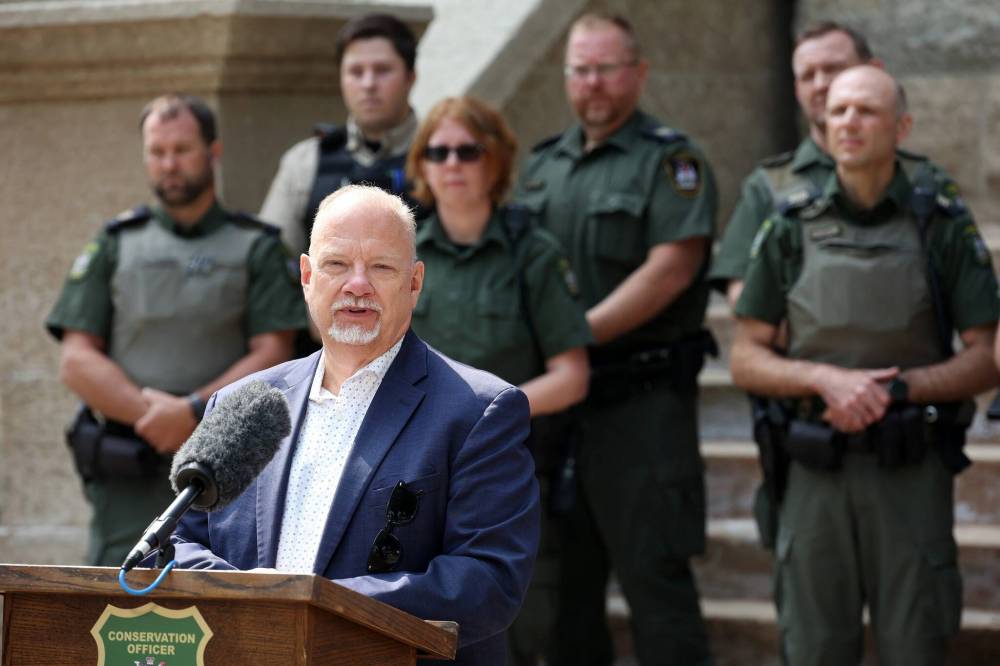
(Tim Smith/The Brandon Sun)
Manitoba Justice Minister Kelvin Goertzen: “You’re going to end up with a higher prison population, which again isn’t a bad thing.”
Around the same time, she announced millions of dollars in new police investments to apprehend offenders, track down people wanted on warrants, and supervise individuals on probation and bail.
Heading into this fall’s election, Manitoba’s jail population is growing faster than at any point in the past nine years.
As reported by my colleague Danielle Da Silva, adult inmate counts “increased by more than 12 per cent during the 2022-2023” and, as of Tuesday, “there were 2,073 adults in custody at jails and 100 youth in correctional facilities.”
Justice minister Kelvin Goertzen attributed this to two main reasons: an increase in violent crime and targeted government initiatives.
The minister is right. Crime is on the increase nationally and every province is dealing with the outcomes of increased poverty, drug and alcohol abuse, and other struggles that were made exponentially worse during the COVID-19 pandemic.
Manitoba isn’t an anomaly when dealing with increased crime. In fact, Winnipeg police have reported that 2022 was a record year for violence and homicides.
What is an anomaly is Manitoba’s — and Goertzen’s — answer to the problem.
When asked about the impact of Manitoba’s “targeted government initiatives” to deal with crime, Goertzen said: “You’re going to end up with a higher prison population, which again isn’t a bad thing, if it’s taking those who would otherwise be at risk to the community and taking them off the street.”
With all due respect to the minister, a ballooning prison population is always a bad thing. It’s especially disrespectful to those who work in the system — police, lawyers, judges, correctional officers, and probation officers — who have to try to keep the balloon from popping.
Related Articles
‘Tough on crime’ claim tough to swallow


It’s also a sign the government cares less about supporting the systems that give people hope and direction — families, schools and social service agencies — and more about building and expanding police stations, courts, and jails.
Save for rare cases attributed to mental illness, crime almost always comes from trauma. Harmed people harm others. Solutions are rarely found in instituting more trauma.
In other words, police, lawyers, and judges don’t bring much when it comes to love, education, or kindness but they sure come with a lot of conflict and violence.
Which brings me to who Manitoba is locking up. A staggering 70 per cent of inmates in Manitoba’s adult jails are Indigenous. An equally upsetting 50 per cent of Manitoba’s youth in custody are also Indigenous.
Using this week’s numbers, that’s over 1,450 Indigenous adult inmates and 50 or so Indigenous young people in jails. That’s 1,500 people.
There isn’t one Indigenous community that wouldn’t rather have their relatives home and in supported, healthy systems that could help build their families and communities. For every person “taken off the street” there are two or more children, partners, and parents.
In some communities, entire generations of fathers, mothers, and sons and daughters have been taken to jail while hundreds more have had to pick up the pieces.
While in some cases locking up people has brought short-term safety, the trauma created by Manitoba’s justice system is equally devastating.
The solution for crime in Manitoba is not more jails for Indigenous peoples, no matter what the Manitoba government or justice minister has to say about it.
To understand how Indigenous justice works, here’s an analogy.
When an Indigenous community hosts a feast, no one goes without food, kindness, or attention. The intention and meaning of ceremonies and events in Indigenous communities is to acknowledge and include all for the betterment of all.
This is exhausting, complicated, and intricate work but it’s the way communities have continued for millennia.
Indigenous communities have justice systems and all build families, institutions, and communities with the intention of keeping people, not locking them away.
When it comes to justice in Manitoba, the best outcome is not to be proud of the number of people our justice system puts in jail, but the people we keep out of it.
So, as this province heads towards an election where most of the debate will be about justice, crime and jails, one hopes that any “targeted government initiative” looks more like a feast than a jail.
niigaan.sinclair@freepress.mb.ca
Niigaan Sinclair is Anishinaabe and is a columnist at the Winnipeg Free Press.
Our newsroom depends on a growing audience of readers to power our journalism. If you are not a paid reader, please consider becoming a subscriber.
Our newsroom depends on its audience of readers to power our journalism. Thank you for your support.
Niigaan Sinclair is Anishinaabe and is a columnist at the Winnipeg Free Press.
Our newsroom depends on a growing audience of readers to power our journalism. If you are not a paid reader, please consider becoming a subscriber.
Our newsroom depends on its audience of readers to power our journalism. Thank you for your support.
Advertisement Advertise With Us
Advertisement Advertise With Us
History
Updated on Thursday, July 6, 2023 11:48 AM CDT: Clarifies the jail population is growing