

CP reporters and photographers reflect on a unique Olympic experience in Japan
Advertisement
Read this article for free:
or
Already have an account? Log in here »
To continue reading, please subscribe:
Digital Subscription
One year of digital access for only $75*
- Enjoy unlimited reading on winnipegfreepress.com
- Read the E-Edition, our digital replica newspaper
- Access News Break, our award-winning app
- Play interactive puzzles
*Billed as $5.77 plus GST every four weeks. After 52 weeks, price increases to the regular rate of $19.95 plus GST every four weeks. Offer available to new and qualified returning subscribers only. Cancel any time.
Monthly Digital Subscription
$4.99/week*
- Enjoy unlimited reading on winnipegfreepress.com
- Read the E-Edition, our digital replica newspaper
- Access News Break, our award-winning app
- Play interactive puzzles
*Billed as $19.95 plus GST every four weeks. Cancel any time.
To continue reading, please subscribe:
Add Free Press access to your Brandon Sun subscription for only an additional
$1 for the first 4 weeks*
- Enjoy unlimited reading on winnipegfreepress.com
- Read the E-Edition, our digital replica newspaper
- Access News Break, our award-winning app
- Play interactive puzzles
*Your next Brandon Sun subscription payment will increase by $1.00 and you will be charged $17.95 plus GST for four weeks. After four weeks, your payment will increase to $24.95 plus GST every four weeks.
Read unlimited articles for free today:
or
Already have an account? Log in here »
Hey there, time traveller!
This article was published 08/08/2021 (1900 days ago), so information in it may no longer be current.
Tokyo hosted an Olympics unlike any other. The global pandemic postponed the Games for a year, and there remained uncertainty whether they would ever happen amid rising COVID-19 cases in Japan.
Here are some reflections from The Canadian Press writers and photographers in Tokyo:
I was chatting with a volunteer at the media bus stop near our hotel. The young man is a student in Tokyo. He said “I’m from Burma, you know, Myanmar.” He told me his family escaped from their village, but he can’t always contact them. His eyes welled up and so did mine.
I followed a man into the women’s washroom at the swimming pool. I saw his reaction in the mirror when he realized his faux pas. We howled with laughter. Embarrassment knows no language barriers.
Thank you to the Japanese woman at the traffic light who threw her umbrella over my head (she was short and I am tall) to protect me from the blazing sun.
When Tokyo won the bid for 2020, they didn’t sign up to host an Olympic Games in a pandemic. I never sensed resentment or anger from Japanese people I met. I’m grateful to them for taking care of us.
— Donna Spencer
—
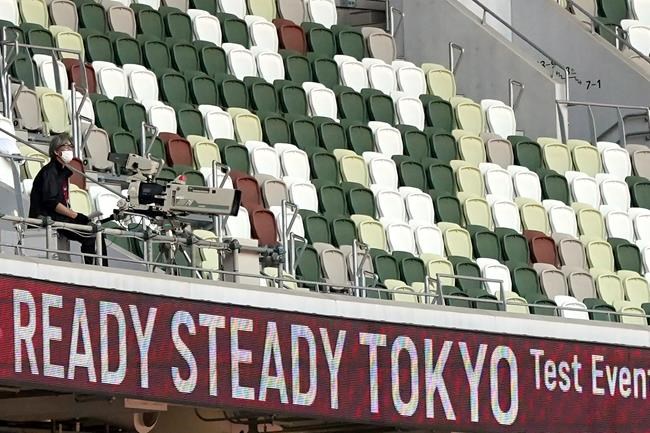
Japanese organizers had held out hope until the 11th hour that, despite rising COVID-19 cases in Tokyo, fans would be permitted in the Olympic venues. Two weeks before the opening ceremonies, they announced fans would be banned.
The absence of spectators was profoundly felt. At the boxing venue, athletes usually come out punching the air to psych-up songs and the roar from the crowd. Instead, the only seats filled were by coaches and journalists. At the track and field stadium, where fans erupt at the sound of the starters gun, the tapping of the runners’ feet on the rubberized track was audible.
When the lights dimmed for the start of the opening ceremonies on July 23, the magnitude of the moment — that the Games were actually starting, finally — wasn’t lost on the couple of thousand reporters in attendance. For once, the “no cheering in the press box” rule didn’t apply.
Athletes’ loved ones weren’t permitted to travel to Tokyo, and videos of family members and friends cheering back home tugged at heartstrings. Organizers tried to bridge the distance virtually. Every gold medallist at track and field was connected post-event to loved ones via a huge video screen.
But the relative silence lent a sense of intimacy to these Games. It was evident when Mutaz Barshim of Qatar and his friend Gianmarco Tamberi of Italy decided to share high jump gold medals, rather than go to a jump off. The shouts of pure joy from Tamberi were heard around the cavernous 50,000-seat Olympic Stadium.
When he was about to long jump or high jump, Canada’s decathlon gold medallist Damian Warner raised his hands to encourage a clap. Asked why, since there were no fans to clap along, Warner said he knew that his family and friends at home were clapping along. “There was never a moment in this decathlon that I felt like I was doing it by myself,” he said — words I’ll never forget.
— Lori Ewing
—
Convenience stores in Japan put their North America counterparts to shame.
There are the usual staples like chips — including some curious varieties — and soft drinks, but also so much more.
From fresh sushi to various cuts of chicken on a stick to fresh sandwiches and other ready-to-go meals, there’s no need to hit the grocery store or restaurant if you’re in a rush. There are also some interesting choices at least one Canadian journalist steered well clear of, including pre-wrapped seafood sticks and pork tongues. And there’s of course plenty of Japanese beer on offer to help thirsty media cool off and wind down after a day working in Tokyo’s searing summer heat.
— Joshua Clipperton
—
Covering my first Olympics in person I didn’t know what to expect. But with the COVID-19 pandemic drastically altering these Games and the Japanese government moving the city of Tokyo into a state of emergency just a week out from the opening ceremony I don’t think anyone did.
My enduring memory of the events themselves will be the high character of al the Canadian athletes I covered. They were all gracious in defeat or respectful in victory, always congratulating their opponents regardless of the competition’s outcome. Above all, there was an overwhelming sense of gratitude and understanding it was a privilege to compete at the Olympics, especially in the face of a global catastrophe.
I’ll also always remember the heat — it may take me weeks to recover! — that was a challenge to the athletes, media, volunteers, and officials alike. Temperatures hovered around 35 degrees Celsius most days, with the humidity making it feel closer to 50. In some ways, it became a unifying force as everyone worked to protect each other from heat stroke. The heat was also somehow humanizing. After all, if a world-class athlete is struggling to stay on their feet because of the blazing sun, it’s OK if I feel a little dizzy too.
— John Chidley-Hill
—
Peering out at the wide expanse of International Stadium Yokohama from the upper-deck media tribune left one wondering whether it would be possible for any Olympic buzz to be generated in such a massive near-empty venue.
It was amazing just how much electricity the Canadian and Swedish players brought with them as they walked onto the pitch for the women’s soccer final. You could almost feel the presence of the millions of people glued to their televisions and screens back home.
The Olympic rings bring a certain energy no matter the event. But every tackle that night, every kick, and every save was packing more of a punch. Of the nine Olympics I’ve covered, few — if any — Games have matched it. The storybook finish made it all the more memorable.
The bizarre in-stadium soundtrack featured the occasional chant from a small group of Swedish supporters seated nearby. Some Canadian team officials could be heard voicing their support from the lower deck.
The fake crowd noise that was piped in to the stadium during Canada’s previous games was absent this time around. Instead it was the sound from players on the sideline — bellowing words of encouragement to their teammates on the field — that filled the muggy air.
A shootout that had it all — stellar shots, brilliant saves, a post, a crossbar, a potential game-winner that cleared the net, and of course, the Julia Grosso dagger — provided a dramatic exclamation point for a game that won’t soon be forgotten.
— Gregory Strong
—
Of course I’ll be taking back actual memories from the Games.
Catherine Beauchemin-Pinard’s bronze medal at the famed Nippon Budokan, where Japan’s judo legends fought on the same tatamis. Antoine Valois-Fortier’s broken voice after failing to get back on the podium after what might have been his last judo bout. Men’s volleyball playing the best they’ve ever played, only to be stopped once again in the quarterfinals by Russia — or Russian Olympic Committee, as they are officially named here. Laurence Vincent-Lapointe’s comeback from two hellish years, to win silver by herself, and then bronze with her longtime partner Katie Vincent.
But what I’ll remember for the longest time from these Games are the food and its people.
I knew I would love the food. I didn’t know I would love it that much. I didn’t know I would love convenience store food that much!
You can find anything there: fresh and tasty sushi and sashimi, dumplings, steamed edamame, mochis, fried chicken and pork, udon noodles: name it, they have it. And then, once our quarantine was over and we could forget about our UberEats app, we discovered their steaks and strong taste for Italian food. That thin-crusted smoked salmon pizza will linger in my mind.
And then, the people. Language barrier was strong. In fact, stronger than I expected. But my, are they eager to help. They don’t have all the answers, but they’ll go out of their way to help you. A special thought for the front desk employees who helped with all of our questions.
I haven’t seen enough of Tokyo. What I’ve seen makes me desire to come back.
— Fred Daigle
—
For me the whole games was put in context by a Japanese volunteer on the way to the opening ceremony. She said: “Please take good pictures and write good stories, You get to see the games that we cannot see.”
— Adrian Wyld
—
At our hotel’s restaurant, I ordered the lunch meal of the day, which was a hamburger smothered with onion style gravy. I asked if instead I could just have it with cheese instead of the onion gravy. In the end, after some back-and-forth, the person I was dealing with told me I couldn’t get it with cheese because it’s not the meal of the day so I had it with the onion gravy mix.
Another time, I ordered a taxi. I gave a time I thought I would be done at my event and they said they would be there. I was 30 mins late getting to the taxi pick up and thought 100 per cent that the driver would have left. When I arrived at the taxi pick-up my cab still waiting for me, even though I’m sure many people had asked for my place.
The Japanese people are kind, respectful, follow rules, have great pride in what they do and never deviate from the plan. Ever!
— Nathan Denette
—
This report by The Canadian Press was first published Aug. 8, 2021.
Related Articles
Japan's PM thanks people for safe Olympics during pandemic




Advertisement Advertise With Us
Advertisement Advertise With Us