

Staff are calling in sick by the hundreds during the Omicron wave and hospitals are feeling the strain
Advertisement
Read this article for free:
or
Already have an account? Log in here »
To continue reading, please subscribe:
Digital Subscription
One year of digital access for only $75*
- Enjoy unlimited reading on winnipegfreepress.com
- Read the E-Edition, our digital replica newspaper
- Access News Break, our award-winning app
- Play interactive puzzles
*Billed as $5.77 plus GST every four weeks. After 52 weeks, price increases to the regular rate of $19.95 plus GST every four weeks. Offer available to new and qualified returning subscribers only. Cancel any time.
Monthly Digital Subscription
$4.99/week*
- Enjoy unlimited reading on winnipegfreepress.com
- Read the E-Edition, our digital replica newspaper
- Access News Break, our award-winning app
- Play interactive puzzles
*Billed as $19.95 plus GST every four weeks. Cancel any time.
To continue reading, please subscribe:
Add Free Press access to your Brandon Sun subscription for only an additional
$1 for the first 4 weeks*
- Enjoy unlimited reading on winnipegfreepress.com
- Read the E-Edition, our digital replica newspaper
- Access News Break, our award-winning app
- Play interactive puzzles
*Your next Brandon Sun subscription payment will increase by $1.00 and you will be charged $17.95 plus GST for four weeks. After four weeks, your payment will increase to $24.95 plus GST every four weeks.
Read unlimited articles for free today:
or
Already have an account? Log in here »
Hey there, time traveller!
This article was published 02/01/2022 (1742 days ago), so information in it may no longer be current.
One hundred staff members per day are calling in sick to Toronto’s University Health Network hospitals.
More than 150 employees at one London hospital have tested positive for the virus.
Four hundred staff members of Hamilton Health Sciences are in isolation due to COVID-19 exposures.
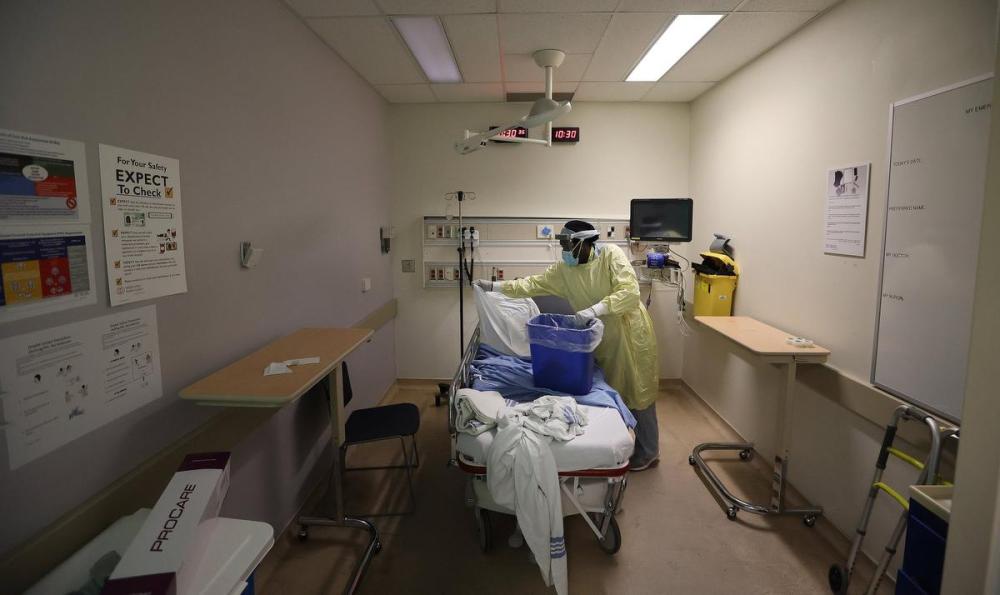
As Omicron rips through Ontario, the province’s hospitals say they’re looking at a new kind of challenge: a wave of staff absences forcing them to consider cancelling scheduled medical treatments, or calling isolating staff back to work early.
Gillian Howard, spokesperson for the University Health Network, said this is the case across the Greater Toronto Area, not just at UHN.
“We are seeing very large numbers of staff calling in sick — about 100 a day — either with an exposure which needs to be evaluated by Health Services or because they are ill,” Howard told the Star. “We are currently working through the advice from the Chief Medical Officer of Health and Ontario Health in terms of how we will manage through January.”
Howard said the measures they take will include redeploying staff, and reducing scheduled care. UHN has a staff of around 17,200.
Unlike in previous COVID waves, it’s the unprecedented transmissibility of Omicron, rather than its severity, that is straining the health-care system. While hospitals are increasingly filling up with COVID-19 patients, there have been proportionally fewer in need of intensive care compared to earlier waves. That means that while there isn’t yet the same demand on staff to manage huge numbers of very ill patients, the sheer number of cases and potential exposures risks forcing more health-care workers into isolation, where they’re unable to help out.
“We don’t usually have calls on the weekend, but we had to have an all-hands-on-deck because we had six or seven COVID-19 cases coming into emergency,” said Julia Oosterman, communications chief at Bluewater Health in Sarnia. “As of yesterday we started calling staff on vacation to see if they can come back to work — it’s not a desirable outcome. They really really need and deserve their vacation.”
A total of 89 of 1,800 staff members at Bluewater are currently isolating, Oosterman said. That’s approximately four times the number usually off sick.
“Due to widespread community transmission of the Omicron variant, the Ontario Hospital Association is actively working on contingency plans with health-care sector authorities in an effort to continue essential hospital operations during this wave,” wrote Anthony Dale, president and CEO of the association. “Managing through the next few months can only be achieved if we continue to act as one health system.”
Omicron spread among hospital staff has resulted in policy changes in hospital networks and other jurisdictions. The Star reported last week that some nurses in Ontario were being called back to work during periods of isolation. The province of Quebec has said some COVID-positive health-care workers will be called back to work, a plan its health minister Christian Dubé called “the best alternative to not providing care.”
Oosterman said she expects there may be some sharing of staff between jurisdictions, noting that Bluewater took in patients from the GTA and Manitoba during the first waves of the pandemic and would help out again if it had capacity.
In Quebec City, the main hospital network said on Sunday that it will postpone half of its surgeries and appointments beginning Wednesday. The announcement came as Quebec faces a surge in cases in hospitals, with more than 1,200 hospitalized with COVID as of Sunday, according to The Canadian Press.
In the U.K., where Omicron has been circulating longer, the situation is similar — with the sheer volume of cases creating dire staffing issues in some areas.
“Right now, (the National Health Service is) facing potential immediate emergency it needs to prepare for. Choice could potentially be leaving patients untreated or creating extra temporary capacity,” Chris Hopson, chief executive officer of NHS Providers, an association representing health-care workers, wrote in a Twitter thread on Saturday. “Unlike last January, there are currently many fewer, seriously ill, older people needing critical care … Problem therefore less one of patient acuity, intensity of care and length of stay required. More one of sheer volume of patient numbers needing general and acute beds.”
Dr. Donald Vinh, an infectious disease specialist at the McGill University Health Centre, says all Canadian provinces will likely face choices around whether to allow exposed staff to return to work in the coming days as the number of sick people rises and the pool of workers available to treat them shrinks.
“We are in a fixed, limited number of health-care workers in every province, because there’s no reservoir or pool of health-care workers that we can sort of depend on to bail us out here,” he told The Canadian Press last week.
Rob MacIsaac, CEO of Hamilton Health Sciences, said Friday the hospital is taking “extraordinary measures” to try to meet their staffing shortfalls, including paying premiums to staff who work on their time off, and calling back asymptomatic isolating staff after a negative rapid test result.
“We are once again facing immense pressures around hospital occupancy and staffing,” MacIsaac wrote in the Dec. 31 statement.
As of New Year’s Eve, 152 staff at London Health Sciences Centre had tested positive for COVID, according to its website.
There are additional stressors on health-care staff at the moment, even if they are not isolating. When a nurse or administrative assistant or paramedic or personal support worker comes in from their vacation, they are sometimes meeting patients who resist their care.
“We’re dealing with large groups of unvaccinated people, many of whom don’t believe in traditional science,” Oosterman said. “So the tonality within the hospitals, the level of discourse, has significantly changed since the first wave.”
“It’s really unfortunate because the whole team is exhausted and coming in on their vacation,” she said. “It’s very different from how it used to be.”
With files from The Canadian Press
Alex McKeen is a Vancouver-based reporter for the Star. Follow her on Twitter: @alex_mckeen

Advertisement Advertise With Us
Advertisement Advertise With Us