

MLB doubles camera angles for video reviews of umpires
Advertisement
Read this article for free:
or
Already have an account? Log in here »
To continue reading, please subscribe:
Digital Subscription
One year of digital access for only $75*
- Enjoy unlimited reading on winnipegfreepress.com
- Read the E-Edition, our digital replica newspaper
- Access News Break, our award-winning app
- Play interactive puzzles
*Billed as $5.77 plus GST every four weeks. After 52 weeks, price increases to the regular rate of $19.95 plus GST every four weeks. Offer available to new and qualified returning subscribers only. Cancel any time.
Monthly Digital Subscription
$4.99/week*
- Enjoy unlimited reading on winnipegfreepress.com
- Read the E-Edition, our digital replica newspaper
- Access News Break, our award-winning app
- Play interactive puzzles
*Billed as $19.95 plus GST every four weeks. Cancel any time.
To continue reading, please subscribe:
Add Free Press access to your Brandon Sun subscription for only an additional
$1 for the first 4 weeks*
- Enjoy unlimited reading on winnipegfreepress.com
- Read the E-Edition, our digital replica newspaper
- Access News Break, our award-winning app
- Play interactive puzzles
*Your next Brandon Sun subscription payment will increase by $1.00 and you will be charged $17.95 plus GST for four weeks. After four weeks, your payment will increase to $24.95 plus GST every four weeks.
Read unlimited articles for free today:
or
Already have an account? Log in here »
Hey there, time traveller!
This article was published 20/07/2020 (2290 days ago), so information in it may no longer be current.
NEW YORK – Taking a chance to review instant replay, Major League Baseball doubled the isolated cameras available for video reviews to 24 this year.
MLB also arranged for high-frame rate cameras to stream directly to the new replay operations centre and ballpark video rooms, and for MLB-controlled 4K cameras with zoom lenses to be installed at high locations behind home plate.
A new replay hub about twice the size of the old one was constructed as part of the move of Major League Baseball and MLB Advanced Media to a combined office space in Manhattan, across the street from Radio City Music Hall.
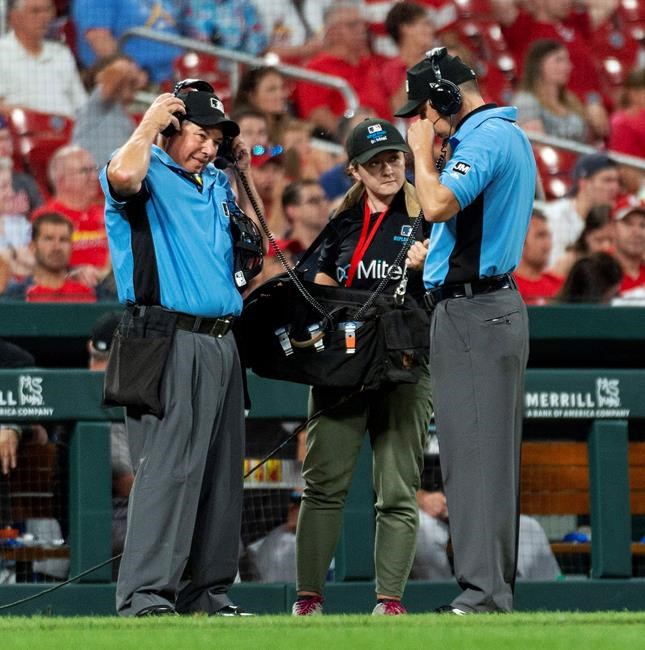
“We think that the product of all these items is going to result in a much more rapid review process, so that we’ll be getting video available much more quickly to the umpires, who will be making decision more quickly,” Chris Marinak, MLB executive vice-president of strategy, technology and innovation, said Monday. “The same will be true of the replay personnel in the ballpark, who are helping their manager make a decision on whether to challenge.”
Each manager will have 20 seconds to decide whether to ask for a video review of a call subject to a challenge, down from 30.
MLB’s pandemic-delayed season starts Thursday with the New York Yankees at the World Series champion Washington Nationals.
MLB started widespread video review in 2014 after years of embarrassing calls, such as the blown call by first base umpire Jim Joyce that denied Detroit’s Armando Galarraga what should have been the final of out a perfect game.
There were 1,275 reviews during the 2019 regular season, including 1,051 requested by managers that averaged 1 minute, 46 seconds. Among those calls, 603 (47.3%) were overturned, 310 (24.3%) were confirmed, 352 (27.6%) were allowed to stand and 10 (0.8%) were for record keeping.
Clear plastic barriers have been installed, and additional conference rooms will be used to enable social distancing. If the Toronto Blue Jays play home games at a non-regular season MLB facility, cameras for video review would be installed.
Also debuting this week is a second-generation Statcast system that shifts from TrackMan and Doppler radar to Hawk-Eye and an array of 12 cameras whose data will be stored on Google Cloud to create graphics for scoreboards and broadcasts. Five of the cameras are targeted for pitch tracking, four behind the plate and one in centre field, and seven are used to track players. Each camera is 4K resolution and typically tracks at a rate of 100 frames per second, though they can be sped to as fast as 500 frames per second.
“We’re trying to set a foundation here with this new deployment that is a foundation that we can innovate on for the next five years as technology continues to progress,” said Jason Gaedtke, MLB’s chief technology officer.
MLB said the error margin, which had averaged mostly 1-2 inches in 2016, is expected to drop to 0.1 inches this season. The system is designed to eliminate previous blind spots on high popups and in outfield corners. Error margins on fielder movements are expected to drop from 3 feet to less than one foot.
TrackMan took over pitch velocity tracking from PITCHf/x in 2017.
“We would argue that it’s more accurate than what you’ve seen in the past,” MLB executive vice-president of strategy, technology and innovation Chris Marinak said. He added it “mirrors historical data at closely as possible.”
Gaedtke said extensive testing was employed to avoid changes to velocities that some claimed resulted from the 2017 switch.
To enforce social distancing, group viewing of in-game videos by players has been prohibited and each team is being given 15 iPads for player use that will be wiped clean after each game. The iPads have software the prohibits connectivity during games and can be shut remotely if lost.
MLB also is working with clubs and Sony to create simulated fan noise for games to be played in empty ballparks. Each team had an iPad with more than 75 sound samples, ranging from murmurs to cheers to organists. The scoreboard operators have an app to use as guidance. Broadcasters may add more audio.
“What we’ve basically told the clubs is that they need to produce sound that mimics sounds that would otherwise have been in the ballpark if there had been fans in the ballpark,” Marinak said. “The club needs to match what they would have expected to hear had there been fans in the ballpark. To the extent that there’s issues or disputes around that, that’ll be managed by our baseball operations department.”
___
More AP MLB: https://apnews.com/MLB and https://twitter.com/AP_Sports
Related Articles
Safe at home? Social distancing difficult around MLB plates





Advertisement Advertise With Us
Advertisement Advertise With Us