

Hinch helps combat veterans through Houston-based Camp Hope
Advertisement
Read this article for free:
or
Already have an account? Log in here »
To continue reading, please subscribe:
Digital Subscription
One year of digital access for only $75*
- Enjoy unlimited reading on winnipegfreepress.com
- Read the E-Edition, our digital replica newspaper
- Access News Break, our award-winning app
- Play interactive puzzles
*Billed as $5.77 plus GST every four weeks. After 52 weeks, price increases to the regular rate of $19.95 plus GST every four weeks. Offer available to new and qualified returning subscribers only. Cancel any time.
Monthly Digital Subscription
$4.99/week*
- Enjoy unlimited reading on winnipegfreepress.com
- Read the E-Edition, our digital replica newspaper
- Access News Break, our award-winning app
- Play interactive puzzles
*Billed as $19.95 plus GST every four weeks. Cancel any time.
To continue reading, please subscribe:
Add Free Press access to your Brandon Sun subscription for only an additional
$1 for the first 4 weeks*
- Enjoy unlimited reading on winnipegfreepress.com
- Read the E-Edition, our digital replica newspaper
- Access News Break, our award-winning app
- Play interactive puzzles
*Your next Brandon Sun subscription payment will increase by $1.00 and you will be charged $17.95 plus GST for four weeks. After four weeks, your payment will increase to $24.95 plus GST every four weeks.
Read unlimited articles for free today:
or
Already have an account? Log in here »
Hey there, time traveller!
This article was published 25/10/2019 (2559 days ago), so information in it may no longer be current.
HOUSTON – AJ Hinch clicked open his email and could hardly believe the words that filled his screen.
“I know this may sound a little farfetched to you,” the note read, “but baseball saved a young man’s life tonight.”
Hinch had been involved with the Houston-based PTSD Foundation of America and its treatment centre for combat veterans called Camp Hope for some time. He knew of the good work they did.
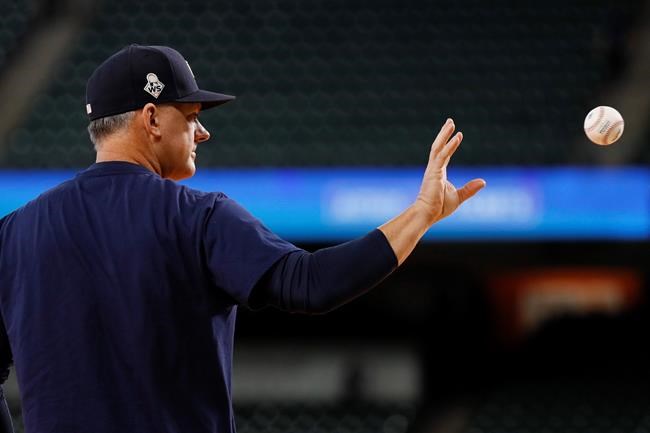
But the manager of the Houston Astros was stunned by that message last summer from executive director David Maulsby.
He kept reading and learned that Maulsby had been alerted to alarming Facebook posts from friends of a veteran who seemed hopeless and was “telling the world goodbye.”
Maulsby reached out to the man, who was not at all open to getting help. But he liked baseball and rooted for the Astros. So Maulsby used that as an opening to get him talking. From there they invited him to an Astros game with people from Camp Hope.
“We got him to agree to do something in the future and get him through the night,” Maulsby said. “You never know what’s inside somebody’s brain, but when someone is threatening suicide you have to assume that they intend to go through with it. Our tactic was to just get him talking about anything else.”
So as Hinch’s team pitched, hit and ran through the nine innings of a game that hot Saturday night, the man watched his beloved Astros and listened as other veterans described Camp Hope. By the time the players trotted off the field, he was ready to get help.
“He went straight to Camp Hope from there and checked immediately into our program,” Maulsby said. “Straight from the ballpark — he didn’t even go home to pack.”
Hinch said that result will resonate with him for life.
“It’s stories like that that inspire me and make me want to be involved in this organization saving one veteran at a time,” he said this week during the World Series.
It’s been a few months since that game and Maulsby offered an encouraging report.
“I converse with him through Facebook quite a bit and he seems to be doing a lot better than he was and he’s not suicidal anymore,” he said.
While this man’s story of finding the path to help through baseball is particularly dramatic, the group often uses sporting events to reach people who are reticent to seek treatment.
“These guys are all alpha types and they’re trained to kill. They’re not trained to say, ‘Hey, I need help myself,'” Maulsby said. “So quite often sporting events are a great way to break through that barrier.”
Hinch learned of Camp Hope , which has treated more than 1,100 veterans since 2012, through a friend. And after touring the facility and getting to know the people in charge, he knew immediately that he wanted to help.
“We need to increase awareness that a facility like this even exists,” Hinch said. “And we need to learn more about a soldier’s experience, not only in the war but after the war and the rehabilitation and getting them back into society, getting them a job and getting them back into what we consider normal life, when after you experience war it’s probably never normal.”
To that end, when Hinch learned that June was PTSD awareness month, he decided it would be the perfect time to bring a group from Camp Hope to a game. He and his wife, Erin, hosted a group of 33 veterans, paying for their tickets and giving each person $50 to spend at the ballpark. The group sat down with Hinch and his wife before the game in a session where they could talk to the manager about anything.
“They were just interested in my experiences,” Hinch said. “For me, a lot of the questions were about overcoming adversity. When we talk about adversity in sports it might be coming back from a tough loss or it might be having a difficult slump, which pales in comparison to the adversities that these men and women have to overcome.”
Hinch says getting the opportunity to give back to such an important organization is inspiring. To Maulsby, Hinch and the Astros are truly lifesavers.
“Our No. 1 issue always has been and always will be getting in front of that combat vet before he becomes a statistic,” Maulsby said. “And the only way we can do that is sharing our story. And when AJ Hinch and the Houston Astros stepped to the plate to help us get that word out, it absolutely without question helps us save lives.”
___
More AP baseball: https://apnews.com/MLB and https://twitter.com/AP_Sports
Related Articles
Astros look to pull even with Nationals in Game 4 Having a catch: Astros, Nats kids crash World Series warmups









Advertisement Advertise With Us
Advertisement Advertise With Us