

Police opposition to safety officers unexpected
Advertisement
Read this article for free:
or
Already have an account? Log in here »
To continue reading, please subscribe:
Digital Subscription
One year of digital access for only $75*
- Enjoy unlimited reading on winnipegfreepress.com
- Read the E-Edition, our digital replica newspaper
- Access News Break, our award-winning app
- Play interactive puzzles
*Billed as $5.77 plus GST every four weeks. After 52 weeks, price increases to the regular rate of $19.95 plus GST every four weeks. Offer available to new and qualified returning subscribers only. Cancel any time.
Monthly Digital Subscription
$4.99/week*
- Enjoy unlimited reading on winnipegfreepress.com
- Read the E-Edition, our digital replica newspaper
- Access News Break, our award-winning app
- Play interactive puzzles
*Billed as $19.95 plus GST every four weeks. Cancel any time.
To continue reading, please subscribe:
Add Free Press access to your Brandon Sun subscription for only an additional
$1 for the first 4 weeks*
- Enjoy unlimited reading on winnipegfreepress.com
- Read the E-Edition, our digital replica newspaper
- Access News Break, our award-winning app
- Play interactive puzzles
*Your next Brandon Sun subscription payment will increase by $1.00 and you will be charged $17.95 plus GST for four weeks. After four weeks, your payment will increase to $24.95 plus GST every four weeks.
Read unlimited articles for free today:
or
Already have an account? Log in here »
Hey there, time traveller!
This article was published 24/01/2024 (973 days ago), so information in it may no longer be current.
Given the added strain placed on Winnipeg police officers in recent years, it’s curious the union representing cops would oppose steps taken by the city to lighten their load.
The Winnipeg Police Association has filed a grievance against the city over the hiring of 21 community safety officers who will patrol Winnipeg Transit buses. The creation of the new transit safety officers comes in the wake of growing violence on city buses, including against bus drivers.
The union, which represents more than 1,400 officers and about 450 civilian staff, claims the new safety officers will be doing the work of police because they will have the authority to make arrests. As a result, their work falls within the scope of the WPA bargaining unit and is therefore a breach of the police collective agreement, the union argues.
MIKAELA MACKENZIE / WINNIPEG FREE PRESS Files
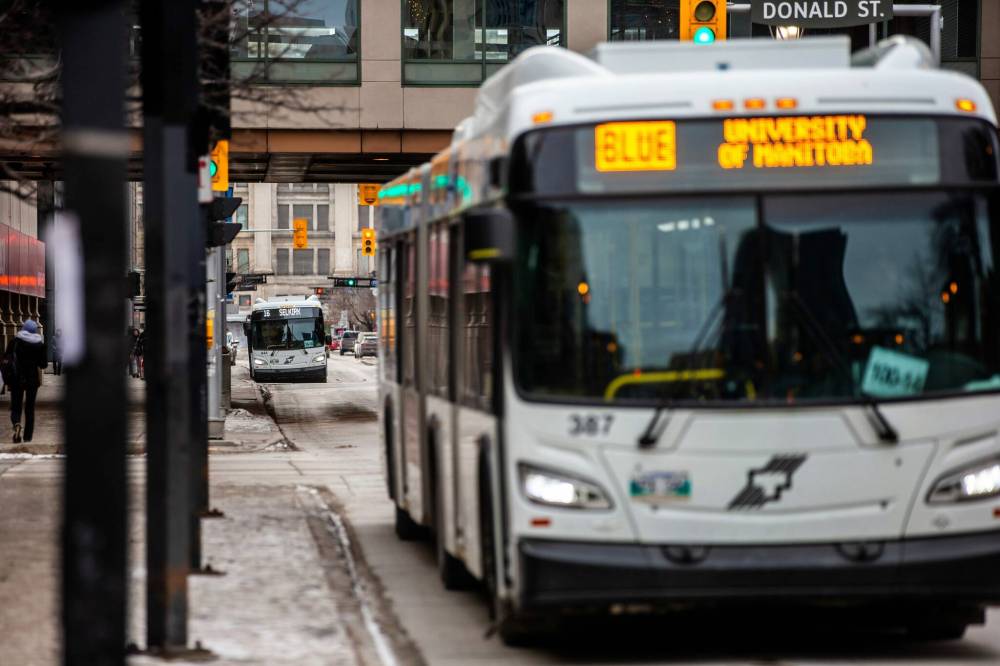
The union for city police officers doesn’t approve of Winnipeg Transit’s new safety patrol program.
That’s a stretch. The new transit security officers would not be the first non-police personnel to have the power of arrest. Institutional safety officers, for example — which can be deployed at post-secondary institutions and hospitals in Manitoba — have many of the same functions as police, including powers of arrest. They can also carry batons, handcuffs and pepper spray, much like police.
Granted, they don’t work for the City of Winnipeg, like the new transit safety officers will. But some of their responsibilities overlap with traditional policing.
WPA president Cory Wiles says work that involves arrest and detention should be the sole domain of police.
“Having employees who aren’t police officers arresting, detaining and dealing with violent criminals is a precedent we cannot allow to stand,” he said. Trouble is, Mr. Wiles doesn’t provide reasons to support the union’s position, except to claim the new transit safety officers will not be properly trained or equipped to handle the associated risks.
That does not appear to be a legitimate issue. City officials say the new safety officers will be fully trained and equipped to handle security threats. As well, they will be trained to help people deal with mental-health and addictions issues. The latter is a salient point, given concerns raised by police in recent years that cops have been increasingly called upon to respond to service calls involving mental-health and addictions issues. Police have argued they need more support from governments to help respond to those types of calls.
Ironically, now that the city has created new positions to help alleviate those pressures, the police union claims the new safety officers are moving into its jurisdiction.
Nothing could be further from the truth. The new safety officers serve a different function than police. While they will have the power of arrest, their primary function will be to help create a safer environment on buses. Their mere presence will help achieve that. They will act as a deterrent and provide transit operators and riders with a greater level of security.
From time to time they may be called upon to intervene in a conflict, but it won’t replace policing. The new safety officers will not carry firearms and will not investigate crimes, the way police do.
One of the most important functions of the new transit officers will be to help those who require access to mental-health and addictions resources by connecting them with services. It’s precisely the kind of support police have been requesting for years to address the growing number of crimes driven by mental-health and addictions issues.
The WPA should be supporting the introduction of this new resource, not fighting it.
Related Articles
Police union files grievance, claims new transit security team violates collective agreement

Advertisement Advertise With Us
Advertisement Advertise With Us