

Politicians held accountable — what about bureaucrats?

Advertisement
Read this article for free:
or
Already have an account? Log in here »
To continue reading, please subscribe:
Digital Subscription
One year of digital access for only $75*
- Enjoy unlimited reading on winnipegfreepress.com
- Read the E-Edition, our digital replica newspaper
- Access News Break, our award-winning app
- Play interactive puzzles
*Billed as $5.77 plus GST every four weeks. After 52 weeks, price increases to the regular rate of $19.95 plus GST every four weeks. Offer available to new and qualified returning subscribers only. Cancel any time.
Monthly Digital Subscription
$4.99/week*
- Enjoy unlimited reading on winnipegfreepress.com
- Read the E-Edition, our digital replica newspaper
- Access News Break, our award-winning app
- Play interactive puzzles
*Billed as $19.95 plus GST every four weeks. Cancel any time.
To continue reading, please subscribe:
Add Free Press access to your Brandon Sun subscription for only an additional
$1 for the first 4 weeks*
- Enjoy unlimited reading on winnipegfreepress.com
- Read the E-Edition, our digital replica newspaper
- Access News Break, our award-winning app
- Play interactive puzzles
*Your next Brandon Sun subscription payment will increase by $1.00 and you will be charged $17.95 plus GST for four weeks. After four weeks, your payment will increase to $24.95 plus GST every four weeks.
Read unlimited articles for free today:
or
Already have an account? Log in here »
Hey there, time traveller!
This article was published 07/06/2025 (506 days ago), so information in it may no longer be current.
The Sio Silica caretaker convention scandal report by Manitoba’s ethics commissioner should be required reading in every public service in Canada. Because there was another governance convention being challenged in this whole episode — that of “speaking truth to power.”
The default phrase for explaining how politicians and public servants should work together is speaking truth to power. Politicians decide, but officials advise. To advise well, they need to be able to speak truth to power or, more succinctly, tell it like it is.
This idealized relationship has been romanticized for years in academic and public service circles. The federal public service even teaches a course on it.
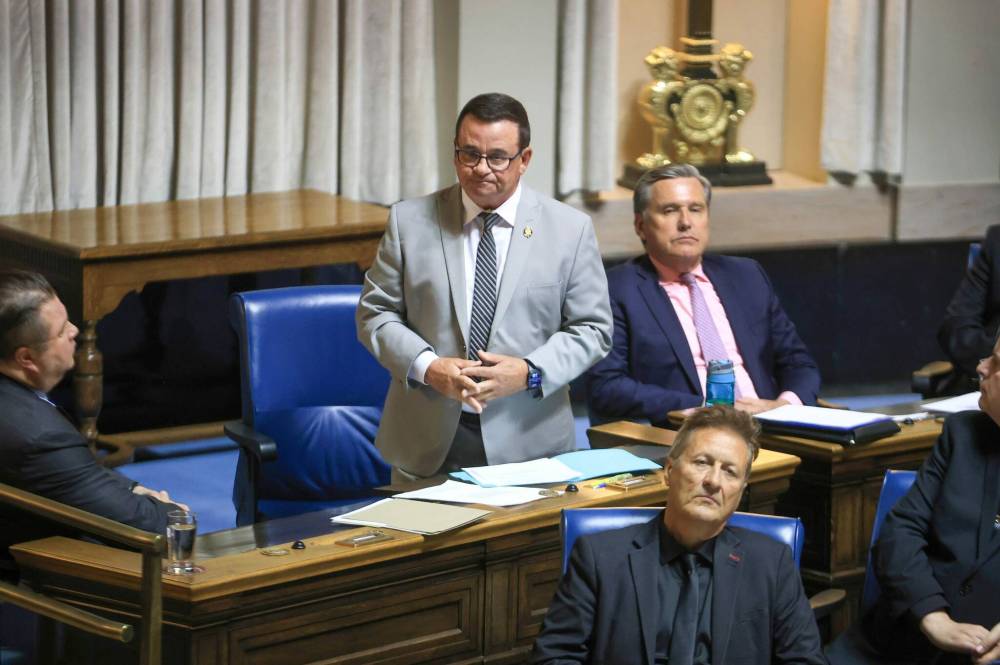
Ruth Bonneville / Free Press Local
Jeff Wharton, PC MLA for Red River North, makes an apology in the Legislative chamber. Politicians have been censored for their roles in an attempt to force through a project licence, but what about the bureaucrats involved?
At its heart is a long-standing public service bargain between “masters and servants.” In exchange for professional independence and tenure, public servants will offer their best advice to their political masters and dutifully implement whatever they decide. Officials can advise without fear of losing their jobs while politicians are upheld as the ultimate decision-maker, the “deciders-in-chief.”
This convention of fearless advice and loyal implementation presumes there are clear, formal institutional rules that both politicians and public servants adhere to in their conduct. The Sio Silica episode shows what happens when this theory gets mugged by reality. The reality when politics, people, and power collide. Or put another way, when the public sees how the sausage is really made.
Commissioner Jeffrey Schnoor’s report unveils a story of uncomfortable advice and tepid implementation. Not liking but unable to resist the pressure being exerted on them by politicians, officials said “maybe” rather than an outright “no” at first. They explored options over several weeks during and after the election that were dubious, unworkable, and illegitimate, until the incoming NDP government shut it all down, communicating its disapproval for any licensing action.
If public servants weren’t convinced it couldn’t be done, they certainly seemed convinced it shouldn’t be done. So, why didn’t the public service just say no?
There are very few clear cases where an outright “no” is warranted. But this was one. The problem flows from the conditioning public servants undergo to be flexible, innovative, and un-bureaucratic in their approaches. This is a very good thing when confronting a pandemic, as Manitoba’s public service repeatedly displayed to their great credit. It is the exact opposite when confronting a matter of great democratic principle, as the caretaker convention demands.
But can officials be truly faulted when the tone at the top from the cabinet and senior public service encouraged at worst, did not deter at best, these improper instincts? Public servants serve their political masters, as well as themselves, in then drawing a hard line in the sand. Standing on principle and communicating that loudly and clearly is the only, uncomfortable alternative. They are neither powerless nor choiceless.
But this should be a rare occurrence. Governance mechanisms at both the departmental and cabinet levels exist to prevent this occurring in the first place. Somehow, during the most clear and obvious moment of good governance necessity — a democratic transition from one government to another — this was lacking or ignored.
The premier failed to set clear governance guidelines on this matter at the outset to either her cabinet or clerk.
The deputy premier went rogue in pressuring officials outside his own department to pursue options and actions.
The minister of economic development took to lobbying defeated ministers to convince them to act when their authority had evaporated.
If there was ever a case study in speaking truth to power, this is it. While political accountability for the scandal has arrived in the form of public shaming and proposed fines on the politicians involved, does bureaucratic accountability still need to come?
That accountability need not be personalized — officials did ultimately advise against proceeding to issue an environmental licence — but generalized in the form of a teachable lesson to build a stronger Manitoba public service culture of accountability.
This begins with reinforcing the role of the clerk of the executive council. The most senior public servant, the clerk is also the cabinet secretary and head of the public service. This triad of roles are distinct but reinforcing. In the Sio Silica case, all three were in play and each could and should have been used to shut this down.
The clerk is the premier’s deputy minister and would advise the premier personally and directly on any issue at odds with the caretaker convention. As cabinet secretary, you are responsible for the integrity of cross-ministerial decision making and would advise on any issue where one minister seeks to arrogate authority from another, as was occurring here. And as public service head, you uphold those values of independence and integrity which were clearly under duress.
Uniquely, Manitoba public servants work at closer proximity to politicians than in any other jurisdiction with ministers and deputy ministers in adjoining offices. This is all for the good. But good governance requires perspective. In short, distance matters. Proximity can lead to capture in ideas and implementation and an unhealthy accommodation of “getting along to go along.”
Truth be told, public servants have no monopoly on truth. Our system of responsible government guards against that.
But when a clear-cut case emerges, as it did here, then good governance mechanisms must be respected to allow that truth to be told, without fear or favour.
David McLaughlin is a former clerk of the executive council and cabinet secretary in the Manitoba government.
Our newsroom depends on a growing audience of readers to power our journalism. If you are not a paid reader, please consider becoming a subscriber.
Our newsroom depends on its audience of readers to power our journalism. Thank you for your support.
Our newsroom depends on a growing audience of readers to power our journalism. If you are not a paid reader, please consider becoming a subscriber.
Our newsroom depends on its audience of readers to power our journalism. Thank you for your support.
Related Articles
People locked out of Sio Silica ‘open house’ on sand mine proposal

Advertisement Advertise With Us
Advertisement Advertise With Us