

The Holocaust 80 years later — teaching its history
Advertisement
Read this article for free:
or
Already have an account? Log in here »
To continue reading, please subscribe:
Digital Subscription
One year of digital access for only $75*
- Enjoy unlimited reading on winnipegfreepress.com
- Read the E-Edition, our digital replica newspaper
- Access News Break, our award-winning app
- Play interactive puzzles
*Billed as $5.77 plus GST every four weeks. After 52 weeks, price increases to the regular rate of $19.95 plus GST every four weeks. Offer available to new and qualified returning subscribers only. Cancel any time.
Monthly Digital Subscription
$4.99/week*
- Enjoy unlimited reading on winnipegfreepress.com
- Read the E-Edition, our digital replica newspaper
- Access News Break, our award-winning app
- Play interactive puzzles
*Billed as $19.95 plus GST every four weeks. Cancel any time.
To continue reading, please subscribe:
Add Free Press access to your Brandon Sun subscription for only an additional
$1 for the first 4 weeks*
- Enjoy unlimited reading on winnipegfreepress.com
- Read the E-Edition, our digital replica newspaper
- Access News Break, our award-winning app
- Play interactive puzzles
*Your next Brandon Sun subscription payment will increase by $1.00 and you will be charged $17.95 plus GST for four weeks. After four weeks, your payment will increase to $24.95 plus GST every four weeks.
Read unlimited articles for free today:
or
Already have an account? Log in here »
Hey there, time traveller!
This article was published 05/05/2025 (517 days ago), so information in it may no longer be current.
As the 80th anniversary of the end of the Second World War in Europe will be marked on May 8, the government of Premier Wab Kinew is to be commended for its decision to ensure Manitoba students in grades 6,9 and 11 will learn about the Holocaust and antisemitism.
For far too long, the vast majority of students in the province have graduated from high school with, at most, a limited understanding of the war and less about the Holocaust. Like many complex issues covered in social studies — which is an option in Grade 12 — students’ knowledge about these events is entirely a matter of a teacher’s discretion.
Admittedly, there is a lot of ground to cover in a compulsory subject like Grade 11 Canadian history (which I taught for close to 30 years) so it should not be surprising that the Holocaust and antisemitism get short shrift from many teachers who have not studied these issues in depth.
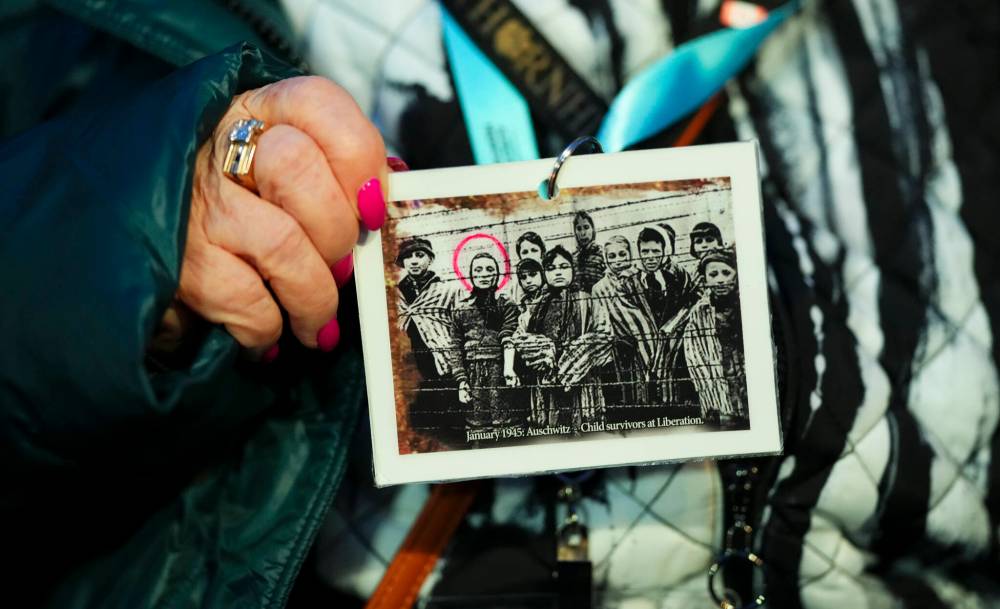
Sean Kilpatrick / The Canadian Press via AP
Canadian Holocaust survivor Miriam Ziegler holds up a photo of her (circled) as she attends the Commemoration Ceremony of the 80th Anniversary of the Liberation of Auschwitz, in Oswiecim, Poland, on Jan. 27.
This deficient approach has had long-term consequences. About a year ago, a Leger poll undertaken for the Association of Canadian Studies found that “18 per cent of Canadians between 18 and 24 years old agreed with the statement ‘I think the Holocaust was exaggerated.’”
More worrisome was another survey from 2019 by the Toronto-based Azrieli Foundation, which found that “52 per cent of millennials (could not) name even one concentration camp or ghetto and 62 per cent of millennials did not know that six million Jews were killed in the Holocaust.”
More than eight decades ago, many Canadians, including many Canadian Jews, also found the newspaper stories about the Holocaust difficult to accept.
Early in the conflict, Yiddish newspapers (as well as several Polish ones) carried regular reports on the persecution of European Jews. Mainstream papers, on the other hand, were slow to cover the story. And even when they did, there was skepticism — perhaps understandable, but a reflection, too, of the negative attitudes toward Jews in Canada.
One of the first articles the Free Press ran about the Holocaust was an editorial on Dec. 19, 1942. Entitled “The Ultimate in Horror” the editors wrote that “the systematic extermination of the Jews of Europe by the Nazis is so appalling, so cold-blooded, so cruel, so barbarous that it leaves the civilized world chilled and struck with horror.”
By September 1943, the mass killings had been reported in more detail — and officially acknowledged by the British and American governments on behalf of the Allied Powers in a widely publicized joint declaration of Dec. 17, 1942. Yet, Louis Robillard of Montreal’s Le Devoir prefaced his comments about the slaughter by wondering “if the Jews aren’t exaggerating these numbers in some Middle Eastern or Talmudic manner.”
On June 24, 1943, Scott Young of the Canadian Press — in a news story carried in the Winnipeg Tribune as well as other newspapers — reported from London that Jews in occupied Poland were being “steamed to death” by the Nazis. The article was based on information supplied by the Polish underground, with details about “major (Nazi-run) extermination camps in eastern Poland.” Young’s story was incorrect about the gruesome method of death — millions of Jews were being killed by lethal Zyklon B gas rather than steam.
Two years later, as the war came to an end and Allied soldiers witnessed for themselves the mass atrocities, both the Free Press and Tribune ran front-page stories, some with horrific photos of dead bodies detailing the gas chambers, crematoria and the death of millions of Jews.
As terrible as this news from Europe was, it did not mean the end of antisemitism Canada. In October 1946, a Gallup poll showed that in the opinion of a majority of Canadians, the two least-desirable immigrant groups were the Japanese followed by the Jews. Antisemitism in Canada was perceived by a majority of Canadians to be different than Nazi antisemitism: Canadian-style antisemitism with quotas and restrictions was merely the accepted norm.
Still, beginning in the late ’40s, Canadian courts ruled against such discriminatory practices as property covenants, which legally forbid homes and cottages to be sold to Jews and other visible minorities. But it would take much longer for businesses and private social and golf clubs to rid themselves of restrictive hiring practices and membership policies.
Prejudice, of course, has never vanished and never will. As has been evident since the Hamas attack on Israel on Oct. 7, 2023, protests against Israel and Zionism can often turn ugly and become nothing more than virulent antisemitism — despite the affirmation of those protesting that they only hate Israel, not Jews. Such racist actions as the defacing of politician Marty Morantz’s election posters, the firebombing of a Montreal synagogue, assaults on religious Jews in Toronto and New York, among numerous other incidents, suggest otherwise.
Or, consider this sign held by a person protesting the recent talk given by two Israeli soldiers at the Asper Community Campus: “Jesus is for Christianity as Jews are for Zionism.” In other words, according to this thinking, all Jews are fair targets for Israel’s perceived transgressions.
By teaching students more about the Holocaust, antisemitism and racism, the new provincial government curriculum can only have a positive impact on the next generations of Manitobans and temper the hatreds of the past.
Now & Then is a column in which historian Allan Levine puts the events of today in a historical context.
Related Articles
100-year-old veteran kicks off V-E Day events as Britain thanks those who saved it during WWII

Advertisement Advertise With Us
Advertisement Advertise With Us