

Portage la Prairie riding once again captures national attention
Advertisement
Read this article for free:
or
Already have an account? Log in here »
To continue reading, please subscribe:
Digital Subscription
One year of digital access for only $75*
- Enjoy unlimited reading on winnipegfreepress.com
- Read the E-Edition, our digital replica newspaper
- Access News Break, our award-winning app
- Play interactive puzzles
*Billed as $5.77 plus GST every four weeks. After 52 weeks, price increases to the regular rate of $19.95 plus GST every four weeks. Offer available to new and qualified returning subscribers only. Cancel any time.
Monthly Digital Subscription
$4.99/week*
- Enjoy unlimited reading on winnipegfreepress.com
- Read the E-Edition, our digital replica newspaper
- Access News Break, our award-winning app
- Play interactive puzzles
*Billed as $19.95 plus GST every four weeks. Cancel any time.
To continue reading, please subscribe:
Add Free Press access to your Brandon Sun subscription for only an additional
$1 for the first 4 weeks*
- Enjoy unlimited reading on winnipegfreepress.com
- Read the E-Edition, our digital replica newspaper
- Access News Break, our award-winning app
- Play interactive puzzles
*Your next Brandon Sun subscription payment will increase by $1.00 and you will be charged $17.95 plus GST for four weeks. After four weeks, your payment will increase to $24.95 plus GST every four weeks.
Read unlimited articles for free today:
or
Already have an account? Log in here »
Hey there, time traveller!
This article was published 06/06/2023 (1231 days ago), so information in it may no longer be current.
On June 19, Maxime Bernier, the leader of the far right-wing People’s Party of Canada, is running for a seat in Parliament in a byelection in the federal riding of Portage-Lisgar. You would have to go back to the federal election of December 1921 to find another electoral contest in the rural area west of Winnipeg that has attracted as much media attention.
More than a century ago, it was the incumbent Arthur Meighen running in the riding of Portage la Prairie (which existed from 1904 to 1949), the only prime minister who has served as a member of Parliament from Manitoba. Meighen, however, was as unlike Bernier as two political leaders could be.
Bernier, a former cabinet minister in Stephen Harper’s Conservative Party government, has morphed into a MAGA Republican. He has declared that “we are living in a highly immoral time.” He opposes multiculturalism and diversity programs, does not support mass immigration, does not believe climate change is real, and is against “gender ideology.” During the pandemic, he opposed lockdowns and gathering restrictions and consequently was recently fined $2,000 for violating Manitoba’s public health rules.
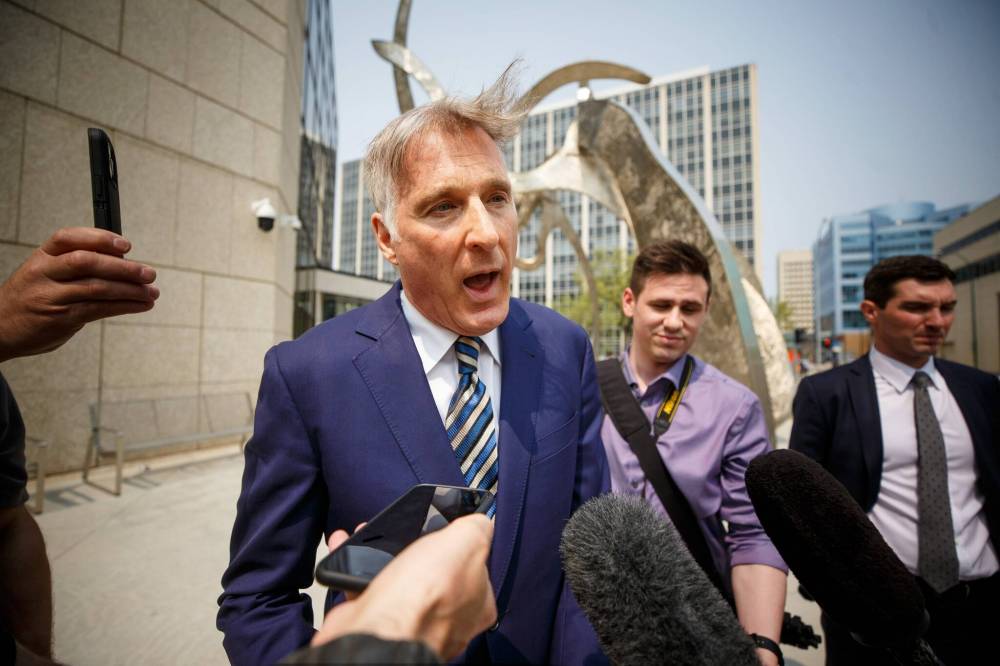
Mike Deal / Winnipeg Free Press Files
Maxime Bernier, People’s Party of Canada leader, shown leaving court on May 16 after contesting his June 2021 arrest and charges for violating pandemic restrictions.
Astute enough to realize that the only way he and other members of his party can be elected federally is if they siphon off Conservative Party votes, Bernier’s chief target is Pierre Poilievre, the equally outspoken and MAGA-leaning Conservative leader. Bernier maintains that Poilievre, as John Ibbitson of the Globe and Mail recently noted, “has betrayed the conservative movement.”
Thus, Bernier’s decision to run as a candidate in Portage-Lisgar. Still, it is a long shot. The riding has been solidly Conservative since it was established in 1997 and a recent poll has the Conservatives at 55 per cent (with the PPC in second at 18 per cent) and easily holding the riding in the byelection as Candice Bergen did in the September 2021 federal election.
Before that in the other key ridings that served the area dating back to 1870, Conservative Party members of Parliament dominated for many years, though Liberal, Progressive and Liberal-Progressive candidates were also elected at various times.
The federal election of December 1921 was Meighen’s first contest after taking over from prime minister Robert Borden in July 1920. Born in Ontario in 1874, Meighen attended the University of Toronto where he first encountered William Lyon Mackenzie King, who was to become his great Liberal Party opponent. The two men grew to detest each other.
Meighen trained and worked as a teacher before becoming a lawyer. By then, he had moved to Manitoba and opened a law office in Portage la Prairie in 1903. A staunch Conservative, Meighen first ran successfully in the 1908 federal election defeating the Liberal incumbent. Thereafter he represented the Portage la Prairie riding until he was defeated in 1921 by the Progressive (farmers) Party candidate. He was later re-elected in a safe Conservative seat in eastern Ontario, but again served as Portage’s MP for about a year following the 1925 federal election, during which time he was prime minister once more for a three-month period in 1926.
A skilled parliamentarian and a superb orator, Meighen was smart, dedicated and highly-principled. He was loyal to Conservative Party leader Robert Borden, who became prime minister after the 1911 federal election, and as a member of the cabinet supported the party’s protectionist economic policy—though early in his political career, he advocated lowering tariffs on farm machinery to appease his rural Manitoba constituents. He had unyielding faith in the pre-eminence of the British Empire and fully backed Borden’s decision to implement conscription during the First World War, a bill which Meighen drafted.
Conscription, a volatile political issue that split the country along English-French lines as well as other legislative measures and controversial actions taken by Meighen, ultimately proved detrimental to his political longevity and led to his defeat in the 1921 election.
Meighen generally refused to change course once he decided what was a proper approach to take. Thus, he failed to understand that French Canadians would never forgive him for drafting the conscription bill; businessmen in Montreal opposed his nationalization of railways; labourites detested him for jailing the leaders of the Winnipeg General Strike; and westerners disliked him for his refusal to lower the tariff. It was not by accident that Meighen titled his collection of speeches and essays, published in 1949, Unrevised and Unrepented.
At the same time, Meighen was prime minister for a total of 20 months, while Mackenzie King served as prime minister for nearly 22 years. Meighen did not grasp an important lesson about Canadian politics that King innately understood: Extreme and inflexible policies will never sustain long-term victory at the polls. “The extreme man,” King reasoned later in his career, “is always more or less dangerous, but nowhere more so than in politics. In a country like ours it is particularly true that the art of government is largely one of seeking to reconcile rather than to exaggerate differences — to come as near as may be possible to the happy mean.”
It is a dictum that voters in Portage-Lisgar will no doubt remind Maxime Bernier of about again on June 19 and one that Pierre Poilievre should seriously consider as well if he hopes to defeat the Liberals in the next general election.
Historian Allan Levine’s Now & Then column puts the events of today in a historical context.
Related Articles
NDP, Tory leaders hit Manitoba byelection campaign trail




Advertisement Advertise With Us
Advertisement Advertise With Us