

Tension builds in Kirkfield Park byelection
Advertisement
Read this article for free:
or
Already have an account? Log in here »
To continue reading, please subscribe:
Digital Subscription
One year of digital access for only $75*
- Enjoy unlimited reading on winnipegfreepress.com
- Read the E-Edition, our digital replica newspaper
- Access News Break, our award-winning app
- Play interactive puzzles
*Billed as $5.77 plus GST every four weeks. After 52 weeks, price increases to the regular rate of $19.95 plus GST every four weeks. Offer available to new and qualified returning subscribers only. Cancel any time.
Monthly Digital Subscription
$4.99/week*
- Enjoy unlimited reading on winnipegfreepress.com
- Read the E-Edition, our digital replica newspaper
- Access News Break, our award-winning app
- Play interactive puzzles
*Billed as $19.95 plus GST every four weeks. Cancel any time.
To continue reading, please subscribe:
Add Free Press access to your Brandon Sun subscription for only an additional
$1 for the first 4 weeks*
- Enjoy unlimited reading on winnipegfreepress.com
- Read the E-Edition, our digital replica newspaper
- Access News Break, our award-winning app
- Play interactive puzzles
*Your next Brandon Sun subscription payment will increase by $1.00 and you will be charged $17.95 plus GST for four weeks. After four weeks, your payment will increase to $24.95 plus GST every four weeks.
Read unlimited articles for free today:
or
Already have an account? Log in here »
Hey there, time traveller!
This article was published 09/12/2022 (1405 days ago), so information in it may no longer be current.
The provincial byelection campaign in Kirkfield Park, which will come to a dramatic close next week, continues to generate interesting stories to discuss over a double-double.
First, this week, NDP Leader Wab Kinew rolled out an appeal to residents to vote strategically. The argument is: if voters want to send a message to Heather Stefanson’s Progressive Conservative government, the best way to do so is by casting a ballot for the NDP, since it’s unlikely any other party can beat the Tories in next year’s general election.
In contrast, a vote for the Liberal candidate, Kinew suggested, is a wasted ballot.
John Woods / Winnipeg Free Press files
NDP supporters rallied outside Grace Hospital on Nov. 14 to focus public attention on the provincial government’s health-care record, but Liberal Party candidate Rhonda Nichol’s long history as a nurse at the hospital could boost her chances in the Kirkfield Park byelection.
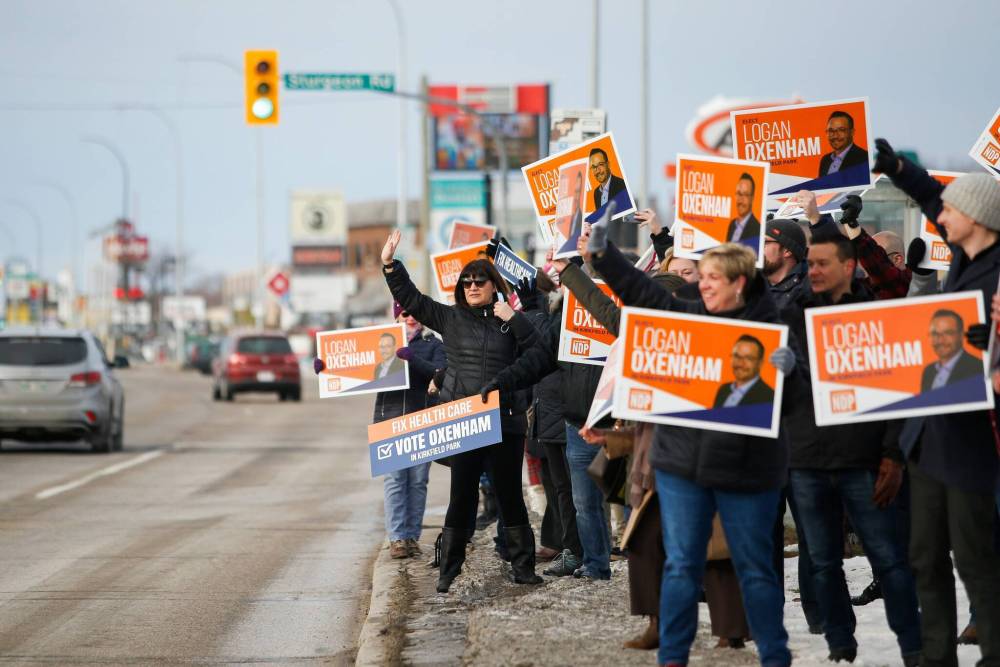
There have been several indications the NDP is concerned about Liberal candidate Rhonda Nichol’s chances in this race. On the doorstep, Nichol has played up her history as a longtime nurse at the Grace Hospital. The NDP hopes concerns about health care will translate into votes for candidate Logan Oxenham, but Nichol’s nursing bona fides may threaten that.
Kinew’s concern is not unjustified. In a general election, when voters are deciding who will form government, they will often refuse to vote for minor parties such as the Manitoba Liberals, for fear their vote will be wasted. No one wants to vote for a party that is unlikely to win.
But that concern evaporates in byelection campaigns in which the power of government is not at stake. In this byelection, if voters like Nichol, they can vote for her without the immediate worry their ballots will be wasted on a party that is very unlikely to form government.
The recent Fort Whyte byelection provides some justification for NDP concern. Ultimately, PC candidate Obby Khan triumphed in what everyone concedes is a solid Tory seat. But Liberal candidate Willard Reaves nevertheless raised eyebrows with a strong performance, scoring 2,853 votes to Khan’s 3,050, and beating the NDP candidate by a country mile.
It was clear Reaves benefited from a lack of strategic voting: without having to worry about who would form government, many voters simply voted for the candidate they liked the most.
Kinew is hoping to impose the strategic logic of general elections onto this byelection campaign. The worst-case scenario for the NDP is that Nichol attracts enough votes not to win, but to allow PC candidate Kevin Klein to skate into the legislature on the basis of a split anti-Tory vote, giving the PCs bragging rights in the lead-up to next year’s general election.
The second interesting story relates to Klein, who fired off a social-media post promising, if he is elected, to take on all comers on behalf of his constituents. “As an MLA in Kirkfield Park,” Klein thundered, “I will fight for you if it is with Wab Kinew or even Heather Stefanson. I am going to fight for the rights, values and expectations of all residents in our community.”
It is a rare spectacle indeed in Canada, where parties are notoriously disciplined, to see a candidate pledging to scuffle with his own leader. Given his party’s low approval rating in Winnipeg, Klein can hardly be blamed for wanting to put a little distance between him and Stefanson. Indeed, he has been running a campaign focused largely on his own record as a city councillor, rather than one focused on his party or its leader.
Kinew picked up on Klein’s pledge, arguing it was evidence of Tory disarray. “PC Kirkfield Park candidate: Send me to the legislature to fight with Heather Stefanson,” Kinew tweeted. “Voting for Klein will only continue the PC infighting.”
There may be benefit to framing Klein’s social-media post as an indication of Tory disarray. Voters are notoriously hard on parties that fail to present a unified face. In the 2016 provincial election, for example, the PCs hammered Greg Selinger’s NDP after a series of rebellions within the party, claiming they were evidence of a “broken government.”
But Kinew should tread carefully on this issue.
Broadly speaking, Canadians disapprove of rigidly enforced party discipline, and they take a particularly dim view of politicians who get elected promising to represent the people of their seats, only to then go on to kowtow to the leader and march in lockstep with all the other MLAs.
In general, Canadians want to see politicians act more independently when it comes to representing the needs and concerns of their constituents to the government, even if that means taking on the party leader.
After all, candidates are elected by the people in their constituencies, not by their party leaders.
That’s why I suspect, if Klein’s post was shown to 20 random people on the streets of Kirkfield Park, almost all would wholeheartedly agree with the sentiment that MLAs should stand up for their constituents even if doing so brings them into conflict with their leader.
In hoping to highlight Tory infighting, both Kinew and his candidate may be inadvertently boosting a unique strength of Klein in this race.
Royce Koop is a professor of political studies at the University of Manitoba and academic director of the Centre for Social Science Research and Policy.
Related Articles
Byelection will test Tories’ staying power
Advertisement Advertise With Us
Advertisement Advertise With Us