

Trump continues to target Indigenous peoples

Advertisement
Read this article for free:
or
Already have an account? Log in here »
To continue reading, please subscribe:
Digital Subscription
One year of digital access for only $75*
- Enjoy unlimited reading on winnipegfreepress.com
- Read the E-Edition, our digital replica newspaper
- Access News Break, our award-winning app
- Play interactive puzzles
*Billed as $5.77 plus GST every four weeks. After 52 weeks, price increases to the regular rate of $19.95 plus GST every four weeks. Offer available to new and qualified returning subscribers only. Cancel any time.
Monthly Digital Subscription
$4.99/week*
- Enjoy unlimited reading on winnipegfreepress.com
- Read the E-Edition, our digital replica newspaper
- Access News Break, our award-winning app
- Play interactive puzzles
*Billed as $19.95 plus GST every four weeks. Cancel any time.
To continue reading, please subscribe:
Add Free Press access to your Brandon Sun subscription for only an additional
$1 for the first 4 weeks*
- Enjoy unlimited reading on winnipegfreepress.com
- Read the E-Edition, our digital replica newspaper
- Access News Break, our award-winning app
- Play interactive puzzles
*Your next Brandon Sun subscription payment will increase by $1.00 and you will be charged $17.95 plus GST for four weeks. After four weeks, your payment will increase to $24.95 plus GST every four weeks.
Read unlimited articles for free today:
or
Already have an account? Log in here »
Hey there, time traveller!
This article was published 30/01/2026 (247 days ago), so information in it may no longer be current.
The Assembly of First Nations recently issued an official travel advisory to all its members considering travel to the United States.
“The Assembly of First Nations has heard reports that some First Nation citizens have been subjected to increased questioning and detainment by U.S. Immigration and Customs Enforcement,” says the notice on Jan. 23. “The AFN strongly condemns these actions and reaffirms First Nations inherent and treaty rights to cross-border mobility.”
Numerous First Nations governments and organizations, such as the Blood Tribe (Alberta), Mississauga First Nation, Six Nations of the Grand River, Garden River First Nation (Ontario) and Saint Regis Mohawk Tribe (New York), have issued similar warnings.
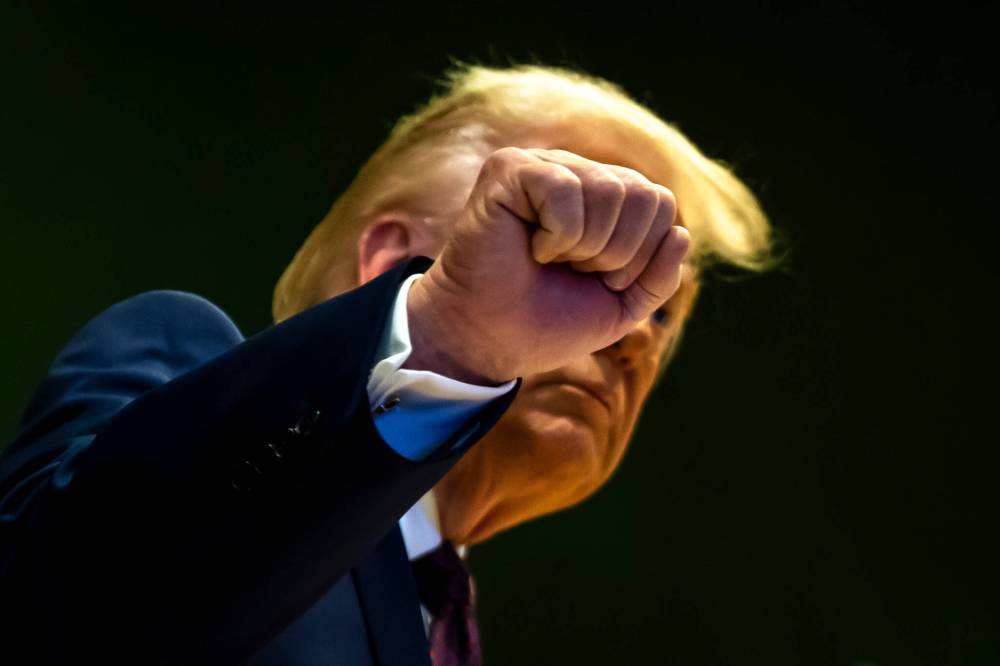
U.S. President Donald Trump has spent a career making life brutal for Indigenous peoples. (Laurent Gillieron / The Associated Press)
First Nations near the U.S.-Canada border have been particularly worried. “I’m advising our members not to cross the border at this time,” Northwest Angle #33 First Nation Chief Darlene Comegan said on social media on Jan. 15.
If First Nations individuals wish to visit family, attend ceremonies or conduct business in the U.S. – a legal right under the 1794 Jay Treaty – leaders are encouraging use of a Canadian passport instead of, or alongside, their Status Indian ID.
“Please note that the (U.S.) federal law enforcement may not be familiar with tribal IDs,” the AFN advisory states.
The idea of Indigenous people evoking an Indigenous right to do Indigenous things but having to claim they represent a country which spent most of its history trying to eradicate Indigeneity is incredibly ironic.
Carrying an understandable and updated ID is just one of many issues for Indigenous travellers to the United States, however.
There are also worries of border guards searching smartphones and social media history, visa requirements for anyone staying in the U.S. for longer than 30 days and being racially profiled as an “illegal alien” by an ICE officer.
Things have gotten progressively worse for Indigenous people inside the U.S., as well. With regularity, they, too, have been detained by ICE during its sweeps and raids in U.S. cities.
For weeks, the U.S.-based Native American Rights Fund has been hosting webinars, issuing fact sheets and printing pamphlets informing Indigenous people of their rights if they encounter one the many ICE militias active in U.S. cities.
“Native Americans, Alaska Natives and Native Hawaiians are citizens of the United States,” a ‘Know Your Rights’ fact sheet states. “Immigration and Customs Enforcement has no jurisdiction over (Native American) citizens on immigration enforcement (but) has targeted Native people, tribal citizens and descendants.”
This targeting is hardly random – or even a mistake.
U.S. President Donald Trump has spent a career making life brutal for Indigenous peoples.
There are the well-known battles Trump had in the 1990s with Native American tribes over casinos and land, but there is also his deep affinity for Andrew Jackson — the most brutal and violent American president in history when it comes to Native Americans.
This past year, a list of Trump’s “accomplishments” during his second term illustrates a distinct targeting of all things Indigenous.
From the deep federal cuts creating emergencies in Native American health-care and education institutions, to the revival of Columbus Day, to opening up of millions of acres of Indigenous territories in the Western Arctic for oil drilling, to whitewashing the National Museum of the American Indian, to trying to end U.S. birthright citizenship (which would create the nonsensical situation where some Native Americans from tribes lacking state recognition would not be legal Americans) …
Trump does like some Indigenous people, like those who vote Republican in red states, but much of his love exists for one “tribe”: the Lumbee Tribe of North Carolina – an urban group widely considered not Indigenous. (The U.S. president passed an executive order giving the long-time Trump supporters federal recognition as “Indians.”)
More recently, Trump has taken his fight with Indigenous peoples global.
His military action in Venezuela, a country with 30 Indigenous nations and Indigenous people in offices throughout society (including previous president Hugo Chavez), and his more recent threats to invade or buy Greenland (a country’s population is 80 per cent Inuit) suggest a kind of obsession with Indigeneity.
Even his threats this week to attack Iran, a country with 100 tribal communities and nearly a million Indigenous people, add to this argument. So it’s with little surprise that with every move by the Trump administration, Indigenous peoples across the world suffer the brunt of threats, decisions and policies.
Becoming a common force that displaces and harms Indigenous peoples globally though might also lead to another outcome for Trump.
It may unite them, in resistance.
niigaan.sinclair@freepress.mb.ca
Niigaan Sinclair is Anishinaabe and is a columnist at the Winnipeg Free Press.
Our newsroom depends on a growing audience of readers to power our journalism. If you are not a paid reader, please consider becoming a subscriber.
Our newsroom depends on its audience of readers to power our journalism. Thank you for your support.
Niigaan Sinclair is Anishinaabe and is a columnist at the Winnipeg Free Press.
Our newsroom depends on a growing audience of readers to power our journalism. If you are not a paid reader, please consider becoming a subscriber.
Our newsroom depends on its audience of readers to power our journalism. Thank you for your support.
Advertisement Advertise With Us
Advertisement Advertise With Us