Social Studies Grade 11: History of Canada

Please review each article prior to use: grade-level applicability and curricular alignment might not be obvious from the headline alone.
Constitution Act, Treaty 1 at CMHR

By Ashley Prest 3 minute read Preview

Constitution Act, Treaty 1 at CMHR

By Ashley Prest 3 minute read Thursday, Dec. 18, 2014

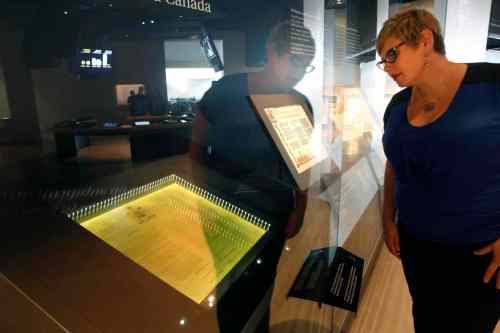
The original Treaty No. 1 land agreement of 1871 and the 1982 Proclamation of the Constitution Act are two of 11 historic and rarely loaned artifacts on display at the Canadian Museum for Human Rights.

The documents can be viewed in the CMHR's Protection Rights in Canada gallery and Canadian Journeys gallery and are on loan until September 2015 from the Library and Archives Canada based in Gatineau, Que. The display has been open to public viewing since the museum's opening day on Nov. 11.

Signed at Lower Fort Garry by Chippewan and Cree First Nations leaders and Queen Victoria, the Treaty No. 1 agreement is the original document with affixed seals and ribbon.

"Just looking at the display in the case, we've got 250 years of Canadian legal tradition and human rights tradition in these documents. There is a really wide breadth of historical significance," said Heather Bidzinski, the CMHR's head of collections.

Read
Thursday, Dec. 18, 2014

WAYNE GLOWACKI / WINNIPEG FREE PRESS
Heather Bidzinski views the Proclamation of the Constitution Act document at the Canadian Museum for Human Rights Wednesday.

WAYNE GLOWACKI / WINNIPEG FREE PRESS
Heather Bidzinski views the Proclamation of the Constitution Act document at the Canadian Museum for Human Rights Wednesday.

A war for Britain

Allan Levine 6 minute read Preview

A war for Britain

Allan Levine 6 minute read Friday, Aug. 29, 2014

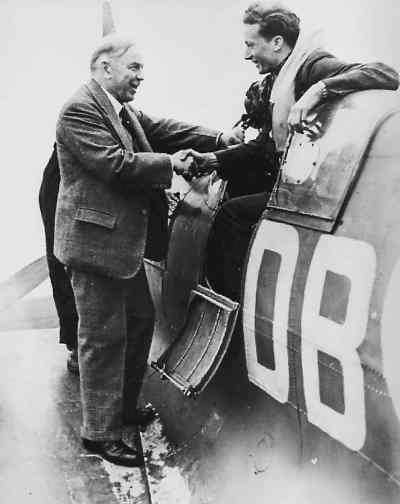
Seventy-five years ago, on Sept. 1, 1939, Prime Minister William Lyon Mackenzie King was awakened early in the morning with news that the German Wehrmacht had crossed the border into Poland.

For the British and French this was the final straw in the frustrating negotiations with Adolf Hitler that had been ongoing for several years. The two western European powers declared war on Germany on Sept. 3.

Within a week Canada had also issued its own declaration of war; for unlike in August 1914 the country -- as a result of the Statute of Westminster of 1931 -- was not automatically at war with the British declaration. Nonetheless, despite Canada's new autonomous status within the empire, there really was never a doubt that Canada would stand by Britain's side in 1939, just as the country had during the First World War.

Ever since his celebrated meeting with Hitler in Berlin in June 1937, King believed war with Nazi Germany could be averted. Like many other world leaders who came into contact with the Hitler in the late '30s, King regarded him as a charismatic visionary, though unpredictable and possibly dangerous. As the situation worsened in the spring of 1938, King wrote in his diary that he was confident the world "will yet come to see a very great man ... in Hitler."

Read
Friday, Aug. 29, 2014

COURTESY OF UNDER THE WIRE / WASHINGTON POST
Mackenzie King greets Bill Ash, an American who served in the Spanish Civil War and who had an action-filled career in the RCAF during the Second World War. Ash died earlier this year.

COURTESY OF UNDER THE WIRE / WASHINGTON POST
Mackenzie King greets Bill Ash, an American who served in the Spanish Civil War and who had an action-filled career in the RCAF during the Second World War. Ash died earlier this year.
No Subscription Required

Une geôle dans son état originel

Sabine Trégouët de La Liberté pour le Winnipeg Free Press 8 minute read Preview
No Subscription Required

Une geôle dans son état originel

Sabine Trégouët de La Liberté pour le Winnipeg Free Press 8 minute read Saturday, Nov. 17, 2012

LA petite prison de Saint-Claude est une perle pour le patrimoine canadien. En effet, ce lieu d’histoire et de patrimoine constitue la seule prison municipale existant par elle-même dans l’Ouest canadien selon le Ministère de la Culture, Patrimoine et Tourisme du Manitoba.

“C’est la seule prison dans toutes les prairies qui subsiste à son état d’origine,” affirme le membre du comité de tourisme et de marketing de Saint-Claude, Roger Bazin. “Il y en avait d’autres de ce type aux alentours de Notre-Dame-de-Lourdes ou de Saint-Lazare, mais elles ont souvent été détruites.”

Construite en 1912, la prison a initialement été construite pour calmer les turbulences.

“Beaucoup d’employés des fermes venaient à Saint-Claude la fin de semaine pour boire dans le petit salon à bière et il y avait souvent des bagarres, raconte Roger Bazin. Il y avait des problèmes de boisson évidemment, mais aussi des vols et d’autres incidents. Comme on est éloignés de Winnipeg, la prison a été construite à la demande de la population pour mettre en détention ceux qui causaient des soucis.”

Read
Saturday, Nov. 17, 2012

Roger Bazin dans l’ancienne prison de Saint-Claude.

Roger Bazin dans l’ancienne prison de Saint-Claude.

Hard lives for home children

Tom Ford 4 minute read Monday, Jun. 27, 2011

OTTAWA -- The elderly man sat in front of me, his rheumy eyes and round, ruddy face giving me no inkling of what he was thinking. His hands were neatly folded in his lap. I had been told he was a home boy and I, a kid reporter at the Winnipeg Tribune, was supposed to interview him.

I'd been given half an hour to look up home children in the Tribune's library. Apparently, they were orphans and other children brought over by charities to stay with Canadian families and work as domestics or on farms. Some of them were as young as five.

I only learned later that Alex, the home boy I was supposed to interview, had been harshly treated in various homes; that he had been told endlessly to sit quietly with his hands folded; that his keepers -- all devoted Christians, I'm sure -- had drained most of the joy and vitality out of him.

I asked some questions; he answered quietly in monosyllables. The interview was a failure because I wasn't prepared.

No Subscription Required

Moody historical fiction gives life to filles du roi banished to French colonies

Reviewed by Dana Medoro 4 minute read Saturday, Jan. 22, 2011

Bride of New France

By Suzanne Desrochers

Penguin Canada, 224 pages, $25

This is a moody, beautiful piece of historical fiction, casting Louis XIV's Paris as a grey and Gothic city, pitiless toward its poor and dark with imperial desires.
FLQ didn’t mean to kill people: Quebec author

By Andy Blatchford 2 minute read Preview

FLQ didn’t mean to kill people: Quebec author

By Andy Blatchford 2 minute read Friday, Oct. 15, 2010

MONTREAL -- An author of Quebec's high-school history textbooks says the FLQ never intended to kill people and its bombing victims were "collateral damage" in its push for independence.

Raymond Bedard also argues that Pierre Laporte's death during the October Crisis 40 years ago this weekend was an accident -- not murder.

Many in English Canada might be surprised to hear those views expressed by an author of history textbooks and a man who has seen thousands of students pass through his class in his 30 years as a teacher.

But Bedard's take on the events of 1970 offers a glimpse into the different lessons taught in the province's history classes.

Read
Friday, Oct. 15, 2010

THE CANADIAN PRESS ARCHIVES
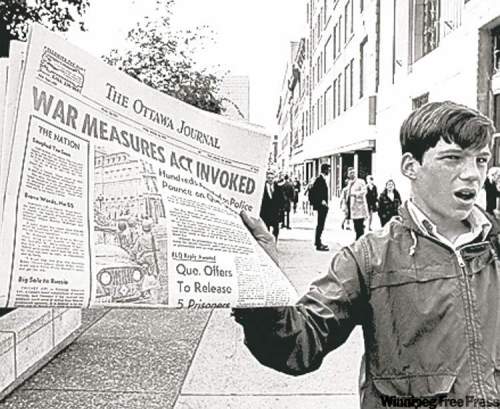
Headline announces War Measures Act in Ottawa, Oct. 16, 1970.

THE CANADIAN PRESS ARCHIVES
Headline announces War Measures Act in Ottawa,  Oct. 16, 1970.

FLQ Manifesto part of the past

3 minute read Friday, Sep. 11, 2009

Decent people should be offended by the fact that a national agency will permit the reading of a terrorist manifesto next weekend at the Plains of Abraham in Quebec City as part of a series of readings to commemorate the 1759 battle that altered the course of Canadian history.

The manifesto in question was issued in October 1970 by the Front de Liberation du Quebec following the kidnapping of British diplomat James Cross and Quebec cabinet minister Pierre Laporte, who was subsequently murdered. The FLQ was responsible for more than 200 bombings in Quebec during the 1960s, causing the deaths of at least five people. It was all done in the name of creating an independent Marxist Quebec.

The National Battlefields Commission, the same group that cancelled plans for a major re-enactment of the battle because of fears of a violent backlash, a decision for which it should be ashamed, has said it will allow the reading of the FLQ Manifesto, but was quick to point out that it does not endorse the document. That kind of courage is admirable, although it's unfortunate it was not in evidence when the commission backed down from plans for the historical re-enactment.

Decent people should be offended that the manifesto will get a public airing at the commemorative event -- Montreal singer and sovereigntist Luck Mervil has even been asked to perform the reading -- but it would be a violation of Canadian values to ban it from the stage.