

Quebec outlines tariff response focused more on financial aid, less on retaliation
Advertisement
Read this article for free:
or
Already have an account? Log in here »
To continue reading, please subscribe:
Digital Subscription
One year of digital access for only $75*
- Enjoy unlimited reading on winnipegfreepress.com
- Read the E-Edition, our digital replica newspaper
- Access News Break, our award-winning app
- Play interactive puzzles
*Billed as $5.77 plus GST every four weeks. After 52 weeks, price increases to the regular rate of $19.95 plus GST every four weeks. Offer available to new and qualified returning subscribers only. Cancel any time.
Monthly Digital Subscription
$4.99/week*
- Enjoy unlimited reading on winnipegfreepress.com
- Read the E-Edition, our digital replica newspaper
- Access News Break, our award-winning app
- Play interactive puzzles
*Billed as $19.95 plus GST every four weeks. Cancel any time.
To continue reading, please subscribe:
Add Free Press access to your Brandon Sun subscription for only an additional
$1 for the first 4 weeks*
- Enjoy unlimited reading on winnipegfreepress.com
- Read the E-Edition, our digital replica newspaper
- Access News Break, our award-winning app
- Play interactive puzzles
*Your next Brandon Sun subscription payment will increase by $1.00 and you will be charged $17.95 plus GST for four weeks. After four weeks, your payment will increase to $24.95 plus GST every four weeks.
Read unlimited articles for free today:
or
Already have an account? Log in here »
Hey there, time traveller!
This article was published 04/03/2025 (602 days ago), so information in it may no longer be current.
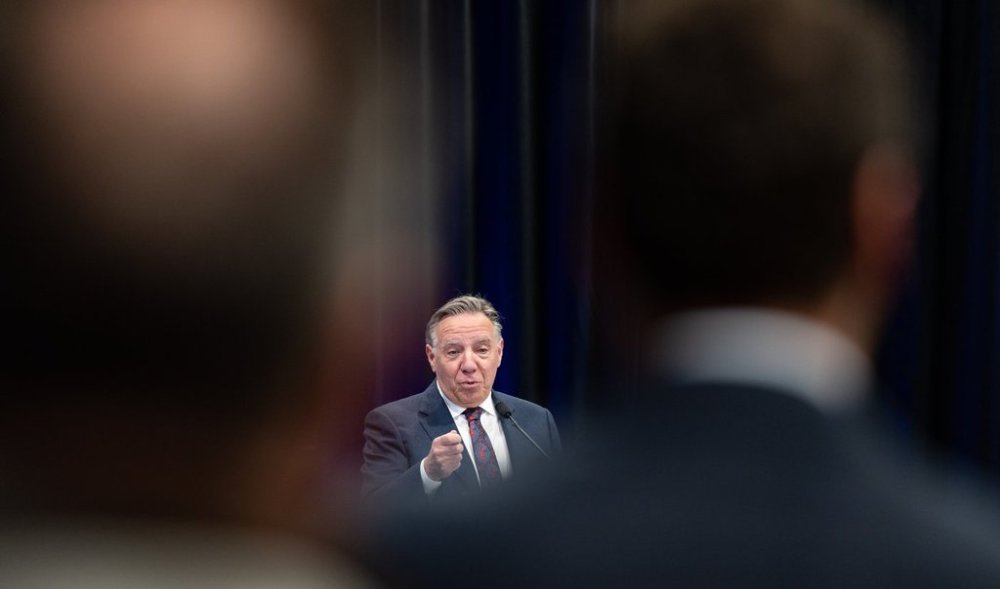
MONTREAL – Promising to protect Quebecers against the “unjustified attack” of the Trump administration, Premier François Legault announced a response to the trade war focused largely on helping Quebec companies weather the storm, and less on retaliatory action.
Legault said Tuesday that Quebec needs to “reshape” its economy, and outlined plans to offer financial aid to businesses and accelerate the pace of infrastructure development in the province. His announcement came hours after U.S. President Donald Trump imposed 25 per cent across-the-board tariffs on Canadian goods, and a 10 per cent levy on energy products.
“We need to keep a cool head, but we also want to be very clear: We are not going to let ourselves be intimidated by Donald Trump,” he told reporters during a news conference in Montreal.
The premier’s response diverged from that of Ontario Premier Doug Ford, who announced a more aggressive plan to retaliate against the U.S. earlier in the day. Where Ford declared he will ban American companies from $30 billion worth of procurement contracts, Legault announced a more modest penalty of up to 25 per cent on bids by American companies.
Ford also said Ontario will rip up a $100-million deal with Starlink — a satellite internet constellation operated by billionaire Elon Musk, one of Trump’s high-level advisers — and said he will soon impose a 25 per cent surcharge on electricity exports. The Ontario premier also threatened to cut off power altogether if U.S. tariffs remain in place into April.
Legault said Quebec “must not rule out anything for the future,” including targeting electricity exports, but it’s not something he’s considering in the short term.
Both provinces have directed their liquor boards to stop selling American alcohol.
Legault warned that a prolonged trade war could cost up to 160,000 jobs. However, he said the province has tools it can leverage to help it weather the storm, such as the province’s investment arm and the power utility, Hydro-Québec, which plans to spend billions of dollars in the coming years to build capacity.
“Even if it will be tough, I think at the end, in one year, two years, our economy will be stronger, less dependent on the United States,” he said. “So our economy will be a new economy, but a more solid economy.”
As part of its response plan, Quebec will offer liquidity to companies over the next 12 months to give them time to adjust their business models or supply chains. Companies can receive loans up to $50 million, with a maximum term of seven years, and a deferral of up to 24 months to begin repaying them.
The province also wants to boost productivity by offering interest-free loans to businesses with investment projects worth more than $10 million.
Legault said the 25 per cent penalty on U.S. bids is to ensure American companies win as few government contracts as possible. But Treasury Board President Sonia LeBel said more than 96 per cent of public contracts already go to companies with a presence in Canada.
During a Tuesday morning news conference in Ottawa, Prime Minister Justin Trudeau suggested Trump is trying to trigger “a total collapse of the Canadian economy” to make it easier to annex the country. Ottawa is retaliating with immediate tariffs on $30 billion worth of American goods, followed by further tariffs on another $125 billion worth of American products in 21 days.
Legault suggested Trump may be trying to annex Canada to gain access to its reserves of critical minerals. “We have the chance to have all these minerals, and I think Mr. Trump would like to get them,” he said. “It doesn’t make sense. It won’t happen.”
While Trump has imposed a 25 per cent tariff on most goods, Legault said the province’s valuable aluminum industry will only be subject to the 10 per cent levy that’s being applied to energy and critical minerals — a sign the United States needs Quebec and Canadian goods, he said.
A recent study by the Canadian Chamber of Commerce says the Quebec cities most at risk from tariffs are Saguenay, Trois-Rivières, and Drummondville.
Several export-dependent industries that are vulnerable to tariffs responded on Tuesday, urging the provincial and federal governments to rapidly develop plans to support industries and workers.
The Quebec director of the United Steelworkers union said the tariffs threaten several sectors, including aluminum, lumber, steel, manufacturing and auto parts. Dominic Lemieux said the government’s plan should include modernizing factories, increasing domestic transformation of natural resources, finding new clients and improving the social safety net.
“There is no room for magical thinking today,” he said. “The storm has begun and we need our governments to protect workers and good jobs in our economy.”
This report by The Canadian Press was first published March 4, 2025.
Related Articles
Canada 'open for business,' minister says as Ottawa pushes critical minerals mining
Advertisement Advertise With Us
Advertisement Advertise With Us