

Manitoba looks ahead to small steps, big projects
Advertisement
Read this article for free:
or
Already have an account? Log in here »
To continue reading, please subscribe:
Digital Subscription
One year of digital access for only $75*
- Enjoy unlimited reading on winnipegfreepress.com
- Read the E-Edition, our digital replica newspaper
- Access News Break, our award-winning app
- Play interactive puzzles
*Billed as $5.77 plus GST every four weeks. After 52 weeks, price increases to the regular rate of $19.95 plus GST every four weeks. Offer available to new and qualified returning subscribers only. Cancel any time.
Monthly Digital Subscription
$4.99/week*
- Enjoy unlimited reading on winnipegfreepress.com
- Read the E-Edition, our digital replica newspaper
- Access News Break, our award-winning app
- Play interactive puzzles
*Billed as $19.95 plus GST every four weeks. Cancel any time.
To continue reading, please subscribe:
Add Free Press access to your Brandon Sun subscription for only an additional
$1 for the first 4 weeks*
- Enjoy unlimited reading on winnipegfreepress.com
- Read the E-Edition, our digital replica newspaper
- Access News Break, our award-winning app
- Play interactive puzzles
*Your next Brandon Sun subscription payment will increase by $1.00 and you will be charged $17.95 plus GST for four weeks. After four weeks, your payment will increase to $24.95 plus GST every four weeks.
Read unlimited articles for free today:
or
Already have an account? Log in here »
Hey there, time traveller!
This article was published 01/01/2025 (653 days ago), so information in it may no longer be current.
After an unremarkable year with characteristically slow growth, there’s no obvious relief in sight for the Manitoba economy in 2025.
The City of Winnipeg is going to raise property taxes, the provincial gas tax holiday is over and the possibility of punitive U.S. tariffs looms over the breadth of Manitoba’s diversified economy with virtually every vertical stripe dependent to some degree on U.S. exports.
With modest growth permanently baked into the province’s economic dynamic, the only up-side is Manitoba will probably feel the negative impacts of those potential tariffs a little less than its Canadian peers.
MIKE DEAL / FREE PRESS FILES
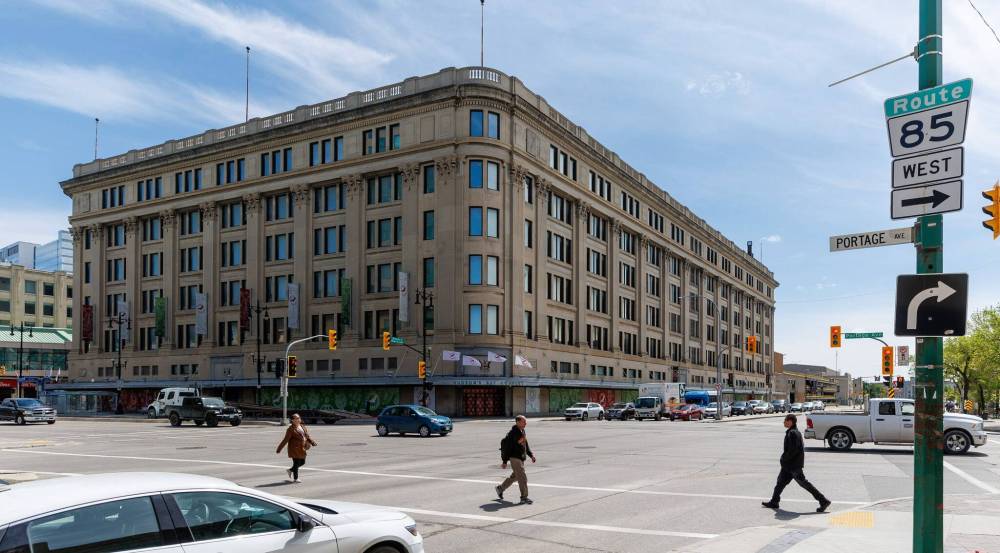
The former Hudson’s Bay Co. building at Portage Avenue and Memorial Boulevard is to be transformed into an Indigenous housing and cultural hub.
In considering Manitoba’s fate in times of uncertainty I always think of the line attributed to Sandy Riley, the local business leader who’s had a lengthy history of defending and advocating for Winnipeg on Bay Street, Wall Street and elsewhere: the city’s very existence is a collective act of will.
The idea is, regardless of what’s happening elsewhere in the world or what stage of the economic cycle it is in, the fate of the city is entirely at the mercy of the actions Winnipeggers take. It’s not dependent on outside forces.
It’s arguably still the case — and more so than many other cities its size.
The small population base means the prospects of landing a mega-employer has never been great for Manitoba.
The strong population growth of the past decade fuelled by new Canadians (the province still has an out-migration problem) has strengthened the workforce, but in its fall provincial forecast CIBC bank said: “In terms of total demand (employment plus job vacancies) relative to supply, Manitoba now has the tightest labour market out of any province.”
So, again, it’s a fool’s errand to wait for an Amazon warehouse or a gigafactory to bail us out.
With such a large land mass and the concentration of population in one large city, it makes sense there’s so much consternation about how to make downtown Winnipeg more functional and inviting.
The sad fact is we’ve got it wrong in the past.
Portage Place mall was to have “saved” downtown in the late 1980s. Kudos to the Chipmans and True North and their partners to take a $680 million stab at a do-over. That’s the kind of collective act of will Riley was talking about.
The redevelopment of the former Hudson’s Bay Co. flagship store — called Wehwehneh Bahgahkinahgohn — is part of that larger strategy.
With a huge physical presence in such a strategic location, the old Bay property can’t help but impact the tenor and tone of downtown in 2025 and in the years to come. Considering some of the most experienced real estate developers took a pass on the property for so many years is a clear sign of how hard a reno job that’s going to be.
Some see the removal of pedestrian barricades at Portage Avenue and Main Street as a linchpin to free up new street-level energy for downtown in 2025. It could also be just something else to distract folks from bigger issues like downtown safety.
This year, the word “tariffs” will likely become a popular utterance.
The province’s lucrative canola industry has already been dealing with the effects after China imposed tariffs after Canada took similar measures against Chinese electric vehicles.

MIKAELA MACKENZIE / FREE PRESS FILES
Portage Place mall is slated to become a mixed-use campus, featuring a 12-storey health-care centre.
In the context of what could be across-the-board pain, in a stroke of good fortune (that was decades in the making) NFI Group, one of the province’s largest manufacturers, had already been forced to establish “Buy American” bona fides.
It worked out so well that, in 2025, it will be repatriating capacity so it can service Canadian customers from its home base in Winnipeg.
If the U.S. does impose broad tariffs on Canadian goods, it will revive the narrative about diversifying global trade partners.
Manitoba’s agri-food industry does that better than most already. That’s why recent labour strife on the national railways can cause out-sized concern in the middle of the country.
Speaking of railroads, Manitoba’s homegrown Hudson Bay Railway will look for further incremental growth this coming year. Significant maintenance, repair and overhaul work took place in 2024. It also experienced a modest market breakthrough with an export shipment of zinc concentrate from a Manitoba mine to European customers.
That’s the kind of supply chain enhancement the Port of Churchill has been trying to make happen for decades. Granted, it was a modest development, but taking another step in that direction in 2025 will be encouraging.
The province will take any new business it can get.
In December, RBC noted per-capita gross domestic product declined in Manitoba for the sixth consecutive quarter and the unemployment rate was up one percentage point from a year ago.
Wealth generation in Manitoba will continue to require ingenuity and resourcefulness in 2025.
One of these days, those kinds of inputs, along with some much needed capital might be applied to the North which, despite on-going neglect, continues to provide hope for the future of the province.
martin.cash@freepress.mb.ca
Related Articles
Drivers line up to fill tanks before gas tax reappears




Advertisement Advertise With Us
Advertisement Advertise With Us