Manitoba to study food prices Independent grocers say reasons for escalating prices beyond government control
Read this article for free:
or
Already have an account? Log in here »
To continue reading, please subscribe:
Digital Subscription
One year of digital access for only $75*
- Enjoy unlimited reading on winnipegfreepress.com
- Read the E-Edition, our digital replica newspaper
- Access News Break, our award-winning app
- Play interactive puzzles
*Billed as $5.77 plus GST every four weeks. After 52 weeks, price increases to the regular rate of $19.95 plus GST every four weeks. Offer available to new and qualified returning subscribers only. Cancel any time.
Monthly Digital Subscription
$4.99/week*
- Enjoy unlimited reading on winnipegfreepress.com
- Read the E-Edition, our digital replica newspaper
- Access News Break, our award-winning app
- Play interactive puzzles
*Billed as $19.95 plus GST every four weeks. Cancel any time.
To continue reading, please subscribe:
Add Free Press access to your Brandon Sun subscription for only an additional
$1 for the first 4 weeks*
- Enjoy unlimited reading on winnipegfreepress.com
- Read the E-Edition, our digital replica newspaper
- Access News Break, our award-winning app
- Play interactive puzzles
*Your next Brandon Sun subscription payment will increase by $1.00 and you will be charged $17.95 plus GST for four weeks. After four weeks, your payment will increase to $24.95 plus GST every four weeks.
Read unlimited articles for free today:
or
Already have an account? Log in here »
Hey there, time traveller!
This article was published 11/02/2026 (237 days ago), so information in it may no longer be current.
The Manitoba government has followed through on its promise to conduct a study on groceries in a bid to lower food costs.
Project leads will investigate whether differential pricing — in which shoppers are charged different prices by the same retailer based on customer segment, location, time or demand — is occurring in Manitoba.
Antitrust and anti-competition policies, supply chain vulnerabilities and geographic food deserts will also be probed, the government said Wednesday.

Ruth Bonneville / Free Press files
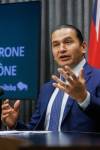
Finance Minister Adrien Sala
“We know Manitobans are struggling with the price of food, and we know that the prices of food continue to grow in ways that are very concerning,” Finance Minister Adrien Sala told reporters.
“This study is going to focus on what we can do to respond to that.”
He cited the United States: Consumer Reports has publicized differential pricing in that country, including in its December 2025 article on Instacart’s artificial intelligence use.
Costs might change based on customer habits and demand — both online and in-store via digital tags, Sala said.
Experts in the field haven’t found evidence of the practice in Manitoba. There’s little data available to examine, said Sylvain Charlebois, director of the Agri-Food Analytics Lab at Dalhousie University in Halifax.
His lab recently held a session on food prices and data collection with representatives from the province’s agriculture department.
“Grocers will have a lot of data, but they may not be willing to share any of it,” Charlebois said. “A good study, you need good data — and if you want good data, you need to pay for it.”
It’s harder the more region-specific you get, Charlebois continued.
Sala didn’t specify how the government will collect data for the study. It has tasked the Manitoba Bureau of Statistics with the job; staff will tap researchers and experts “as needed,” Sala said, adding for now, there’s no cost to the study, which is expected to be completed this spring.
Early findings could lead to affordability measures in the upcoming budget, although Sala made no promises.
He flagged the possibility of applying a maximum retail price to two- and four-litre jugs of milk. The province capped the price of one-litre cartons in January. The measure will stay in place throughout 2026.
A Canadian Federation of Independent Grocers official described being “perplexed and surprised” by the grocery study.
Gary Sands, a CFIG senior vice-president, penned a letter to Premier Wab Kinew following the price freeze on one-litre milk cartons. He alleged the province didn’t consult the association on the change; it squeezes shops with margins averaging two per cent, Sands wrote. There are roughly 6,900 independent grocers nationally.
The grocery study, similarly, has been launched without the association’s input, Sands said.
“We understand the concerns around rising food prices,” he said. “The things that are driving up food prices are beyond the control of a government.”
Sands cited impacts from the Russia-Ukraine war, wildfires, droughts that affect cattle herd sizes and U.S.-based supply chain disruptions as food price contributors.
If CFIG noticed price gouging, it would be “screaming about it from the rooftops,” Sands said, adding the practice hasn’t been identified by Competition Bureau Canada.
Sands proposed industry engagement — including on ways to reduce food distribution costs — as a better approach to tackling grocery prices.
The New Democrats have had two and a half years to address affordability. The new study is a “distraction from what they’re really failing at,” said Richard Perchotte, consumer protection critic for the Tories.
Nationally, grocery prices rose five per cent year-over-year in December. Manitoba’s inflation rate was 3.7 per cent that month, the highest among provinces.
The biggest food price increases took place during the COVID-19 pandemic, said Ramsey Zeid, a Food Fare co-owner.
“You… see an increase every year, because the cost of goods goes up — the cost of cans go up, the cost of shipping goes up, the cost of gas goes up,” Zeid said, adding price increases have largely steadied.
Minimum wage, utilities and wholesale pricing contribute to the price tag, Zeid continued. He called grocery store studies “great,” adding box chains and suppliers should be scrutinized.
“We need to figure out a way for Manitobans to be able to afford groceries to eat,” Zeid said.
Melissa Blocker approved of the study once she heard about it during a grocery run Wednesday.
“It’s very expensive to eat,” she said, with salad dressings in hand.
Blocker has been visiting stores more often to compare prices and find sales. Thursdays are generally best for deals, she said: “Our wages aren’t going up, but food is going up — that’s the struggle.”
The New Democrats first announced the grocery study in their throne speech in November.
Lowering taxes and removing interprovincial trade barriers are ways provinces can decrease food costs, Charlebois said.
gabrielle.piche@winnipegfreepress.com

Gabrielle Piché reports on business for the Free Press. She interned at the Free Press and worked for its sister outlet, Canstar Community News, before entering the business beat in 2021. Read more about Gabrielle.
Every piece of reporting Gabrielle produces is reviewed by an editing team before it is posted online or published in print — part of the Free Press‘s tradition, since 1872, of producing reliable independent journalism. Read more about Free Press’s history and mandate, and learn how our newsroom operates.
Our newsroom depends on a growing audience of readers to power our journalism. If you are not a paid reader, please consider becoming a subscriber.
Our newsroom depends on its audience of readers to power our journalism. Thank you for your support.