

After Manwin fire, Winnipeg’s community network steps up
As 150 shelter residents were forced out, Indigenous-led organizations, volunteers and donors mobilized within hours

Advertisement
Read this article for free:
or
Already have an account? Log in here »
To continue reading, please subscribe:
Digital Subscription
One year of digital access for only $75*
- Enjoy unlimited reading on winnipegfreepress.com
- Read the E-Edition, our digital replica newspaper
- Access News Break, our award-winning app
- Play interactive puzzles
*Billed as $5.77 plus GST every four weeks. After 52 weeks, price increases to the regular rate of $19.95 plus GST every four weeks. Offer available to new and qualified returning subscribers only. Cancel any time.
Monthly Digital Subscription
$4.99/week*
- Enjoy unlimited reading on winnipegfreepress.com
- Read the E-Edition, our digital replica newspaper
- Access News Break, our award-winning app
- Play interactive puzzles
*Billed as $19.95 plus GST every four weeks. Cancel any time.
To continue reading, please subscribe:
Add Free Press access to your Brandon Sun subscription for only an additional
$1 for the first 4 weeks*
- Enjoy unlimited reading on winnipegfreepress.com
- Read the E-Edition, our digital replica newspaper
- Access News Break, our award-winning app
- Play interactive puzzles
*Your next Brandon Sun subscription payment will increase by $1.00 and you will be charged $17.95 plus GST for four weeks. After four weeks, your payment will increase to $24.95 plus GST every four weeks.
Read unlimited articles for free today:
or
Already have an account? Log in here »
Hey there, time traveller!
This article was published 17/01/2026 (276 days ago), so information in it may no longer be current.
In the early morning hours Wednesday, as a massive blaze at the Manwin Hotel forced 150 people to evacuate from the Main Street Project’s emergency shelter, a tightly connected network of community organizations sprang into action, supported by Winnipeggers of all ages and walks of life.
N’Dinawemak, an Indigenous-led shelter nearby, temporarily swelled its capacity to bring a 40 more people into their space. By 6:30 a.m., when MacArthur Colon, a team lead at N’Dinawemak, arrived for his morning shift, community members from Main Street Project had already been arriving for about two hours.
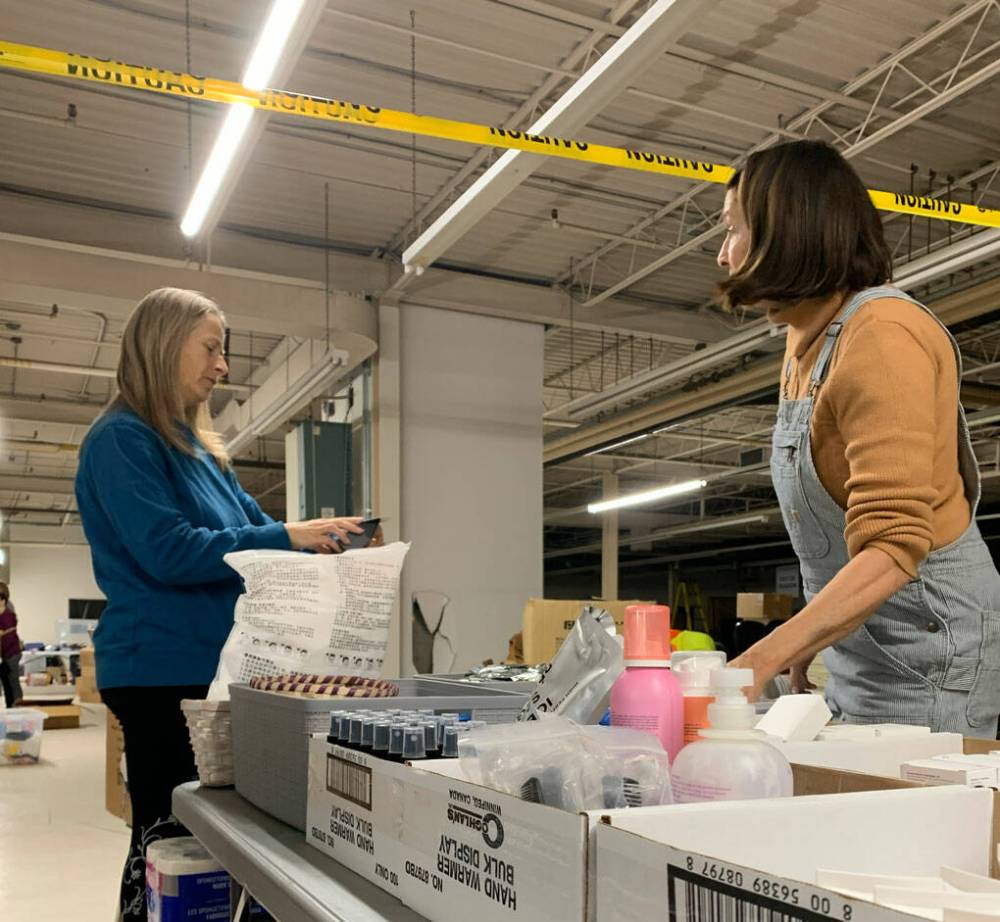
Another N’Dinawemak staff member headed upstairs to the large, warehouse-like floor that hosts Linking Hope, a registered non-profit that connects businesses and individuals with surplus supplies to community organizations in need. There, among tables and racks, they pulled winter clothes for those who’d been hurriedly evacuated from Main Street Project.
MARSHA MCLEOD / FREE PRESS
Gail Johnston (left) and Liz Prall, volunteers with Linking Hope (Prall is also a board member), sort hygiene products before they are distributed to organizations that need them.
It was fortuitous timing: a big donation of winter coats had just come to Linking Hope from Mark’s, the work apparel company.
“They were displaced and they had nothing,” said Tara Bell, a coordinator with both N’Dinawemak and Linking Hope. “It was amazing to see that go out. Because sometimes we don’t have coats at all, we just happened to get this shipment.”
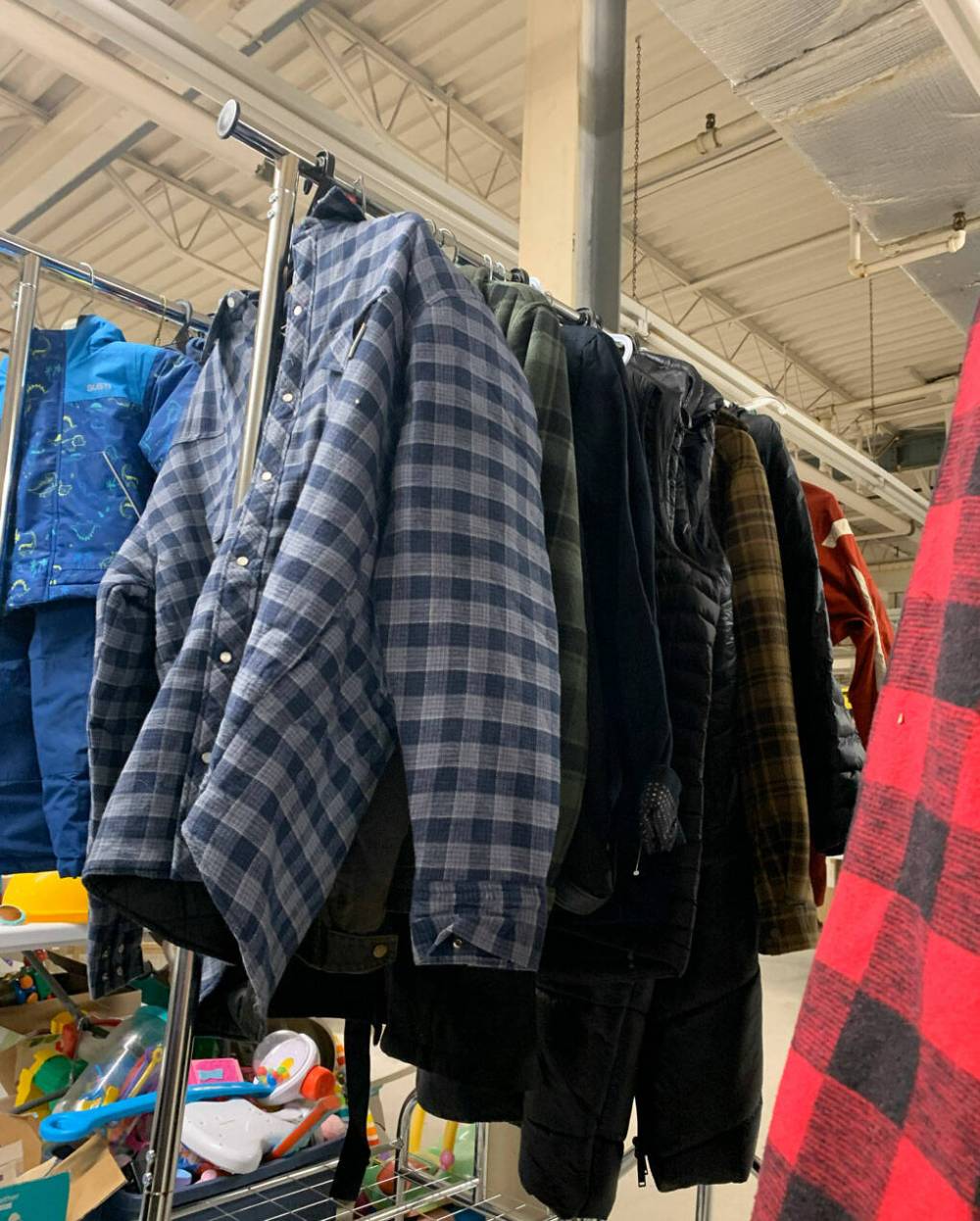
It also meant that by Saturday afternoon, Linking Hope was down to “maybe one or two” winter jackets, said founder Kristie Pearson, as she showed a Free Press reporter around the non-profit’s roughly 15,000-square foot hub for donations. The racks that normally hold winter coats were filled instead with flannels and fleecy sweaters that would not be warm enough to withstand the punishing January weather. Men’s clothing is also always needed, Pearson explained, especially in larger sizes. She pointed to three tables of men’s clothing, compared to the seven or eight tables of women’s. (Socks and underwear, she said, also can’t be overstocked).
What the organization did have a good store of, however, was volunteers.
By 2 p.m., around 40 people were busily filling the space. Members of a U16 boys hockey team were sorting sports equipment. Two young children surveyed piles of clothing: “Stack them neatly, OK?” one was told by a family member, while the other looked cautiously for the right spot to place a folded women’s sweater. Nearby, Pearson was explaining to two new volunteers how things were done, before adding, “nothing has to be perfect here.” Meanwhile, other volunteers were “decommissioning” donations – taking tags and other packaging off – including shorts that were being set aside for the summer. Someone else wheeled a dolly of winter boots – another high need, Pearson said – toward the door.
Five people told the Free Press Saturday about the high level of coordination between Winnipeg’s social service organizations in response to the fire, with staff members in constant communication to support those who’d been evacuated. But they also spoke of how everyday Winnipeggers, including those who might be apprehensive or who lack specific training, can also step up to be a part of the response.
“It’s a big family,” said Colon, of N’Dinawemak. “I come in every day, and I’m greeted with a smile. I’m greeted with, ‘Hey, how are you doing? It’s nice to see you.’ It’s beautiful. If more people reached out to the communities and started coming and volunteering, they’ll start to see we’re all human. We’re all good people. You know, we go through hard times. But if we can get more of that, that would be amazing.”
Then, Colon has to run. A barber and a Registered Massage Therapist will be spending time at N’Dinawemak on that afternoon, and he needs to make sure the day is running smoothly – that everyone has what they need.
MIKE DEAL / FREE PRESS FILES
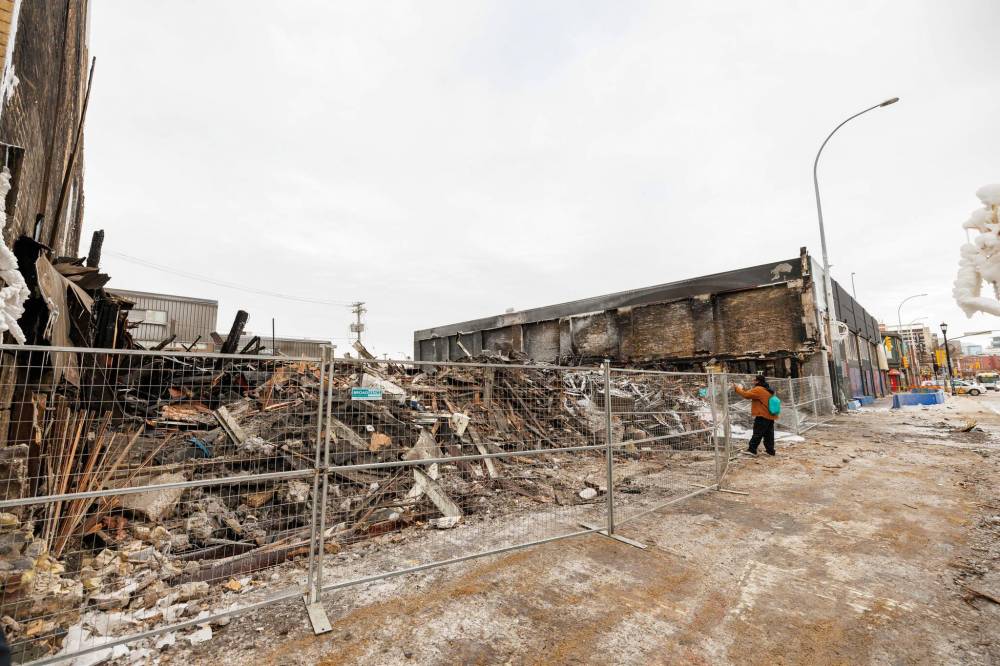
A person looks out over the piles of rubble that are all that remain of the site of the old Manwin Hotel the day after it burned to the ground.
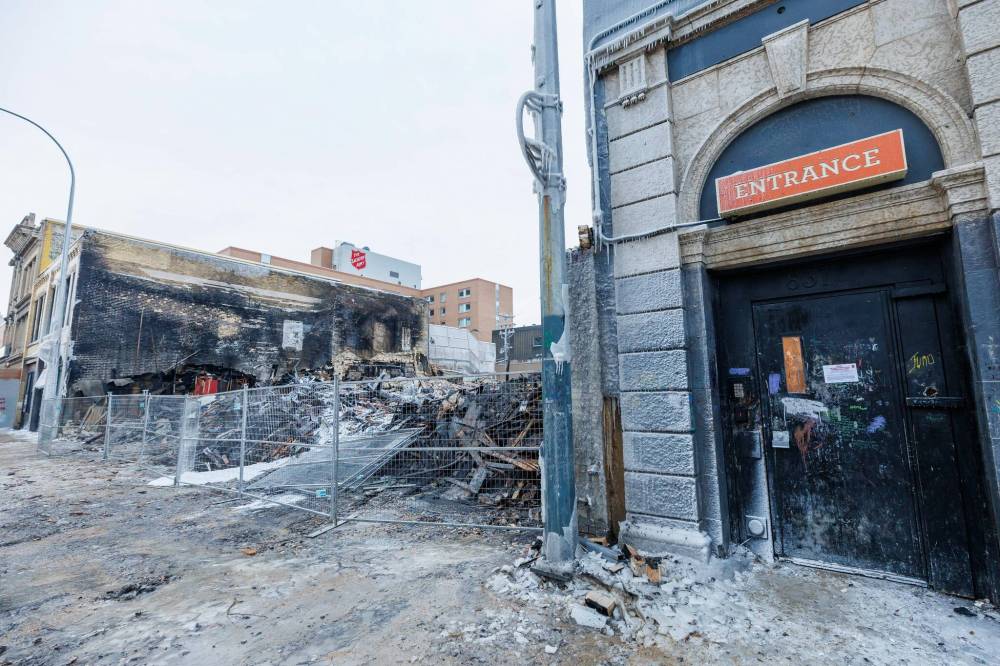
The Manwin Hotel — which was shuttered last year by the city, and its residents forced out — had functioned as a low-cost, if dilapidated, residence. It was located directly between two Main Street Project buildings: the organization’s emergency shelter at 637 Main St., and a second building at 661 Main St., which contained their food bank, admin offices and a clothing donation hub.
Cindy Titus, Main Street Project’s interim director of development, said Saturday that their emergency shelter suffered only minimal damage – just some water in the basement. Still, a company was brought in to do a deep clean of the space, including of the HVAC system, and on Friday, they were given the all-clear to resume operations. With the help of city buses, evacuated community members were brought back to the space.
The building at 661 Main St., however, did not come through the fire in the same condition, experiencing more extensive smoke and water damage. Most food and clothing donations will need to be thrown out, Titus said, describing it as a “big hit.” She expects it will be weeks before they will be able to return.
Amid the challenges, Titus said Manitobans have shown a “wonderful outpouring of support,” as have their community partners.
“Just acknowledging that it’s right after the holidays, and budgets might be tight for folks, if people can’t donate, going on our social media and engaging with our posts is super helpful,” Titus added.
Main Street Project’s posts about the fire have already been shared hundreds of times online.
Lisa Lewis, a lifelong Winnipegger and member of Animakee Wa Zhing #37, who runs a consulting company called Beyond Excellence, is one of the many people who’ve shared the organization’s posts – and recently donated herself.
“They’re supporting people using a harm reduction model, so they’re supporting people with dignity, and giving them more of the wraparound supports that they need,” Lewis said.
MIKE DEAL / FREE PRESS FILES
The Manwin Hotel was located between two Main Street Project buildings.And to have a downtown that’s safe for everyone, Lewis added, these supports are necessary.
“These are people’s lives, and they need some basic stuff,” she said. “They’re asking for blankets and hygiene products and menstrual products – they’re asking for some pretty basic stuff… even a small donation helps.”
Getting involved is something that Pearson wants more people to feel the benefit of.
“People do want to give back. They want to try to help out. Sometimes they don’t know how,” she said.
She invites anyone who’s interested to join them at Linking Hope, where the barrier to entry is low – no specific skills are necessary. Volunteers need not be able to haul heavy loads. They can sit, if need be.
Bell knows how it feels to be able to give back.
She herself became homeless for the first time several years ago, and stayed at N’Dinawemak, where she began volunteering for the organization, then working for them, as well as for Linking Hope and eventually, getting an apartment of her own again.
“To give back feels phenomenal, right? Like to be able to help folks, especially, because I was helped,” Bell said.
MARSHA MCLEOD / FREE PRESS
After distributing many of its winter jackets to those forced to evacuate the Main Street Project’s shelter on Wednesday morning, Linking Hope’s supply of weather-appropriate jackets is depleted.
“Even if you’ve never been homeless, to just kind of go, ‘oh, that’s somebody else’s problem,’ or ‘those are those people,’ or ‘those are meth heads,’ or just dehumanize it. But when you can do something active, like get out and volunteer, then you can see that there’s so much more going on behind the scenes.”
Helping hands
For those wanting to help, Main Street Project is asking for financial donations or support through its 50/50 raffle.
Gently used or new clothing – including jackets, boots and other winter gear like hats and mitts – as well as hygiene products, can be made through a temporary drop-off location at Siloam Mission at 300 Princess St.
Donations through Linking Hope are also welcome. These can be dropped off at N’Dinawemak’s front desk at 190 Disraeli Fwy. While many donations are currently headed to Main Street Project anyway, Winnipeggers can use a label to specify their donation is meant specifically for them.
Marsha McLeod
Investigative reporter
Signal
Marsha is an investigative reporter. She joined the Free Press in 2023.
Our newsroom depends on a growing audience of readers to power our journalism. If you are not a paid reader, please consider becoming a subscriber.
Our newsroom depends on its audience of readers to power our journalism. Thank you for your support.
Marsha McLeod
Investigative reporter
Signal
Marsha is an investigative reporter. She joined the Free Press in 2023.
Our newsroom depends on a growing audience of readers to power our journalism. If you are not a paid reader, please consider becoming a subscriber.
Our newsroom depends on its audience of readers to power our journalism. Thank you for your support.
Related Articles
Vacant Main Street hotel ‘total loss’ after overnight fire



Advertisement Advertise With Us
Advertisement Advertise With Us
History
Updated on Sunday, January 18, 2026 11:24 AM CST: Corrects photo captions