

Truth, lies and video fakes
Fewer than one in five Manitobans are sure they know fabricated online content when they see it, Probe-Free Press survey on media literacy reveals

Advertisement
Read this article for free:
or
Already have an account? Log in here »
To continue reading, please subscribe:
Digital Subscription
One year of digital access for only $75*
- Enjoy unlimited reading on winnipegfreepress.com
- Read the E-Edition, our digital replica newspaper
- Access News Break, our award-winning app
- Play interactive puzzles
*Billed as $5.77 plus GST every four weeks. After 52 weeks, price increases to the regular rate of $19.95 plus GST every four weeks. Offer available to new and qualified returning subscribers only. Cancel any time.
Monthly Digital Subscription
$4.99/week*
- Enjoy unlimited reading on winnipegfreepress.com
- Read the E-Edition, our digital replica newspaper
- Access News Break, our award-winning app
- Play interactive puzzles
*Billed as $19.95 plus GST every four weeks. Cancel any time.
To continue reading, please subscribe:
Add Free Press access to your Brandon Sun subscription for only an additional
$1 for the first 4 weeks*
- Enjoy unlimited reading on winnipegfreepress.com
- Read the E-Edition, our digital replica newspaper
- Access News Break, our award-winning app
- Play interactive puzzles
*Your next Brandon Sun subscription payment will increase by $1.00 and you will be charged $17.95 plus GST for four weeks. After four weeks, your payment will increase to $24.95 plus GST every four weeks.
Read unlimited articles for free today:
or
Already have an account? Log in here »
Hey there, time traveller!
This article was published 02/01/2026 (274 days ago), so information in it may no longer be current.
When Weekly World News stories about a half-boy, half-bat lined supermarket checkout lanes in the 1990s, most consumers — including Probe Research partner Curtis Brown — could readily, easily and confidently identify the eye-grabbing tabloid reports as false.
Bat boy appeared in the supermarket tabloid Weekly World News in the early 1990s.
“When it comes to (content generated by) AI, people have a bit less confidence,” says Brown. “Sometimes it’s very obviously so-called AI slop — like a historical figure talking about something contemporary. The last couple of months I’ve seen a lot of videos of JFK talking about what a fool his nephew is.”
Even if a quick Google search to note RFK Jr. was nine when his uncle was assassinated in 1963 — marking such videos as debris in an artificial intelligence mudslide — new media literacy polling conducted by Probe for the Free Press reveals that only 18 per cent of Manitobans feel very confident that they can identify whether video footage is “fake or AI-generated.”
Of the 1,000 Manitobans randomly surveyed by Probe between Nov. 25 and Dec. 10, 13 per cent believed that they’d personally shared video, images or text on social media that they didn’t realize was fake.
Brown, a former newspaper reporter, columnist and political commentator, says the proliferation of fake, unverified or AI-generated media could be an understandable symptom of society-wide trends toward more fragmented media consumption habits.
Unsurprisingly, Probe’s polling found that Manitobans aged 18-34 were most likely to get their news through social media videos (55 per cent) or written social media posts (53 per cent). That demographic group’s likelihood of turning to traditional media was comparatively low, with nearly three in 10 respondents using local broadcasts and online news websites to stay in the loop. Only 18 per cent of respondents in that age range relied on local radio stations or newspapers to receive their daily dose of information.
By contrast, respondents aged 55 and above still relied on traditional media, by and large, in order to keep up with news and current affairs: nearly two-thirds of that demographic group said they consumed content produced by local broadcasters, with about 56 per cent turning to other online news websites. The 35-54 age group typically falls in the middle of the two extremes.
“You have these huge generational gaps,” says Brown. “Young people aren’t reading the paper or watching the 6 o’clock news, and that’s really tricky in terms of having a shared set of facts or assumptions about the world.”
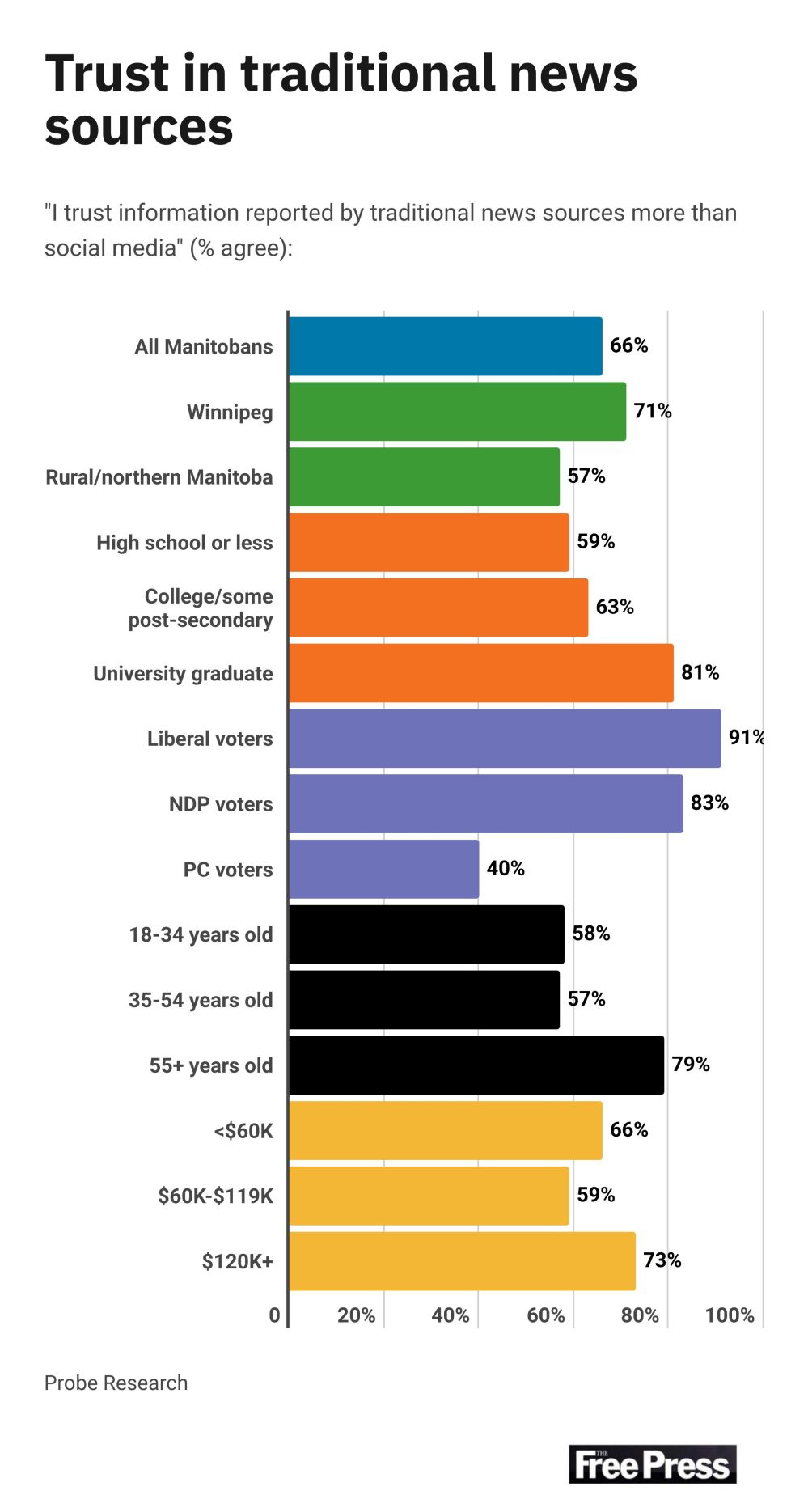
That idea is probably best exemplified by the respondents’ input when it came to media trust, a value that was clearly split across political, geographic, economic, educational and age-based variables.
Asked to agree or disagree with the statement, “I trust information reported by traditional news sources more than social media,” 71 per cent of Winnipeg residents agreed, as compared with 57 per cent of rural or northern Manitobans. As educational attainment and annual household salary increased so, too, did trust for traditional media, with 81 per cent of university graduates and 73 per cent of those earning more than $120,000 agreeing with the statement.
The majority of respondents who voted for the Liberal (91 per cent) or the New Democratic (85 per cent) parties trusted traditional news sources over social media. However, only 40 per cent of respondents who identified as Progressive Conservative voters shared that sentiment.
At the end of a year in which Canada and the United States engaged in a prolonged trade scuffle, most respondents said that they trusted Canadian-owned media outlets ahead of American counterparts.
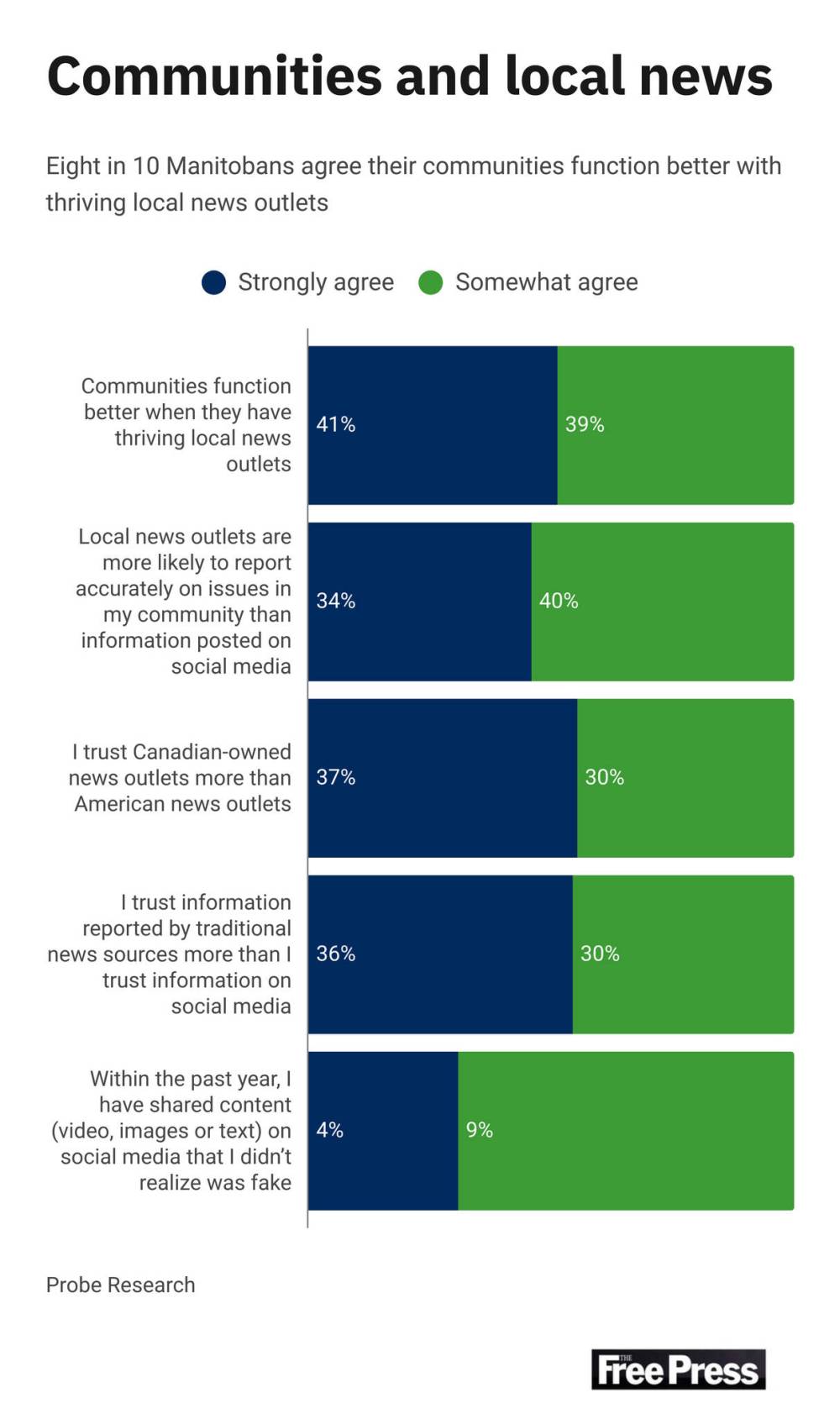
Those responses trended in the same pattern as those for the traditional vs. social media question, with Winnipeggers (75 per cent) putting their elbows up at a higher rate than rural or northern neighbours (54), and Liberal or NDP voters (92 and 85 per cent) more likely to trust domestic sources than their PC counterparts, 56 per cent of whom would choose American.
That said, eight in 10 Manitobans say that their communities function better with thriving local news outlets, pointing to a level of overall appreciation for the service that exceeds those outlets’ realized market reach. To Brown, that avowed support for local news highlights the disparity between what consumers actually do and what they say they do.
“I’m not surprised that people agree with a lot of the sentiments about the value of local news outlets,” he says. “Intrinsically, they’re going to say that they prefer thriving (news outlets), and that they’re most likely to trust Canadian (content) created and vetted by journalists as opposed to something Joe Blow said on social media. None of that surprises me.”
Brown, who started working with Probe in 2008, says the data mostly falls in line with expectations, but the societal divides in terms of trust, media consumption and social media habits provide a template for understanding how information is transmitted, received and interpreted now, and how it might be in the future.
winnipegfreepress.com/benwaldman
Ben Waldman is a National Newspaper Award-nominated reporter on the Arts & Life desk at the Free Press. Born and raised in Winnipeg, Ben completed three internships with the Free Press while earning his degree at Ryerson University’s (now Toronto Metropolitan University’s) School of Journalism before joining the newsroom full-time in 2019. Read more about Ben.
Every piece of reporting Ben produces is reviewed by an editing team before it is posted online or published in print — part of the Free Press‘s tradition, since 1872, of producing reliable independent journalism. Read more about Free Press’s history and mandate, and learn how our newsroom operates.
Our newsroom depends on a growing audience of readers to power our journalism. If you are not a paid reader, please consider becoming a subscriber.
Our newsroom depends on its audience of readers to power our journalism. Thank you for your support.
Ben Waldman is a National Newspaper Award-nominated reporter on the Arts & Life desk at the Free Press. Born and raised in Winnipeg, Ben completed three internships with the Free Press while earning his degree at Ryerson University’s (now Toronto Metropolitan University’s) School of Journalism before joining the newsroom full-time in 2019. Read more about Ben.
Every piece of reporting Ben produces is reviewed by an editing team before it is posted online or published in print — part of the Free Press‘s tradition, since 1872, of producing reliable independent journalism. Read more about Free Press’s history and mandate, and learn how our newsroom operates.
Our newsroom depends on a growing audience of readers to power our journalism. If you are not a paid reader, please consider becoming a subscriber.
Our newsroom depends on its audience of readers to power our journalism. Thank you for your support.

Advertisement Advertise With Us
Advertisement Advertise With Us
History
Updated on Tuesday, January 6, 2026 1:11 PM CST: Replaces graphic with new version (same data)