

Kinew pitching Indigenous Crown entity to review, approve economic projects

Advertisement
Read this article for free:
or
Already have an account? Log in here »
To continue reading, please subscribe:
Digital Subscription
One year of digital access for only $75*
- Enjoy unlimited reading on winnipegfreepress.com
- Read the E-Edition, our digital replica newspaper
- Access News Break, our award-winning app
- Play interactive puzzles
*Billed as $5.77 plus GST every four weeks. After 52 weeks, price increases to the regular rate of $19.95 plus GST every four weeks. Offer available to new and qualified returning subscribers only. Cancel any time.
Monthly Digital Subscription
$4.99/week*
- Enjoy unlimited reading on winnipegfreepress.com
- Read the E-Edition, our digital replica newspaper
- Access News Break, our award-winning app
- Play interactive puzzles
*Billed as $19.95 plus GST every four weeks. Cancel any time.
To continue reading, please subscribe:
Add Free Press access to your Brandon Sun subscription for only an additional
$1 for the first 4 weeks*
- Enjoy unlimited reading on winnipegfreepress.com
- Read the E-Edition, our digital replica newspaper
- Access News Break, our award-winning app
- Play interactive puzzles
*Your next Brandon Sun subscription payment will increase by $1.00 and you will be charged $17.95 plus GST for four weeks. After four weeks, your payment will increase to $24.95 plus GST every four weeks.
Read unlimited articles for free today:
or
Already have an account? Log in here »
Hey there, time traveller!
This article was published 08/08/2025 (445 days ago), so information in it may no longer be current.
The Manitoba government is proposing a new Crown corporation to proactively assemble Indigenous leaders for reviews and approvals of economic development projects.
Premier Wab Kinew started meeting with First Nations and Métis policy-makers in the spring to pitch a “Crown Indigenous corporation.”
“We need future generations of our people to know that, although we recognize and we stand firm in our treaty, we’re willing, at times, to compromise and to make accommodations… that make sense, and this might make sense,” said Derek Nepinak, chief of Minegoziibe Anishinabe, also known as Pine Creek First Nation.
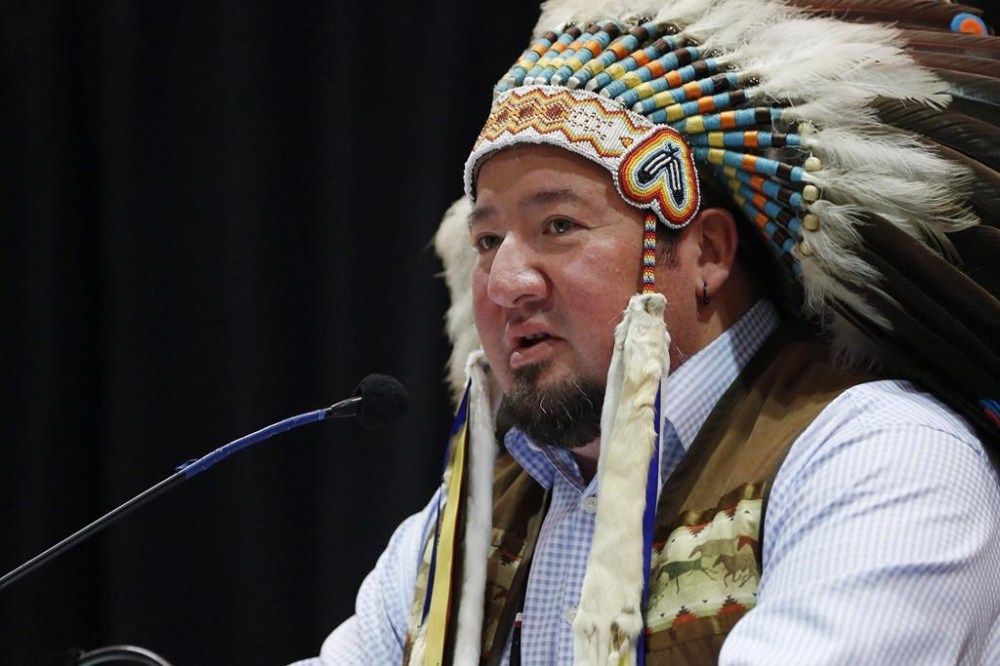
The corporation is not simply a board to discuss co-management, but rather one that would create revenue streams with concrete benefits for the Anishinaabe people, Nepinak said.
His initial understanding is that First Nations people would be represented on the governing board with just under half of all director seats.
Brainstorming is taking place against the backdrop of a Canada-United States trade war and Prime Minister Mark Carney’s related push to fund large-scale infrastructure projects.
Kinew’s office declined to comment on the initiative because of its early stage, but multiple sources confirmed the short-term goal is to secure federal dollars for local “nation-building” projects.
Such projects develop trade corridors, create good-paying unionized jobs and bolster Canada’s energy production and natural resource development, as per Bill C-5, the One Canadian Economy Act.
The federal legislation, a direct response to U.S. tariffs, allows cabinet to accelerate the approval of initiatives that fall into this category.
It received royal assent on June 26, despite pushback from Indigenous groups that have raised concerns projects could be rammed through without their meaningful input.
Exactly three months ago, Kinew penned a letter to the then-newly elected Carney to identify Manitoba’s top development-related priorities.
That list named expanding activity at the Port of Churchill, twinning the Trans-Canada Highway and fast-tracking exploration and extraction in the mineral-rich North.
“We can’t forget what’s at stake. We’re at war with the United States. Maybe it’s not a physical war where we’re shooting guns or rockets, but it is a war that could cause so much damage and could hurt a lot of people,” said David Chartrand, president of the Manitoba Métis Federation.
Chartrand, who oversees the MMF’s economic development ministry, said he’s worried about the growing financial stress his citizens and their neighbours are facing across the country.
There’s an urgency required to show Ottawa “we’re ready” as a province to undertake billion-dollar projects, he said.
As far as Chartrand is concerned, establishing a board-run entity with proactive, built-in consultation processes would do just that.
Pine Creek’s chief echoed those comments, although Nepinak has trepidations about how the CIC will operate and the potential for projects to negatively affect waterways.

He noted that consultation with Indigenous peoples who could be adversely affected by a nation-building project is explicitly spelled out in Bill C-5.
The Assembly of Manitoba Chiefs is meeting later this month to discuss what’s at stake with the Crown corporation concept.
Nepinak said his conflicting feelings are tied to First Nations maintaining they have unceded title to land and resources in their traditional territories, and that has not been affirmed by the province.
At the same time, government officials have extended an olive branch that could yield concrete benefits for Anishinaabe people, he said.
He suggested this particular partnership could prove to be one example where compromise makes sense, owing to its potential to drive revenue and bolster the Canadian economy during a particularly difficult time.
Nepinak said there’s potential to raise revenue not only through commodities that come of new ventures, but also procurement and taxation.
Manitoba Keewatinowi Okimakanak confirmed its involvement in meetings about the matter.
The Manitoba Inuit Association indicated its leadership team was aware of the proposal, but it had not been contacted directly to discuss it.
There are currently five Crown corporations in the province: Manitoba Hydro; Manitoba Public Insurance; Manitoba Liquor and Lotteries; Manitoba Centennial Centre Corp.; and Efficiency Manitoba.
maggie.macintosh@freepress.mb.ca
Maggie Macintosh
Education reporter
Maggie Macintosh reports on education for the Free Press. Originally from Hamilton, Ont., she first reported for the Free Press in 2017. Read more about Maggie.
Funding for the Free Press education reporter comes from the Government of Canada through the Local Journalism Initiative.
Every piece of reporting Maggie produces is reviewed by an editing team before it is posted online or published in print — part of the Free Press‘s tradition, since 1872, of producing reliable independent journalism. Read more about Free Press’s history and mandate, and learn how our newsroom operates.
Our newsroom depends on a growing audience of readers to power our journalism. If you are not a paid reader, please consider becoming a subscriber.
Our newsroom depends on its audience of readers to power our journalism. Thank you for your support.
Maggie Macintosh
Education reporter
Maggie Macintosh reports on education for the Free Press. Originally from Hamilton, Ont., she first reported for the Free Press in 2017. Read more about Maggie.
Funding for the Free Press education reporter comes from the Government of Canada through the Local Journalism Initiative.
Every piece of reporting Maggie produces is reviewed by an editing team before it is posted online or published in print — part of the Free Press‘s tradition, since 1872, of producing reliable independent journalism. Read more about Free Press’s history and mandate, and learn how our newsroom operates.
Our newsroom depends on a growing audience of readers to power our journalism. If you are not a paid reader, please consider becoming a subscriber.
Our newsroom depends on its audience of readers to power our journalism. Thank you for your support.
Related Articles
Looking for ‘nation-building’ projects? Here’s one






Advertisement Advertise With Us
Advertisement Advertise With Us