

Class-size data for Manitoba elementary schools to go online in fall

Advertisement
Read this article for free:
or
Already have an account? Log in here »
To continue reading, please subscribe:
Digital Subscription
One year of digital access for only $75*
- Enjoy unlimited reading on winnipegfreepress.com
- Read the E-Edition, our digital replica newspaper
- Access News Break, our award-winning app
- Play interactive puzzles
*Billed as $5.77 plus GST every four weeks. After 52 weeks, price increases to the regular rate of $19.95 plus GST every four weeks. Offer available to new and qualified returning subscribers only. Cancel any time.
Monthly Digital Subscription
$4.99/week*
- Enjoy unlimited reading on winnipegfreepress.com
- Read the E-Edition, our digital replica newspaper
- Access News Break, our award-winning app
- Play interactive puzzles
*Billed as $19.95 plus GST every four weeks. Cancel any time.
To continue reading, please subscribe:
Add Free Press access to your Brandon Sun subscription for only an additional
$1 for the first 4 weeks*
- Enjoy unlimited reading on winnipegfreepress.com
- Read the E-Edition, our digital replica newspaper
- Access News Break, our award-winning app
- Play interactive puzzles
*Your next Brandon Sun subscription payment will increase by $1.00 and you will be charged $17.95 plus GST for four weeks. After four weeks, your payment will increase to $24.95 plus GST every four weeks.
Read unlimited articles for free today:
or
Already have an account? Log in here »
Hey there, time traveller!
This article was published 02/02/2024 (992 days ago), so information in it may no longer be current.
Manitoba families will soon be able to scroll through elementary class sizes online as the province implements real-time reporting in its bid to hold school boards accountable to lowering teacher to student ratios.
Boards are expected to release the first round of data — class enrolment averages across kindergarten to Grade 8 — shortly after Sept. 30, the annual headcount day.
“I’m super happy. That’s incredible news, especially for the parents and the students of the younger kids right now,” said Tyler Rogers, a father of a sixth-grader at Winnipeg’s École Luxton School.
“Parents and children alike deserve that kind of accountability.”
This time last year, Rogers’ son was in a multi-age classroom with 34 peers — a crowded environment that the father said caused stress and anxiety among students and resulted in limited one-on-one instruction.
This week, the NDP government announced funding levels for the 2024-25 school year and the first phase of a new initiative to reduce class sizes.
The latter includes the creation of a $3-million fund to hire 30 teachers in boards with significant enrolment growth and updated disclosure requirements.
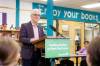
“We want to get to 20:1 with early-years learners (to certified teachers), and we want to ensure that school divisions are following through on that so we’re going to ask them to publicly report on that,” Education Minister Nello Altomare told reporters Thursday.
“We want to get to 20:1 with early-years learners (to certified teachers), and we want to ensure that school divisions are following through on that so we’re going to ask them to publicly report on that.”–Nello Altomare
Altomare said his vision is for all divisions to operate online dashboards similar to that of Louis Riel School Division.
LRSD, which encompasses St. Boniface and St. Vital, publishes school-level data on enrolment and class list averages. As of Friday, its website indicated the average class sizes for K-3 and Grades 4 to 8 were 21 and 24, respectively.
People for Public Education, a coalition of teachers, parents and members of the public who advocate for universally accessible and publicly funded schools, is raising concerns that reporting could create more competition and affect public perceptions about different schools.
“We want all public schools to be seen as places where families want to be sending their students,” said Melanie Janzen, a spokeswoman for the group and professor of education at the University of Manitoba.
School leaders take into account numbers as well as composition, meaning student personalities, differing needs and varying abilities, when they are creating lists.
While noting there is an abundance of research on smaller class size benefits in boosting academic success, increasing attendance, and improving social well-being and student attitudes towards school, Janzen said she is skeptical disclosures about class lists will encourage the above.
“If the purpose (of reporting requirements) is to lower class sizes then the mechanism to do that is through policy and legislation,” she said, adding she wants to know why the NDP government is not reinstating a cap.
“If the purpose (of reporting requirements) is to lower class sizes then the mechanism to do that is through policy and legislation.”–Melanie Janzen
In 2011, Manitoba’s then-NDP government announced it would cap kindergarten-to-Grade 3 classes at 20 students and roll out the ceiling provincewide within six years.
The Pallister government scrapped the requirement — a pillar of his predecessor’s education policies — ahead of the 2017-18 school year.
School divisions were asked to post K-3 class size counts when the cap was in effect.
Brenda Brazeau of the Manitoba Association of Parent Councils said she welcomes the return of mandatory reporting because it will benefit families as well as teachers since the public will have additional insight into the pressures they face.
“We know that sometimes teachers are overworked and stressed and can’t get to every child as much as they want to,” Brazeau said.
For Rogers, change cannot come soon enough. The Luxton father said he wants to see all boards — including the Winnipeg School Division, the largest of its kind and in which his son studies — start to compile and publish local data as soon as possible.
maggie.macintosh@freepress.mb.ca
Maggie Macintosh
Education reporter
Maggie Macintosh reports on education for the Free Press. Originally from Hamilton, Ont., she first reported for the Free Press in 2017. Read more about Maggie.
Funding for the Free Press education reporter comes from the Government of Canada through the Local Journalism Initiative.
Every piece of reporting Maggie produces is reviewed by an editing team before it is posted online or published in print — part of the Free Press‘s tradition, since 1872, of producing reliable independent journalism. Read more about Free Press’s history and mandate, and learn how our newsroom operates.
Our newsroom depends on a growing audience of readers to power our journalism. If you are not a paid reader, please consider becoming a subscriber.
Our newsroom depends on its audience of readers to power our journalism. Thank you for your support.
Maggie Macintosh
Education reporter
Maggie Macintosh reports on education for the Free Press. Originally from Hamilton, Ont., she first reported for the Free Press in 2017. Read more about Maggie.
Funding for the Free Press education reporter comes from the Government of Canada through the Local Journalism Initiative.
Every piece of reporting Maggie produces is reviewed by an editing team before it is posted online or published in print — part of the Free Press‘s tradition, since 1872, of producing reliable independent journalism. Read more about Free Press’s history and mandate, and learn how our newsroom operates.
Our newsroom depends on a growing audience of readers to power our journalism. If you are not a paid reader, please consider becoming a subscriber.
Our newsroom depends on its audience of readers to power our journalism. Thank you for your support.
Related Articles
Winnipeg School Division looking at 3.4% property-tax increase
Advertisement Advertise With Us
Advertisement Advertise With Us
History
Updated on Friday, February 2, 2024 5:58 PM CST: corrects typo