

French immersion entry rules eased
Province updates bilingual education policy

Advertisement
Read this article for free:
or
Already have an account? Log in here »
To continue reading, please subscribe:
Digital Subscription
One year of digital access for only $75*
- Enjoy unlimited reading on winnipegfreepress.com
- Read the E-Edition, our digital replica newspaper
- Access News Break, our award-winning app
- Play interactive puzzles
*Billed as $5.77 plus GST every four weeks. After 52 weeks, price increases to the regular rate of $19.95 plus GST every four weeks. Offer available to new and qualified returning subscribers only. Cancel any time.
Monthly Digital Subscription
$4.99/week*
- Enjoy unlimited reading on winnipegfreepress.com
- Read the E-Edition, our digital replica newspaper
- Access News Break, our award-winning app
- Play interactive puzzles
*Billed as $19.95 plus GST every four weeks. Cancel any time.
To continue reading, please subscribe:
Add Free Press access to your Brandon Sun subscription for only an additional
$1 for the first 4 weeks*
- Enjoy unlimited reading on winnipegfreepress.com
- Read the E-Edition, our digital replica newspaper
- Access News Break, our award-winning app
- Play interactive puzzles
*Your next Brandon Sun subscription payment will increase by $1.00 and you will be charged $17.95 plus GST for four weeks. After four weeks, your payment will increase to $24.95 plus GST every four weeks.
Read unlimited articles for free today:
or
Already have an account? Log in here »
Hey there, time traveller!
This article was published 05/05/2023 (1260 days ago), so information in it may no longer be current.
Manitoba is loosening rules around when students can enter French immersion and increasing the minimum number of credits required to graduate with a bilingual diploma.
This week, the education department unveiled the contents of its new immersion policy — a 50-page document that outlines best practices and expectations for schools that offer bilingual programming to learners whose first language is not French.
“When you go inside a French immersion school, you (shouldn’t) have to second-guess yourself. You have to know it’s a French immersion school because posters, everything around (is in the language),” said Kassy Assié, executive director of the Bureau de l’éducation française under Manitoba Education.
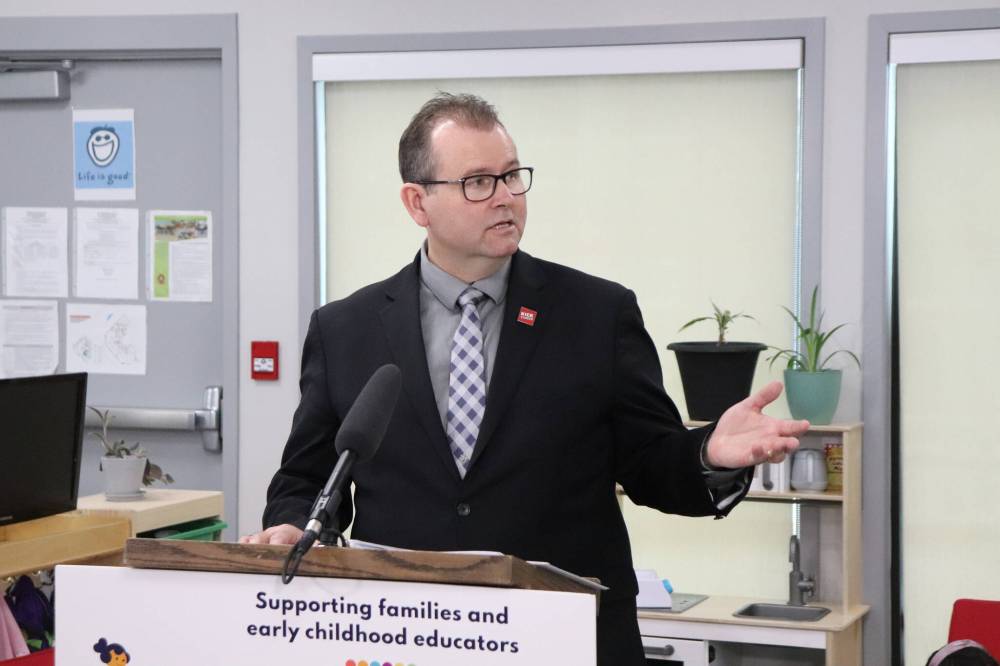
Education Minister Wayne Ewasko said enrolment in the special stream has grown by about 10,000 students across Manitoba since the government released its last immersion policy in 2008. (Tyler Searle / Winnipeg Free Press)
While Assié indicated the program can be implemented effectively in both single- and dual-track schools, the province’s updated policy recommends the former, in which all pupils are studying immersion, be introduced across kindergarten to Grade 12 “where viable.”
“Viable is understood to mean any school division where the student population is significant enough, there are enough schools to enable such a model, and the single-track model would meet the needs of the community,” per the document.
Twenty-four of Manitoba’s 37 public school divisions currently offer immersion to some extent.
Education Minister Wayne Ewasko said enrolment in the special stream has grown by about 10,000 students across Manitoba since the government released its last immersion policy in 2008.
“More and more parents and guardians are seeing the value in having their kids take up a second language and, in some cases, we’ve got newcomers coming in… and they’re wanting to learn yet another language,” Ewasko said.
The new guidelines are not as stringent as the old ones, he said, citing an excerpt that states his department encourages flexibility with regards to student entry or re-entry into immersion for equity’s sake.
Historically, elementary schools have only accepted new pupils into immersion in kindergarten or Grade 1. The other official entry points, which are offered in a limited number of divisions, are Grade 4 in middle years and Grade 6 or 7 for “late immersion.”
The province wants schools to start accepting students at any grade level, with consideration of their personal motivation, family support, bilingual abilities, and ability to provide appropriate academic and linguistic support.
French is the only language of instruction in kindergarten, but that changes as students get a better understanding of it throughout their schooling careers. It’s the language of instruction for 75 to 80 per cent of the time in grades 1 through 6. Between grades 7 and 8, at least 50 per cent of all lessons are delivered in it.
High school students must currently obtain a minimum of 14 French credits — out of at least 30 overall — to earn both a regular and immersion diploma.
That requirement is increasing by a single digit. Starting in 2024-25, incoming Grade 9 students will have to take 15 or more language credits, according to the province’s updated policy.
The local leader of Canadian Parents for French touted a universal entry point that recognizes students move between communities with differing access to immersion, newcomers’ right to access the program and COVID-19 disruptions.
However, Michael Hudon cautioned against making it even more difficult for rural and northern students to graduate with an immersion diploma.
Schools outside the Perimeter Highway grapple with recruiting and retaining bilingual staff and cannot provide as many French courses as their city counterparts, said Hudon, president of CPF’s Manitoba chapter.
The BEF’s recent review of bilingual instruction across Manitoba revealed significant discrepancies between schools, Assié said, noting the Louis Riel School Division has gone so far as to specifically hire French-speaking caretakers.
Assié’s office has developed tools to help principals evaluate and bolster their programs.
In order to create “proud, confident, engaged, plurilingual global citizens,” the policy states schools should facilitate formal and informal discussions in French, have prominent bilingual signage, and make specialty courses available in the language.
Concerns about students’ lacking confidence in their oral skills, known as “language insecurity,” is a hot topic in education circles, said Joël Ruest, an instructor at Saint Boniface University and PhD candidate at Laval University, where he is studying immersion graduates’ outcomes.
“Unfortunately, a problem that we have in education is we’re not giving kids the opportunity to speak in French. They’re being spoken to regularly — they hear a lot of French, but are they having all of those opportunities to speak in French?”
The researcher said he appreciates Manitoba’s updated policy is rooted in research, highlights the oral component of immersion, and debunks the myth a struggling student’s challenges will be fixed if they transfer to English.
maggie.macintosh@freepress.mb.ca
Twitter: @macintoshmaggie
Maggie Macintosh
Education reporter
Maggie Macintosh reports on education for the Free Press. Originally from Hamilton, Ont., she first reported for the Free Press in 2017. Read more about Maggie.
Funding for the Free Press education reporter comes from the Government of Canada through the Local Journalism Initiative.
Every piece of reporting Maggie produces is reviewed by an editing team before it is posted online or published in print — part of the Free Press‘s tradition, since 1872, of producing reliable independent journalism. Read more about Free Press’s history and mandate, and learn how our newsroom operates.
Our newsroom depends on a growing audience of readers to power our journalism. If you are not a paid reader, please consider becoming a subscriber.
Our newsroom depends on its audience of readers to power our journalism. Thank you for your support.
Maggie Macintosh
Education reporter
Maggie Macintosh reports on education for the Free Press. Originally from Hamilton, Ont., she first reported for the Free Press in 2017. Read more about Maggie.
Funding for the Free Press education reporter comes from the Government of Canada through the Local Journalism Initiative.
Every piece of reporting Maggie produces is reviewed by an editing team before it is posted online or published in print — part of the Free Press‘s tradition, since 1872, of producing reliable independent journalism. Read more about Free Press’s history and mandate, and learn how our newsroom operates.
Our newsroom depends on a growing audience of readers to power our journalism. If you are not a paid reader, please consider becoming a subscriber.
Our newsroom depends on its audience of readers to power our journalism. Thank you for your support.
Related Articles
Division pressured to save IB program




Advertisement Advertise With Us
Advertisement Advertise With Us