

Rocking the boats: river traffic increases in city

Advertisement
Read this article for free:
or
Already have an account? Log in here »
To continue reading, please subscribe:
Digital Subscription
One year of digital access for only $75*
- Enjoy unlimited reading on winnipegfreepress.com
- Read the E-Edition, our digital replica newspaper
- Access News Break, our award-winning app
- Play interactive puzzles
*Billed as $5.77 plus GST every four weeks. After 52 weeks, price increases to the regular rate of $19.95 plus GST every four weeks. Offer available to new and qualified returning subscribers only. Cancel any time.
Monthly Digital Subscription
$4.99/week*
- Enjoy unlimited reading on winnipegfreepress.com
- Read the E-Edition, our digital replica newspaper
- Access News Break, our award-winning app
- Play interactive puzzles
*Billed as $19.95 plus GST every four weeks. Cancel any time.
To continue reading, please subscribe:
Add Free Press access to your Brandon Sun subscription for only an additional
$1 for the first 4 weeks*
- Enjoy unlimited reading on winnipegfreepress.com
- Read the E-Edition, our digital replica newspaper
- Access News Break, our award-winning app
- Play interactive puzzles
*Your next Brandon Sun subscription payment will increase by $1.00 and you will be charged $17.95 plus GST for four weeks. After four weeks, your payment will increase to $24.95 plus GST every four weeks.
Read unlimited articles for free today:
or
Already have an account? Log in here »
Hey there, time traveller!
This article was published 16/07/2017 (3390 days ago), so information in it may no longer be current.
On a typical weekday, Gord Cartwright welcomes 200 passengers aboard his Splash Dash water bus, ferrying people between various points on the Red and Assiniboine rivers downtown.
That’s about 200 more than in any of the previous three years.
Cartwright, who owns Splash Dash River Tours Inc., has had to keep the water bus in drydock until this year because summer flooding washed out the docks and made the bus service unusable. He’s relied on his river tours, which aren’t dependent on water levels.
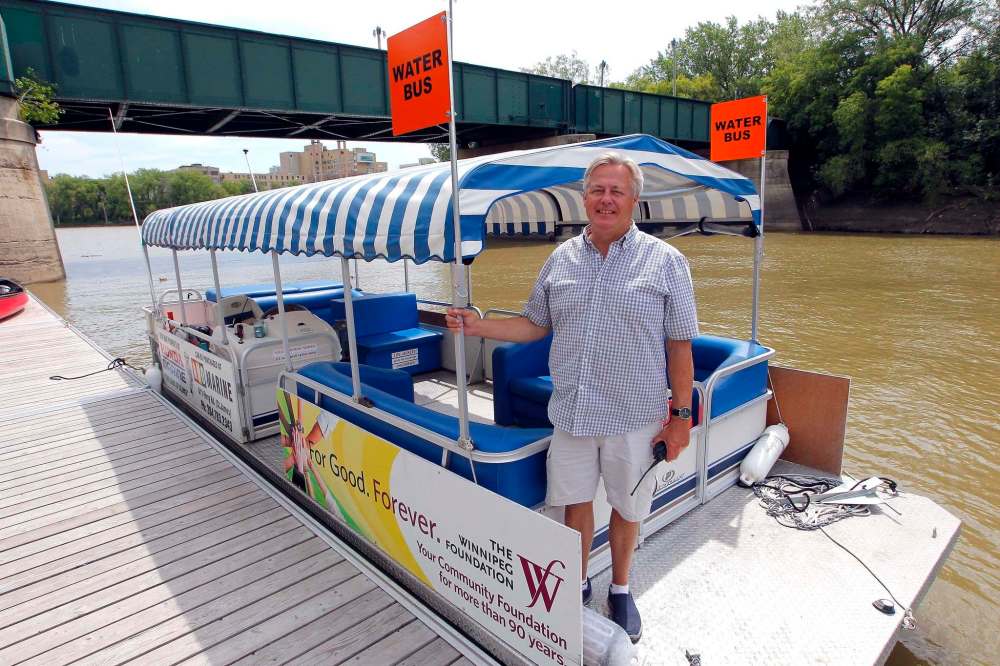
“The last two weeks of June weren’t that great, but yes, overall it’s a good year,” Cartwright said.
“My tours are very busy whether the water is high or low, but it’s the water bus that gets killed when the water goes over the walkway.”
After a number of years when river traffic in summer was devastated by flooding and fast current, Cartwright and Paul Jordan, CEO of The Forks Renewal Corp., have noticed Winnipeggers are getting back into the water in a big way.
Jordan has noticed traffic favours self-powered crafts such as canoes and kayaks, to the point The Forks is installing new docks specifically for the paddling crowd.
“You’ll see this happen… when I started back in the ’90s, there were 800 private boats on the rivers,” Jordan said. “Now there’s about 80. All those boats had private docks and those docks are gone. The big boats are now at Gimli or Kenora where they have a stable operating environment.”
Jordan said in normal years, the walkways are flooded in the spring and are back in operation by the summer. For the past three years, persistent high water has made it impossible to reinstall docks.
Jordan said the interest in canoes and kayaks is linked to two things, a societal shift towards improving fitness and the ease with which canoes and kayaks can be launched.
“People are starting to use it (the water) again. Saying that, we’re one flood away from it being wiped out again.”
Cartwright is frustrated by the inability to use the floodway to stabilize summer river levels. He said the addition of another operating protocol would keep the city’s rivers and walkways in use even during mild summer floods.
Jordan said “we missed the opportunity” during the last floodway expansion, when changes to the design could have added preserving summer river levels to the floodway’s mandate of protecting the city during massive flooding, such as in 1997.
Either way, Alf Warkentin, the province’s former flood forecaster, now retired, said using the floodway as Jordan and Cartwright would like is a political hot potato politicians are reluctant to grab.
“It’s a case of pitting the interests of property owners upstream of the floodway gate against recreational interests in the city,” he said.
Warkentin said when the floodway was built, the province instituted a “golden rule” that the floodway would not be used to raise river levels upstream “above normal levels.” Those normal levels are calculated multiple times a day and reflect what the water level would be given the volume of water flow and without operation of the various flood-control structures, such as the floodway, Portage diversion and Shellmouth reservoir.
“To violate that golden rule would be a big legal battle,” Warkentin said. “Someone’s ox is going to get gored.”
Warkentin said the idea of using the floodway to control summer river levels isn’t dead yet, but consideration has to be given to the market gardeners and property owners south of the city. It’s not possible to operate the floodway without at least partially flooding those lands, he said.
Adapting the floodway to regulate summer levels would also involve making it considerably deeper, “and that would be hundreds of millions of dollars,” he said.
“From a practical consideration, (regulating river levels in the city) might make sense,” Warkentin said.
An official with Manitoba Infrastructure, which operates the floodway, said operation of the floodway is governed by operating protocols that restrict operation to emergency use only, “and any alterations to rules, such as non-emergency summer use require public input and significant consultation with affected stakeholders.”
Effects to wildlife, riverbank erosion, upstream residents and erosion of the floodway itself would need to be part of those considerations, the official said.
Cartwright suggested another alternative: docks that can handle more than two feet of change in the river level. He said in bad years, the water can fluctuate as much as 12 feet.
kelly.taylor@freepress.mb.ca
Kelly Taylor
Copy Editor, Autos Reporter
Kelly Taylor is a copy editor and award-winning automotive journalist, and he writes the Free Press‘s Business Weekly newsletter. Kelly got his start in journalism in 1988 at the Winnipeg Sun, straight out of the creative communications program at RRC Polytech (then Red River Community College). A detour to the Brandon Sun for eight months led to the Winnipeg Free Press in 1989. Read more about Kelly.
Every piece of reporting Kelly produces is reviewed by an editing team before it is posted online or published in print — part of the Free Press‘s tradition, since 1872, of producing reliable independent journalism. Read more about Free Press’s history and mandate, and learn how our newsroom operates.
Our newsroom depends on a growing audience of readers to power our journalism. If you are not a paid reader, please consider becoming a subscriber.
Our newsroom depends on its audience of readers to power our journalism. Thank you for your support.
Kelly Taylor
Copy Editor, Autos Reporter
Kelly Taylor is a copy editor and award-winning automotive journalist, and he writes the Free Press‘s Business Weekly newsletter. Kelly got his start in journalism in 1988 at the Winnipeg Sun, straight out of the creative communications program at RRC Polytech (then Red River Community College). A detour to the Brandon Sun for eight months led to the Winnipeg Free Press in 1989. Read more about Kelly.
Every piece of reporting Kelly produces is reviewed by an editing team before it is posted online or published in print — part of the Free Press‘s tradition, since 1872, of producing reliable independent journalism. Read more about Free Press’s history and mandate, and learn how our newsroom operates.
Our newsroom depends on a growing audience of readers to power our journalism. If you are not a paid reader, please consider becoming a subscriber.
Our newsroom depends on its audience of readers to power our journalism. Thank you for your support.
Related Articles
New water taxi, tour operator enters space long held by Splash Dash
Advertisement Advertise With Us
Advertisement Advertise With Us