A Trump film tariff would send Canadian screen industry into ‘chaos,’ say local producers
Advertisement
Read this article for free:
or
Already have an account? Log in here »
To continue reading, please subscribe:
Digital Subscription
One year of digital access for only $75*
- Enjoy unlimited reading on winnipegfreepress.com
- Read the E-Edition, our digital replica newspaper
- Access News Break, our award-winning app
- Play interactive puzzles
*Billed as $5.77 plus GST every four weeks. After 52 weeks, price increases to the regular rate of $19.95 plus GST every four weeks. Offer available to new and qualified returning subscribers only. Cancel any time.
Monthly Digital Subscription
$4.99/week*
- Enjoy unlimited reading on winnipegfreepress.com
- Read the E-Edition, our digital replica newspaper
- Access News Break, our award-winning app
- Play interactive puzzles
*Billed as $19.95 plus GST every four weeks. Cancel any time.
To continue reading, please subscribe:
Add Free Press access to your Brandon Sun subscription for only an additional
$1 for the first 4 weeks*
- Enjoy unlimited reading on winnipegfreepress.com
- Read the E-Edition, our digital replica newspaper
- Access News Break, our award-winning app
- Play interactive puzzles
*Your next Brandon Sun subscription payment will increase by $1.00 and you will be charged $17.95 plus GST for four weeks. After four weeks, your payment will increase to $24.95 plus GST every four weeks.
Read unlimited articles for free today:
or
Already have an account? Log in here »
Hey there, time traveller!
This article was published 05/05/2025 (519 days ago), so information in it may no longer be current.
When Daniel Bekerman set out to produce “The Apprentice” — last year’s biopic about U.S. President Donald Trump — he figured some controversy might come from the subject, not the city it was filmed in.
But the Toronto-shot film is now an example of the kind of international production that would be hit hardest by Trump’s proposed full-scale tariff on foreign-made movies.
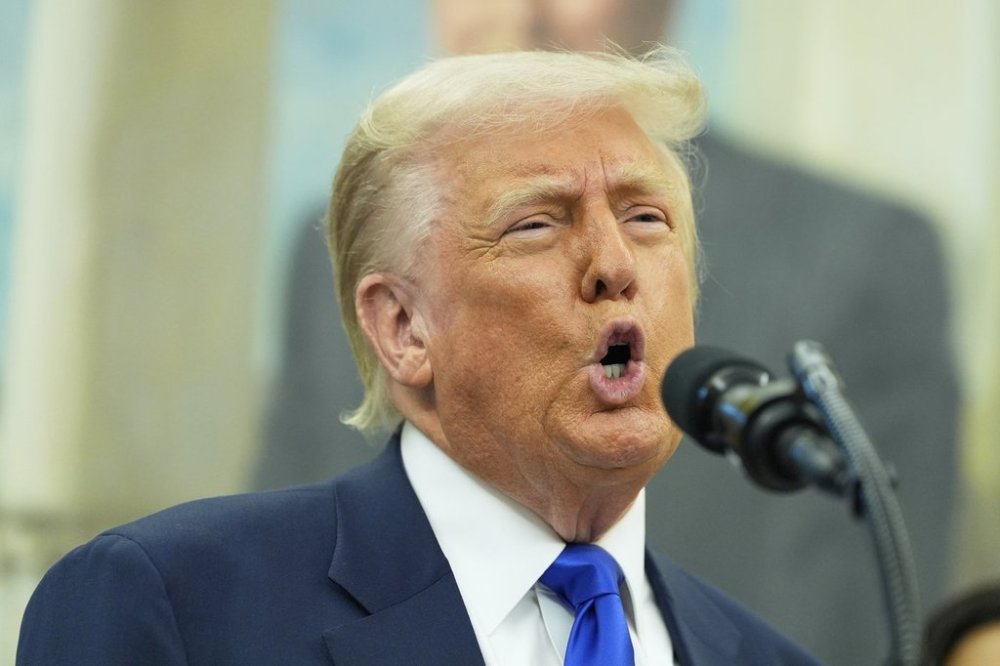
In a social media post Sunday, Trump said he’s authorized trade officials to impose a “100 per cent tariff” on all films produced outside of the United States, claiming the American movie industry is dying a “very fast death” due to the incentives other countries are offering to lure filmmakers.
Many Hollywood projects are shot in Canada, where foreign-funded movies and TV shows make up about half of all output.
The Canadian Media Producers Association pegs the value of foreign productions last year at $4.73 billion, creating more than 90,000 jobs.
Bekerman is among several insiders who say Trump’s proposed tariff on foreign-made films could send Canada’s screen industry into “chaos,” though most believe the plan is unlikely to ever be implemented.
“The worst version of this could change the shape of the industry and my livelihood,” says the Toronto-based producer and founder of Scythia Films.
Still, Bekerman notes Trump has retracted several other tariff threats in recent months.
“I think he’s proving himself to be someone who you can’t necessarily rely on what he says to be followed through on. With that level of unpredictability, the only really rational course is to hold steady, solidify all your partnerships and make sure that you’re making good product that people want.”
Meanwhile, Noah Segal, the co-president of Canadian film distributor Elevation Pictures, says he’s both “concerned and dumbfounded” by Trump’s announcement, adding he can’t see any practical way the tariff could be applied.
“It’s getting harder and harder to make films and shows, and make them make sense so that you can release it and make money,” says Segal, adding that the local industry has faced several hurdles lately, from the pandemic to the Hollywood strikes.
“So I would suspect if something like this (tariff) comes along, there’d be a lessening of production and there would be a slowdown, which is never good for anybody.”
Segal says Trump’s tariff threat underlines the importance of Bill C-11, which requires foreign streaming platforms to allocate five per cent of their Canadian revenues to a fund dedicated to supporting Canadian content. Later this month, the CRTC will hold a public hearing to help define what “Canadian content” means.
“There’s a lot of jobs out there that would be lost if the broad swath of Trump’s initial comment was taken (seriously),” says Segal, whose company Elevation has released Canadian films including 2023’s tech drama “BlackBerry” and cartoon “PAW Patrol: The Mighty Movie.”
“But we’re in a position to make really good content and we have a good internal structure that can help Canada buffer some of those blows by leaning into ‘elbows up.'”
Canada Media Producers Association president and CEO Reynolds Mastin says in a statement that Trump’s proposed tariff would “cause significant disruption and economic hardship to the media production sectors on both sides of the Canada-US border.”
He adds the uncertainty caused by Trump’s announcement underscores the “incredible importance of ensuring that Canada has a strong, independent domestic media industry.”
It’s still unclear when or how the tax would take effect, but U.S. Commerce Secretary Howard Lutnick replied to Trump’s post saying, “We’re on it.”
Media expert Charlie Keil believes Trump’s film tariff would be very hard to implement.
“If you go to a movie theatre, is there going to be differential ticket pricing? If it’s a film that has a tariff slapped on it, are you going to pay more as a consumer for that film? The whole principle of going to a theatre is you just pay a single ticket price,” says Keil, a cinema studies professor at the University of Toronto.
“I think theatre owners will have to sort of absorb that cost and they won’t be happy about that. I can assure you that Trump did not in any way consult with the national theatre owners of America before he put this out into the internet sphere.”
In 2023, nearly half of the spending by American producers on movie and TV projects with budgets exceeding $40 million went outside the U.S., according to research firm ProdPro.
Canadian politicians have been swift to react to Trump’s threats, with B.C. premier David Eby urging the province’s film industry not to panic.
“The president tweets a lot of stuff. The implementation challenges of this are profound and (it’s) hard to understand how this would work,” Eby said during a news conference Monday.
Eby added B.C.’s film industry is “strong and growing,” with HBO’s hit series “The Last of Us” signing on to shoot another season in the province.
Bekerman, who has worked on several co-productions with American companies, says he hopes to see Hollywood succeed, but he’s skeptical Trump truly wants the same.
“He’s trying to tell a story about himself and his own reputation rather than actually trying to create good outcomes for American workers.”
This report by The Canadian Press was first published May 5, 2025.