Stage-fighting the system in touching madcap comedy
Read this article for free:
or
Already have an account? Log in here »
To continue reading, please subscribe:
Digital Subscription
One year of digital access for only $75*
- Enjoy unlimited reading on winnipegfreepress.com
- Read the E-Edition, our digital replica newspaper
- Access News Break, our award-winning app
- Play interactive puzzles
*Billed as $5.77 plus GST every four weeks. After 52 weeks, price increases to the regular rate of $19.95 plus GST every four weeks. Offer available to new and qualified returning subscribers only. Cancel any time.
Monthly Digital Subscription
$4.99/week*
- Enjoy unlimited reading on winnipegfreepress.com
- Read the E-Edition, our digital replica newspaper
- Access News Break, our award-winning app
- Play interactive puzzles
*Billed as $19.95 plus GST every four weeks. Cancel any time.
To continue reading, please subscribe:
Add Free Press access to your Brandon Sun subscription for only an additional
$1 for the first 4 weeks*
- Enjoy unlimited reading on winnipegfreepress.com
- Read the E-Edition, our digital replica newspaper
- Access News Break, our award-winning app
- Play interactive puzzles
*Your next Brandon Sun subscription payment will increase by $1.00 and you will be charged $17.95 plus GST for four weeks. After four weeks, your payment will increase to $24.95 plus GST every four weeks.
Read unlimited articles for free today:
or
Already have an account? Log in here »
Hey there, time traveller!
This article was published 06/02/2026 (240 days ago), so information in it may no longer be current.
One of Winnipeg’s funniest playwrights and an ensemble of five of the city’s strongest comic actors spin gold from parental rage in Holland, a guns-blazing production full of righteously madcap decision-making at the Tom Hendry Warehouse.
Theatre review
Holland
By Trish Cooper
● Tom Hendry Warehouse, 140 Rupert Ave.
● To Feb. 21
★★★★½ out of five
In the latest work by Trish Cooper — directed by Suzie Martin with loose, screwball energy — Carrie and Paul Jacobs (Jessy Ardern and Daniel Bogart) have a lot of nits to pick. For years, Carrie, an artist and restaurant server, and Paul, a contract tradesman, have bitten their tongues when advocating for equitable treatment for their son, Daniel, who has cerebral palsy.
Nothing — not an accessible elevator, an experimental medication or even a registration to badminton camp — is a given, and neither parent can abide the bureaucratic rigamarole much longer.
Getting additional respite funding allocated to their household feels like a Herculean labour, and their assigned social worker Alice Carter (Jennifer Lyon) is cast by Cooper as the figurehead of the systemic hydra.
Ahead of an early meeting with Alice, Carrie warns Paul to keep his cool; as soon as the couple reaches her office, it’s easy to see why. Lyon’s social worker is passive aggressive and patronizing, reminding her guests that the decisions to be made aren’t hers alone before flatly denying their no-brainer request for a few extra dollars each month to cut into exorbitant monthly parking fees incurred while shepherding Daniel from clinician to clinician.
“Our mandate isn’t to support the parking business,” says Alice. “It is to support the children.”
Outfitted in soft textures by designer Daina Leitold, Lyon dresses her character up to dither between self-importance and utter impotence: even if she wants to help, there’s only so much she can do, my dear.
JOHN WOODS / WINNIPEG FREE PRESS Jennifer Lyon (left) and Jessy Ardern tussle over paperwork in the madcap comedy Holland.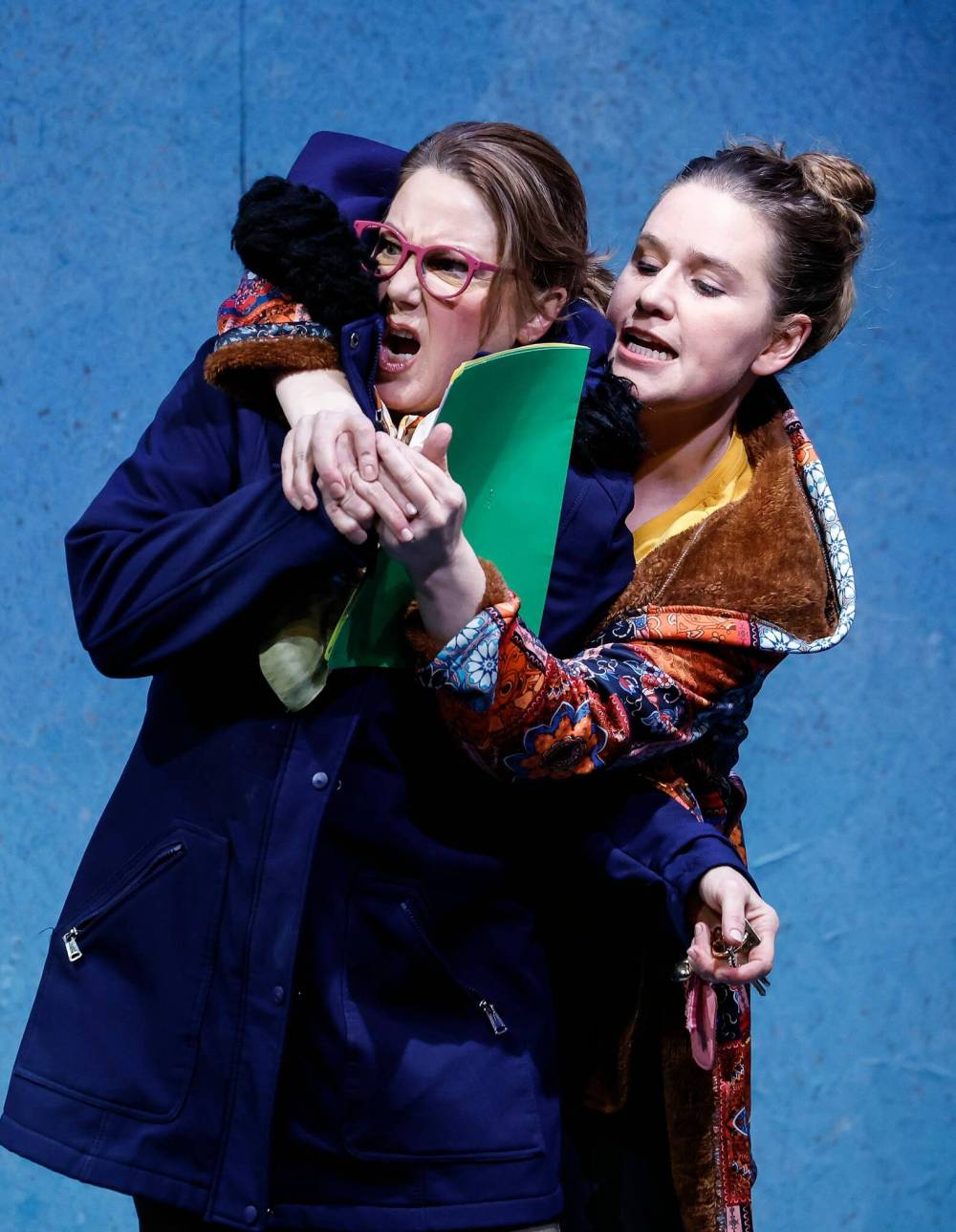
By contrast, Carrie’s patchwork jacket and ketchup-splattered jeans, along with Paul’s vintage skateboarding T-shirt, signify a punkish, battle-worn couple who aren’t exactly afraid of a justified scrap. Her legs bouncing up and down, Ardern’s initial embodiment of Carrie is defined by restraint and self-control.
That serves as the pivot point for Cooper’s characters: how long does it take before stoicism gives way to liberated choices, before a repressed desire for justice transforms into chaotic, emotional vigilantism?
Once Cooper unlatches the bullpen door, she allows Carrie to momentarily see red. All Carrie wants is for Alice to sign a few pesky forms; soon, the hockey mom is staring through balaclava eyeholes at potential kidnapping charges and taking far too many late-night trips to Shoppers for Paul to lack suspicion.
“Paul… babe… I did a terrible thing,” Carrie says late in the first act. “Or an amazing thing.”
It’s a simple, but revealing line of dialogue that highlights the parents’ defining moral dilemma, while echoing and skewering the type of perspective shifting espoused in Alice’s favourite analogy — infuriating to the Jacobses, but meant by the social worker to reassure families that their lives need not be negatively affected by their children’s disabilities.
JOHN WOODS / WINNIPEG FREE PRESS As parents Paul and Carrie, Daniel Bogart and Jessy Ardern battle bureaucracy on behalf of their son with cerebral palsy.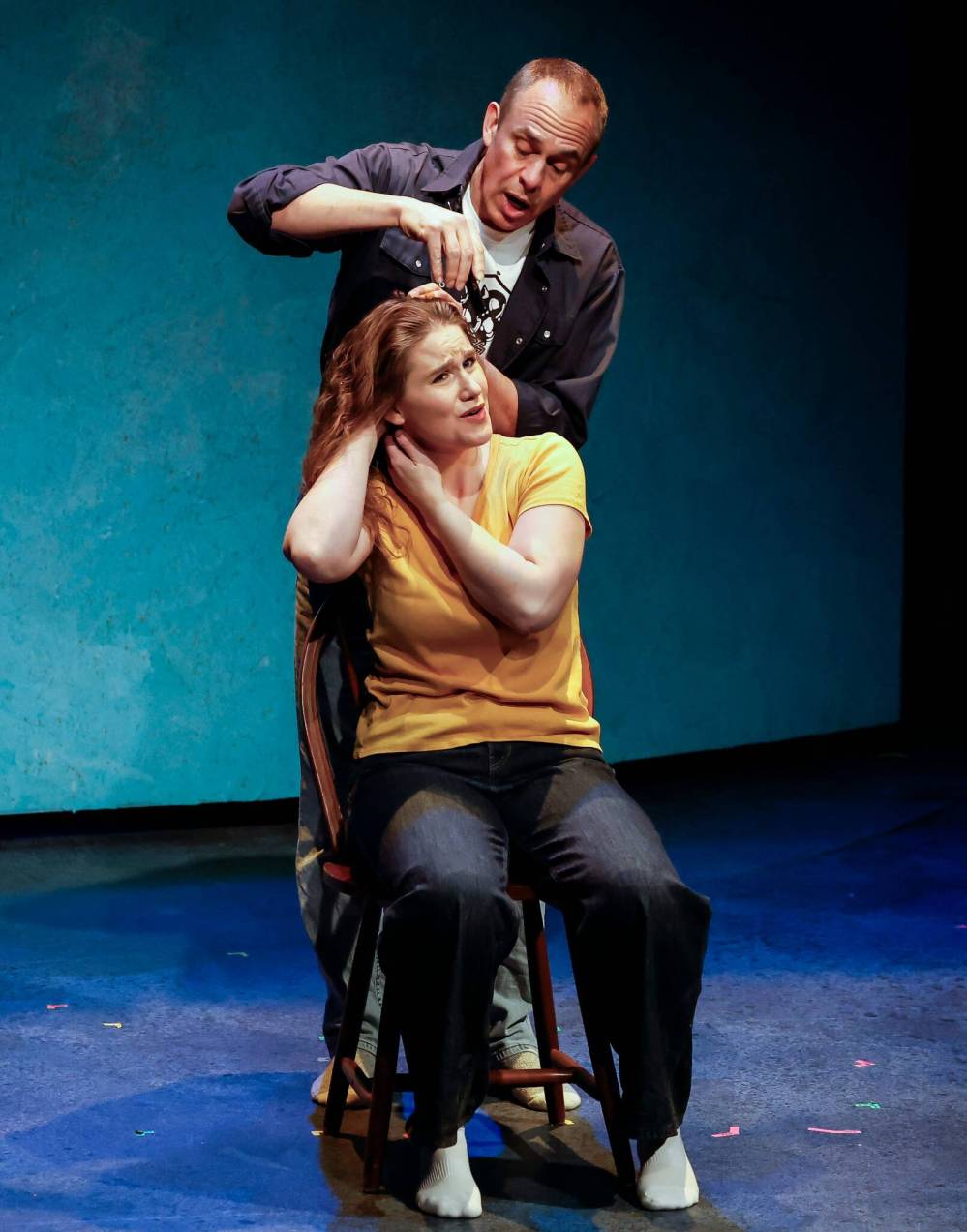
In the Holland analogy, based on a 1987 essay by Emily Pearl Kingsley about raising a son with Down syndrome, instead of a planned vacation in Venice, you unexpectedly wind up in Amsterdam and “if you spend your life mourning the fact that you didn’t get to Italy, you may never be free to enjoy the very special, the very lovely things … about Holland.”
What transpires next in this revenge-fuelled bonanza could easily have been transplanted from an evening of Winnipeg Pro Wrestling, requiring inspired combat choreography by Jacquie Loewen, who helps the actors weaponize everything from a paint brush to a bedpan.
Though the play’s joke-per-minute rate is high, the post-kidnapping interactions between Carrie and Alice are sensitively built.
In Carrie’s art studio, Alice — hands once figuratively tied and now physically bound — becomes completely reliant on her captor for food, access to the restroom, recreation supplies or a breath of fresh air. Carrie has too much humanity to withhold those privileges for too long, but Ardern hesitates just enough to remain both erratic and complex.
This change-up calls to mind the isolation and helplessness often engendered by social support systems that are critically underfunded, understaffed and often paternalistically managed.
It also calls to mind the very recent history when children with disabilities were cut off from their families and institutionalized. Even in captivity, where she gets a bitter taste of her own medicine, Alice is the beneficiary of a remarkably low clinician-to-client ratio.
JOHN WOODS / WINNIPEG FREE PRESS Daniel Bogart (left), Jessy Ardern, Toby Hughes and Jennifer Lyon argue about respite funding in a heated meeting that leads to a kidnapping.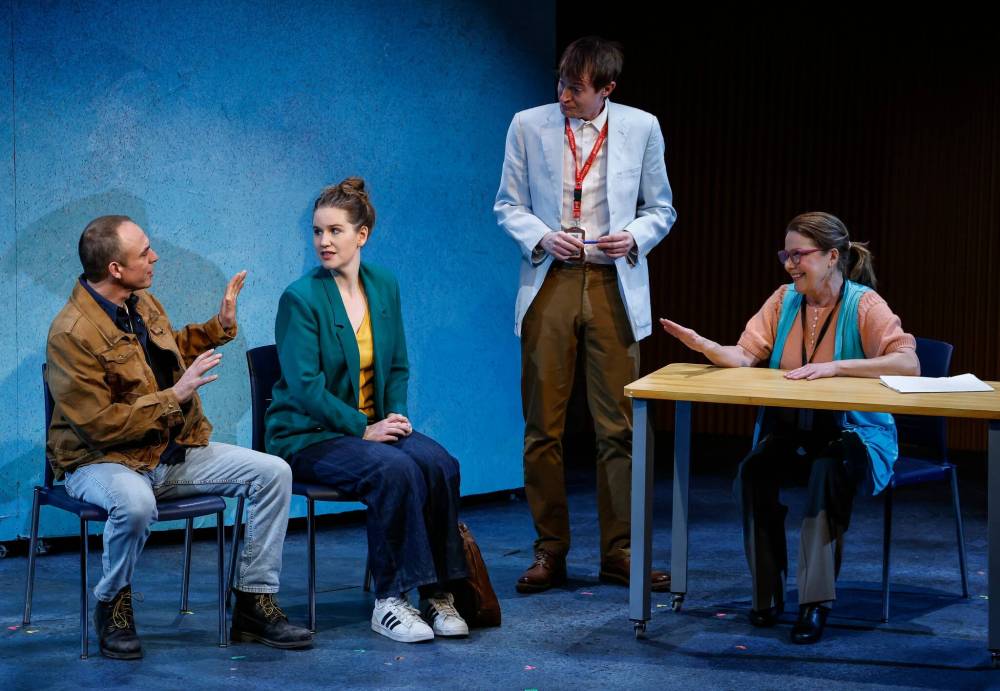
While Ardern, Bogart and especially Lyon craft characters who feel unpredictable yet completely inevitable, director Martin’s production is rounded out by two of the city’s best comic athletes, Outside Joke improv teammates Jane Testar and Toby Hughes, in crucial supporting roles, including soccer moms and hapless police detectives.
As Paul’s sad-sack friend Rudy, Hughes is a constant reminder of the Jacobses’ patience, while he and Testar keep the laughs rolling during asides from Carrie’s parental support group on Facebook. Testar’s character work is spit-take hilarious, especially as Minnedosa’s Gladys McNabb, a lovely, unintentionally funny woman who shares memories of raising her disabled child in the 1960s.
These transitions, along with composer Daniel Roy’s jittery, kinetic score — created in part with gym-class “boomwhacker” tubes — help keep Cooper’s narrative on course, while serving as a reminder to Carrie and Paul that their struggle isn’t solitary, but shared by hundreds of thousands of households across the globe.
It’s probably best to leave the nailgun in the toolshed, but Cooper’s social comedy makes it clear that revolution is often worth a shot.
winnipegfreepress.com/benwaldman

Ben Waldman is a National Newspaper Award-nominated reporter on the Arts & Life desk at the Free Press. Born and raised in Winnipeg, Ben completed three internships with the Free Press while earning his degree at Ryerson University’s (now Toronto Metropolitan University’s) School of Journalism before joining the newsroom full-time in 2019. Read more about Ben.
Every piece of reporting Ben produces is reviewed by an editing team before it is posted online or published in print — part of the Free Press‘s tradition, since 1872, of producing reliable independent journalism. Read more about Free Press’s history and mandate, and learn how our newsroom operates.
Our newsroom depends on a growing audience of readers to power our journalism. If you are not a paid reader, please consider becoming a subscriber.
Our newsroom depends on its audience of readers to power our journalism. Thank you for your support.