

S&P/TSX composite finishes lower, U.S. markets drop
Advertisement
Read this article for free:
or
Already have an account? Log in here »
To continue reading, please subscribe:
Digital Subscription
One year of digital access for only $75*
- Enjoy unlimited reading on winnipegfreepress.com
- Read the E-Edition, our digital replica newspaper
- Access News Break, our award-winning app
- Play interactive puzzles
*Billed as $5.77 plus GST every four weeks. After 52 weeks, price increases to the regular rate of $19.95 plus GST every four weeks. Offer available to new and qualified returning subscribers only. Cancel any time.
Monthly Digital Subscription
$4.99/week*
- Enjoy unlimited reading on winnipegfreepress.com
- Read the E-Edition, our digital replica newspaper
- Access News Break, our award-winning app
- Play interactive puzzles
*Billed as $19.95 plus GST every four weeks. Cancel any time.
To continue reading, please subscribe:
Add Free Press access to your Brandon Sun subscription for only an additional
$1 for the first 4 weeks*
- Enjoy unlimited reading on winnipegfreepress.com
- Read the E-Edition, our digital replica newspaper
- Access News Break, our award-winning app
- Play interactive puzzles
*Your next Brandon Sun subscription payment will increase by $1.00 and you will be charged $17.95 plus GST for four weeks. After four weeks, your payment will increase to $24.95 plus GST every four weeks.
Read unlimited articles for free today:
or
Already have an account? Log in here »
Hey there, time traveller!
This article was published 07/07/2025 (420 days ago), so information in it may no longer be current.
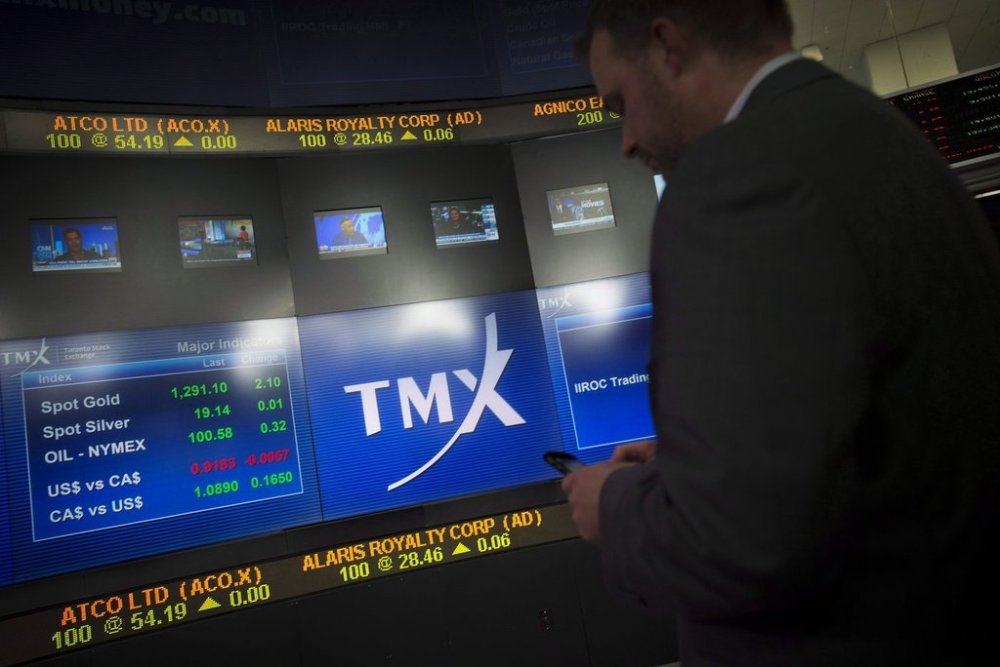
TORONTO – Canada’s main stock index finished lower, driven partly by weakness in real estate stocks, as U.S. markets fell.
The S&P/TSX composite index was down 15.88 points at 27,020.28.
Ryan Crowther, a portfolio manager at Franklin Templeton’s ClearBridge Investments, said in an interview that Monday’s trading session marked a “soft start to the week.”
“Canadian markets (were) weak pretty much across the board on the back of tariffs being reintroduced into the newsfeed today. Obviously, this is not a resolved situation,” he said.
“It’s not something where we should be necessarily worrying about tariffs more today than we were over the past several trading days or weeks. But as the news has resurfaced, investors are forced to digest the potential impact of tariffs and obviously, for Canadian investors, this is front and centre.”
Overall, Crowther said markets experienced a “textbook risk-off day.”
In New York, the Dow Jones industrial average was down 422.17 points at 44,406.36. The S&P 500 index was down 49.37 points at 6,229.98, while the Nasdaq composite was down 188.59 points at 20,412.52.
U.S. stocks declined on Monday as the White House stepped up pressure on major trading partners to make deals before punishing tariffs imposed by the U.S. take effect. U.S. President Donald Trump’s administration released letters informing Japan and South Korea that their goods will be taxed at 25 per cent starting on Aug. 1, citing persistent trade imbalances with the two crucial American allies in Asia.
U.S. Commerce Secretary Howard Lutnick said Sunday that if countries don’t make a deal, the duties would go into effect Aug. 1, which would leave additional time for negotiations compared with the previous July 9 deadline.
Canada was not included in those global tariffs and has committed to coming up with some sort of bilateral deal with the U.S. by July 21.
Canada is still being hit with fentanyl-related tariffs. Those 25 per cent levies, with a lower 10 per cent tax on energy and potash, only apply to exports not compliant with the Canada-U.S.-Mexico Agreement on trade. Canada is also being hit with Trump’s tariffs on steel, aluminum and automobiles.
For investors, Crowther said it’s important to contemplate the broader impacts of tariffs, even though there isn’t enough information to make a detailed assessment.
“We do know that we have potential macroeconomic impacts that could worsen as the year progresses,” Crowther said.
“We also know that we already have impacts on businesses in Canada that have, for example, curtailed capital expenditures, and in consideration of the potential impact of tariffs, have put capital expenditures on hold. This has obvious economic implications both at the company level, and that flows through into valuations and stock prices.”
Going into earnings season for the third quarter, he noted investors should keep a close eye on valuations.
“So we would hope that investors are thinking about valuation and thinking about what risks, whether it’s risks related to tariffs or just general business risks, are being priced into equities,” Crowther said.
“I believe there are still great investment opportunities for Canadian investors. It’s just important to be mindful of what you’re paying for and what’s discounted in.”
The Canadian dollar traded for 73.23 cents US compared with 73.50 cents US on Friday.
The August crude oil contract was up 93 cents US at US$67.93 per barrel.
The August gold contract was down 10 cents US at US$3,342.80 an ounce.
This report by The Canadian Press was first published July 7, 2025.
-With files from The Associated Press.
Companies in this story: (TSX:GSPTSE, TSX:CADUSD)
Related Articles
Trump sets 25% tariffs on Japan and South Korea, and new import taxes on 12 other nations
Advertisement Advertise With Us
Advertisement Advertise With Us