
Village voice Eric the Great a one-man Winnipeg institution
Read this article for free:
or
Already have an account? Log in here »
To continue reading, please subscribe:
Digital Subscription
One year of digital access for only $75*
- Enjoy unlimited reading on winnipegfreepress.com
- Read the E-Edition, our digital replica newspaper
- Access News Break, our award-winning app
- Play interactive puzzles
*Billed as $5.77 plus GST every four weeks. After 52 weeks, price increases to the regular rate of $19.95 plus GST every four weeks. Offer available to new and qualified returning subscribers only. Cancel any time.
Monthly Digital Subscription
$4.99/week*
- Enjoy unlimited reading on winnipegfreepress.com
- Read the E-Edition, our digital replica newspaper
- Access News Break, our award-winning app
- Play interactive puzzles
*Billed as $19.95 plus GST every four weeks. Cancel any time.
To continue reading, please subscribe:
Add Free Press access to your Brandon Sun subscription for only an additional
$1 for the first 4 weeks*
- Enjoy unlimited reading on winnipegfreepress.com
- Read the E-Edition, our digital replica newspaper
- Access News Break, our award-winning app
- Play interactive puzzles
*Your next Brandon Sun subscription payment will increase by $1.00 and you will be charged $17.95 plus GST for four weeks. After four weeks, your payment will increase to $24.95 plus GST every four weeks.
Read unlimited articles for free today:
or
Already have an account? Log in here »
Hey there, time traveller!
This article was published 17/06/2024 (822 days ago), so information in it may no longer be current.
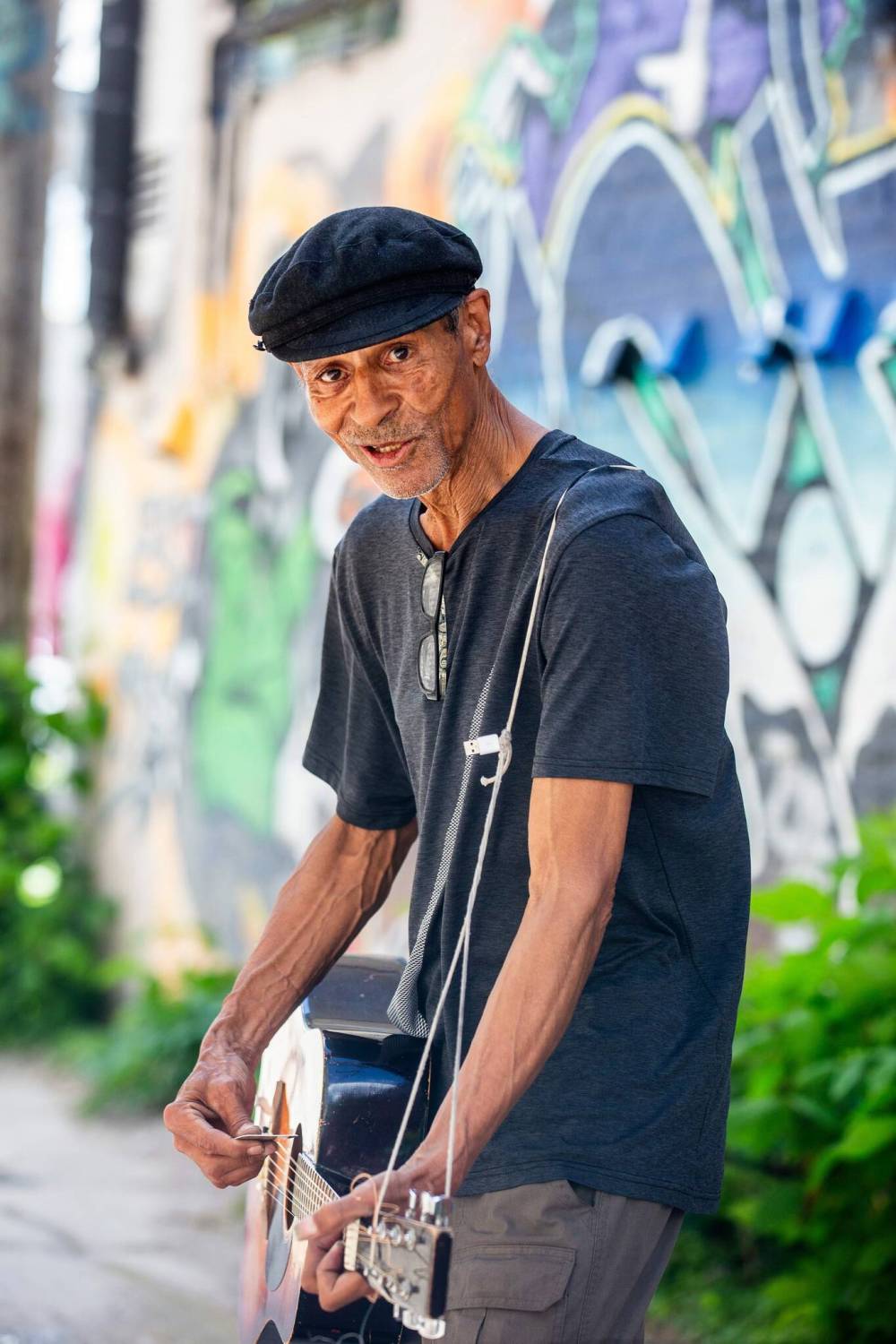
The air is hardly ever quiet in Osborne Village, an enclave as dense in car honks as it is in population. But most days, cutting through the automotive trumpetry is the jangling strum of an acoustic guitar held by Eric the Great.
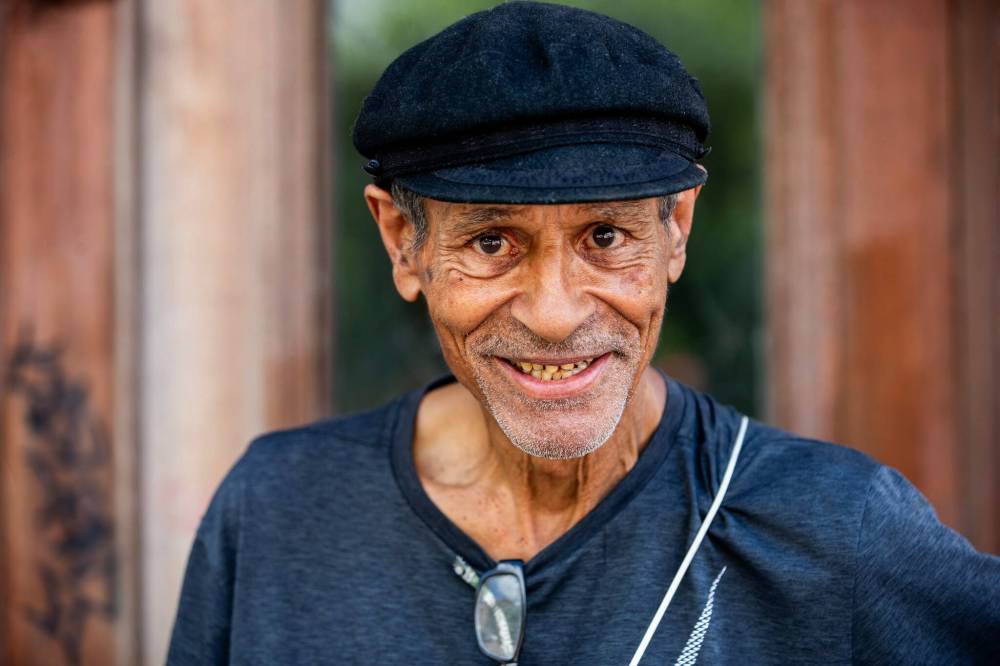
Born in Rivers, Eric the Great, who turned 70 years old on Friday, has spent nearly two decades rifling through his repertoire in various, semi-permanent public residencies: the cement-benched circle outside the now-shuttered Village Starbucks, the shared parking lot of Tim Hortons and Tony Roma’s on Pembina Highway, or in the skywalk near the downtown arena, where he will play Ring of Fire until his voice — a touch of Cab Calloway silk dusted with Gord Downie grit — gives out.
“If it makes someone happy, I’ll play it again and again and again,” says Eric Pyle, an Osborne area denizen who, before becoming a legendary sidewalk storyteller, fronted the 1980s and ’90s alt-rock group the Ludwigs.
“I could play for eternity and I would never get bored, unless the guitar was out of tune.”
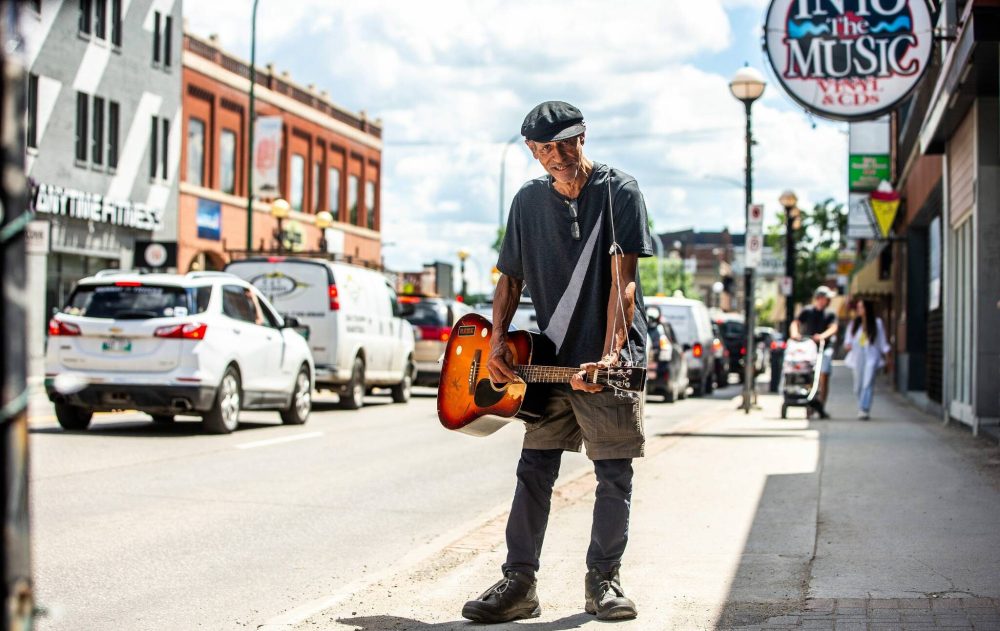
A street performer nonpareil whose career took root inside venues that no longer exist — the Blue Note, Wiseguys, the Windsor Hotel, the Zoo and the Rolling Stone Cabaret — Pyle is a Winnipeg institution by virtue of longevity and a shrewd determination toward positivity. Whenever his guitars have been stolen from him, he knows another will soon land at his feet by some entity resembling fortune or luck, he says.
Regardless of circumstance, he trusts the universe to return a favour.
“Eric Pyle has a different kind of caché,” says longtime Winnipeg rock radio DJ Howard Mandshein of 92 CITI FM, who has known Pyle for nearly 50 years, long before he earned the “great” sobriquet, which, to Mandshein, doesn’t quite feel local enough.
“Call him the Mayor of Osborne Village, the Troubadour of Safeway.”
“You walk into a room in the 1970s, 1980s, 1990s, and Eric would light a room up. He had the molecules jumping,” Mandshein goes on. “He had — I don’t want to say sex appeal — but that It factor. People ingratiated themselves to him. His eyes popped when he spoke. He had rock-star charisma without being a rock star.”
Pyle’s life in music started when his family moved to Winnipeg in 1969 after his father — a veteran of the Second World War named Charlie Pyle, a Nova Scotian who later became a provincial champion welterweight boxer in Manitoba — retired from the armed forces.
Pyle’s father was born in the coal-mining town of New Waterford, where he was a top athlete in several sports, including hockey. He formed a high-scoring — possibly colour-barrier-breaking — line in the Cape Breton Hockey League and showed promise in sweeter sciences, earning military respect as a champion boxer.
“Followers of local ring craft who sat in on last month’s Crescent card at the Auditorium will no doubt pay a return visit next Friday night to get another look at Charlie Pyle, the Cape Breton cutie with the corporal’s stripes,” reported the Winnipeg Tribune ahead of a bout between Pyle and Corp. Eddie Senos.
“Last month, Pyle did everything but devour Jimmy McNamara, a willing young welterweight. Corporal Charlie sent the game little Irishman sprawling twice before winning a unanimous nod, and the majority of the ringsiders whispered something about a mismatch.”
A 14-year-old Eric, along with his parents and three siblings, had spent the bulk of his life in army towns such as Rivers and Shilo, where the Pyle children earned renown in local swim meets.
In March 1965, as part of the Operation Mexico Olympic development program, the siblings were written up in the Winnipeg Tribune thusly: “Competition will be keen in all departments, but there is one Camp Shilo family that will be ganging up on the rest of field in heat events. Swimming for the Camp Shilo Goldeyes the prior fall, a 10-year-old Eric Pyle swam the 50-yard butterfly in 41.6 seconds, setting an age bracket record.”
In his newly established home in Charleswood, Pyle, not yet a musician, began to explore the local scene.
“I got my music fix whenever Duncan Wilson and the Mongrels played. Greg Leskiw was a staple,” Pyle says.
At home, he listened to Louis Armstrong, the Doors and whatever one-hit wonders he could find.
By 21, Pyle had accumulated hundreds of LPs.
“The thing I love about music is I can put on the greatest song ever recorded, and halfway through, switch on an even better one.”
In the mid-1980s, already a fixture in the city’s independent rock ‘n’ roll crowds, Pyle tried his hand at recording music of his own. After a challenging personal period around 1987, he sought a fresh start in Vancouver.
“There was no particular reason to go there,” he told the Free Press in 1994. “I found out the train ticket was only $165.”
In Vancouver, he formed the Ludwigs, recording two albums on the West Coast before returning to Winnipeg in 1993 as a solo act following the band’s breakup.
Once more in his home province, Pyle assembled a new lineup for the Ludwigs — named for Beethoven, not the drum-kit maker — including keyboardist Bob Filep, drummer Eric Gudmandson, guitarist Steve Spraggett and bassist Doug DeCarle.
He started writing and playing guitar more frequently.
“Songs come right to me like the Holy Ghost, shall we say. My hands are moved,” Pyle says.
The band worked with producers and engineers including Cecil English, Chris Burke-Gaffney and Lou Petrovich, with some support by Nite Out Entertainment’s Bruce Rathbone, the influential concert promoter who brought David Bowie, Paul McCartney and Led Zeppelin to Winnipeg.
The Ludwigs released the 1994 album Movement, as well as the 1998 “solo” effort Being Green Ain’t Easy, which features a credit list 30 names deep.
The lyrics of those albums were almost completely written by Pyle during his time living with two bandmates in a two-storey house with a thatched facade on Sherbrook Street, most recently a counselling office.
Despite consistent gigs, the band never quite took off as planned, facing challenges posed by both disagreement and diverging lifepaths. Still, Pyle’s former bandmates appreciate his artistry.
“I consider Eric a special artist,” says DeCarle, who now lives in Teulon. “He doesn’t sound like anybody else. Musically speaking, Eric was uninfluenced. Anything he wrote, I never felt he was revisiting or revising. He was his own entity altogether. He wasn’t copying, and there is no copy.”
Since his era of street performance began, Pyle has become a fixture of Osborne Village, a light on the street that refuses to go out.
“He’s my heart in the Village,” says Noa Swartz, 24, a former neighbourhood resident who now works at the ANAF 60 on River Avenue. “When I think about the Village, I think about him.”
Songwriter Micah Erenberg of the Secret Beach wrote about Pyle — along with performers Blue McLeod and Curtis Falk — on his song 22, a paean to lost Osborne evenings.
“Those folks could sing the whole night away, you could barely feel your toes,” the lyrics go.
Julie Sullivan became a fan of Pyle’s at the Tim Hortons on Pembina.
“He seems to have a bit of a following. People come to see if he’s here. He just loves doing it and putting a smile on people’s faces,” she says.
Related Articles
Busker wants to play by rules


Sullivan was shocked to find out he was turning 70.
“I never noticed any lines on his face because he himself is always smiling,” she says.
Pyle says he doesn’t make music for the money, but that he does make a living by playing.
“Success, to me, is doing your best. Success is the doing in itself, not measured by sales, but by the impact of the music.”
On a Tuesday night in May, during the intermission of a Stanley Cup playoff game between the Colorado Avalanche and the Dallas Stars, Pyle emerges from the legion, in a deerstalker cap and a red knit scarf, with his Espanola guitar hanging from his neck on the strength of an impromptu strap — half shoelace, half lightning cable.
A pair of cigarette smokers and one fresh-air seeker approach him, and Pyle, asked if he remembered the first song he ever wrote, flashes a grin.
“No I don’t, but I do remember the second,” he says, launching into Sawmill, a song inspired by a painting of a red-headed woman that reminded him of impermanence.
“A sawmill, a sky that’s red, a sawmill, a sky that bled, a painting, a painting red, a painting, a painting bled, a love that’s fleeting, a love that’s cheating, a world that’s meeting, a love that’s fleeting,” he sang. “A turning, a turning on, a turning, and then you’re gone, a feeling, that runs through your head, a feeling, that life is dead. A love that’s fleeting, a love that’s cheating, a world that’s meeting, a love that’s cheating. And now I am, you know I am. And now I am, you know I am.”
For 20 more minutes, Pyle recounts his life’s stories and sings through his catalogue, each song punctuated by informative, descriptive and delightful banter, discussing the environment, Amy Winehouse and the Winnipeg weather.
His fans shake his hand and thank Pyle for the show.
He thanks them for listening.
ben.waldman@winnipegfreepress.com

Ben Waldman is a National Newspaper Award-nominated reporter on the Arts & Life desk at the Free Press. Born and raised in Winnipeg, Ben completed three internships with the Free Press while earning his degree at Ryerson University’s (now Toronto Metropolitan University’s) School of Journalism before joining the newsroom full-time in 2019. Read more about Ben.
Every piece of reporting Ben produces is reviewed by an editing team before it is posted online or published in print — part of the Free Press‘s tradition, since 1872, of producing reliable independent journalism. Read more about Free Press’s history and mandate, and learn how our newsroom operates.
Our newsroom depends on a growing audience of readers to power our journalism. If you are not a paid reader, please consider becoming a subscriber.
Our newsroom depends on its audience of readers to power our journalism. Thank you for your support.
History
Updated on Monday, June 17, 2024 10:47 AM CDT: Adds video
Updated on Monday, June 17, 2024 11:06 AM CDT: Corrects spelling of Gord Downie