

Elections, expectations and fiscal reality
Advertisement
Read this article for free:
or
Already have an account? Log in here »
To continue reading, please subscribe:
Digital Subscription
One year of digital access for only $75*
- Enjoy unlimited reading on winnipegfreepress.com
- Read the E-Edition, our digital replica newspaper
- Access News Break, our award-winning app
- Play interactive puzzles
*Billed as $5.77 plus GST every four weeks. After 52 weeks, price increases to the regular rate of $19.95 plus GST every four weeks. Offer available to new and qualified returning subscribers only. Cancel any time.
Monthly Digital Subscription
$4.99/week*
- Enjoy unlimited reading on winnipegfreepress.com
- Read the E-Edition, our digital replica newspaper
- Access News Break, our award-winning app
- Play interactive puzzles
*Billed as $19.95 plus GST every four weeks. Cancel any time.
To continue reading, please subscribe:
Add Free Press access to your Brandon Sun subscription for only an additional
$1 for the first 4 weeks*
- Enjoy unlimited reading on winnipegfreepress.com
- Read the E-Edition, our digital replica newspaper
- Access News Break, our award-winning app
- Play interactive puzzles
*Your next Brandon Sun subscription payment will increase by $1.00 and you will be charged $17.95 plus GST for four weeks. After four weeks, your payment will increase to $24.95 plus GST every four weeks.
Read unlimited articles for free today:
or
Already have an account? Log in here »
Hey there, time traveller!
This article was published 04/04/2024 (876 days ago), so information in it may no longer be current.
Premier Wab Kinew and his government clearly did not read the “You’re a new administration” guidebook.
It’s a simple read, and one that new majority provincial governments have used for years. (Well, actually there isn’t a guidebook for new governments, but let’s pretend for a moment that there is.)
If there was one, the guide would have a clear recommendation for the first budget: say the province was in far worse fiscal trouble than anyone knew, and play dodge-and-weave on any election promise you’d like to either postpone, or even walk away from completely. What was an election promise, unfortunately, is now simply a fiscal impossibility.
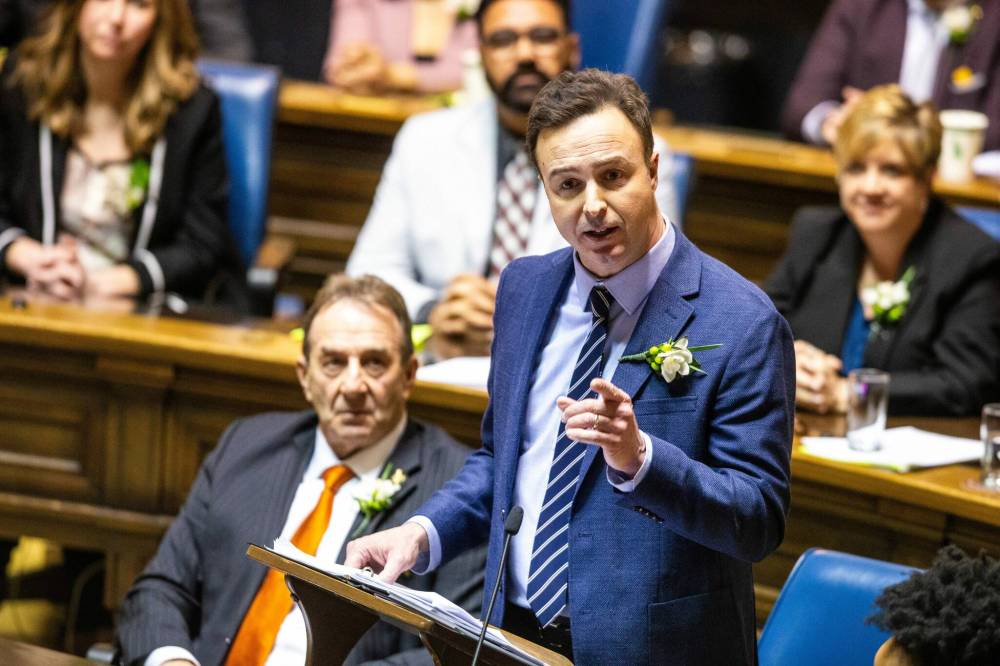
Mikaela MacKenzie/ Free Press FILES
Finance Minister Adrien Sala presents the budget.
The reasons are simple, and are based on pragmatism: as budgets go, your first budget is as far away from facing the voters in the next provincial election as you will ever be. While voters can’t be guaranteed to forgive you for not living up to your promises, you can at least hope that a significant number of them are going to forget. The half-life of outrage is often shorter than the four-year period between elections, and besides, you have the budget before the next election to promise five chickens arriving in every pot.
But back to the current provincial budget: Manitoba’s NDP government clearly inherited fiscal challenges it didn’t expect, including a deficit ballooning to nearly $2 billion in the third quarter, far and away higher than the $363-million deficit the Progressive Conservative government forecast for last year.
But instead of slamming on the brakes, the NDP are moving ahead with their agenda, especially when it comes to health care.
The fallout from that is a healthy budget deficit in this year’s budget: $796 million. As is regularly the case in provincial budgets, the forecast is that things will always get better and better: the Kinew government is forecasting decreasing deficits in future years, before finally forecasting a balanced budget in 2027-28. (If you look at that in weather terms, that’s like forecasting how much rain will fall on Thursday three weeks from now — it’s decidedly in hopeful best-guess territory.)
But reaching that balanced budget gets harder with every passing year, at least as far as electability goes. The only real hope is that there’s suddenly more money coming in from somewhere, and, on that front, governments are eternal optimists.
Because cutting gets harder with each passing day.
It’s far harder to cut back expectations when you’ve had an active hand for several years in building them up.
What’s the verdict on the first budgetary attempt by this government?
Well, that the NDP can at least hold its head high in that it’s trying to make progress on its promised political agenda despite the hard numbers it received after the election.
As well, its changes to income tax rules to claw back the basic personal exemption from extremely high earners, along with its $1,500 cap on rebates for education tax levy rebates are an artful way to raise revenues from wealthier Manitobans, something in keeping with basic NDP tenets. (And, frankly, the basic personal tax exemption clawback is something that’s likely to be noticed and copied by provincial governments in other parts of the country.)
But in common parlance, it may well be that the NDP is making a stick for its own back.
Changes in administrations are an excellent time to change the baseline, including the baseline of expectations. In fact, they may be the only time to make that change.
This year’s NDP government may be delighted with what they’ve been able to achieve.
Three or four years down the road, they may well be wondering just what they were thinking.
Related Articles
Province tackles health care woes while battling massive deficit


Advertisement Advertise With Us
Advertisement Advertise With Us