

Five new affordability measures in the Liberal government’s fall fiscal update
Advertisement
Read this article for free:
or
Already have an account? Log in here »
To continue reading, please subscribe:
Digital Subscription
One year of digital access for only $75*
- Enjoy unlimited reading on winnipegfreepress.com
- Read the E-Edition, our digital replica newspaper
- Access News Break, our award-winning app
- Play interactive puzzles
*Billed as $5.77 plus GST every four weeks. After 52 weeks, price increases to the regular rate of $19.95 plus GST every four weeks. Offer available to new and qualified returning subscribers only. Cancel any time.
Monthly Digital Subscription
$4.99/week*
- Enjoy unlimited reading on winnipegfreepress.com
- Read the E-Edition, our digital replica newspaper
- Access News Break, our award-winning app
- Play interactive puzzles
*Billed as $19.95 plus GST every four weeks. Cancel any time.
To continue reading, please subscribe:
Add Free Press access to your Brandon Sun subscription for only an additional
$1 for the first 4 weeks*
- Enjoy unlimited reading on winnipegfreepress.com
- Read the E-Edition, our digital replica newspaper
- Access News Break, our award-winning app
- Play interactive puzzles
*Your next Brandon Sun subscription payment will increase by $1.00 and you will be charged $17.95 plus GST for four weeks. After four weeks, your payment will increase to $24.95 plus GST every four weeks.
Read unlimited articles for free today:
or
Already have an account? Log in here »
Hey there, time traveller!
This article was published 21/11/2023 (1040 days ago), so information in it may no longer be current.
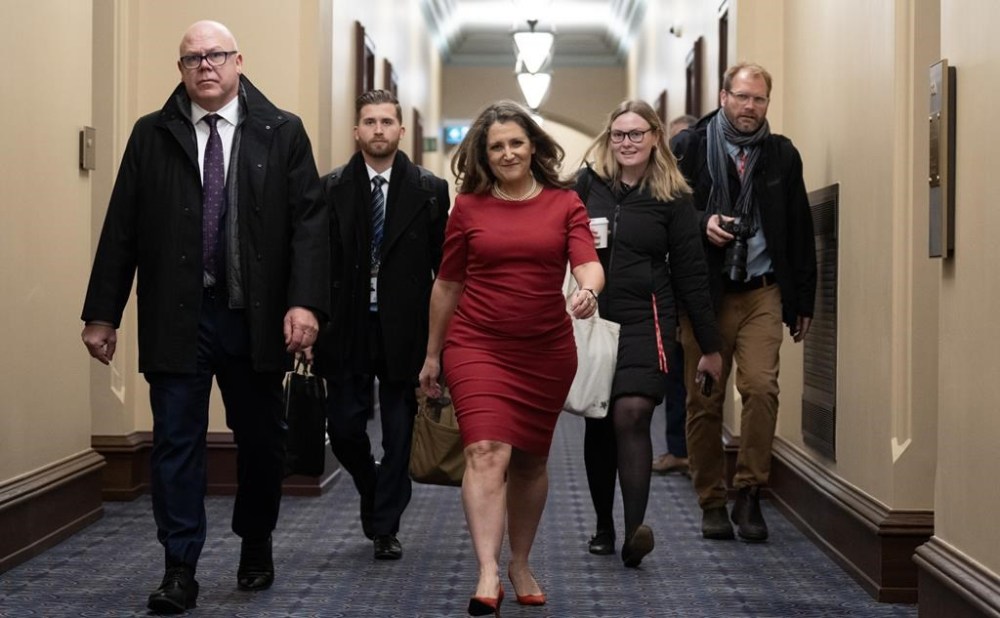
OTTAWA – Finance Minister Chrystia Freeland tabled a fall economic statement on Tuesday that aims to support middle-class Canadians amid soaring consumer prices and looming mortgage renewals.
She announced $168 million in new spending over six years for programs focused on at saving Canadians money.
Here’s what the government proposes to do.
Competition and trade
The Liberals have proposed several amendments to the Competition Act in an attempt to improve consumer choice and lower prices.
The economic statement proposes a “crackdown” on predatory pricing and “killer acquisitions.”
Proposed legislative changes would also broaden the reach of the law so more private parties can bring cases before the Competition Tribunal and receive payment if they win.
The government also wants to make sure that when Canada opens market access to trade partners, Canadian companies are given similar access abroad.
“Going forward, Canada will consider reciprocity as a key design element for new policies, including certain clean economy investment tax credits, federal procurement and federally funded infrastructure projects,” the government announced in the statement.
“This includes reciprocal procurement to ensure that countries that do not provide Canadian goods and services with a similar level of market access do not unfairly benefit from access to Canada’s markets.”
Junk fees crackdown
The economic statement included new details about efforts to reduce junk fees for consumers that were announced in last spring’s federal budget.
The government plans to update its air passenger protection regulations to make sure that children under the age of 14 can sit with an accompanying adult free of charge.
And the Canadian Radio-television and Telecommunications Commission is being asked to study international roaming charges for cellphones, with an eye to proposing next steps to address such fees in 2024.
Consumer banking and mortgage charter
Several new measures aim to improve fairness when it comes to Canadians’ banking experiences, including a plan to target fees that institutions charge for insufficient funds in certain accounts, which the fiscal update says “disproportionately” affect low-income people.
The Liberals previously directed the Financial Consumer Agency of Canada to make no-cost bank accounts more accessible and make other features cheaper, including additional debit transactions, online bill payments and e-transfers. The fall statement promises an update on those efforts in the next few months.
For those worried about mortgage renewals amid soaring interest rates, the government is proposing a renewed Canadian mortgage charter to help people hang on to their homes.
It is intended to provide guidance for financial institutions to ensure they provide tailored relief and reasonable costs to borrowers.
The government says the measures will allow for temporary amortization extensions for mortgage holders at risk, as well as the waiving of certain fees and added costs. Financial institutions would also be required to proactively reach out to vulnerable borrowers, and homeowners at risk would be able to make lump sum payments to avoid negative amortization.
Cheaper mental-health services
The government plans to lift federal taxes on psychotherapy and counselling.
The economic statement proposes lifting the GST and HST from professional services provided by therapists to make such services more affordable and accessible.
Employment insurance changes
Adoptive parents and seasonal workers are also about to get a break, thanks to changes to employment insurance proposed in the mid-year budget update.
Parents who adopt a child will be offered a 15-week sharable benefit starting this fiscal year.
Surrogate parents will also be eligible for the benefit, which the government estimates will give 1,700 Canadian families per year more time and flexibility as they adjust to new parenthood.
The change is expected to cost $48.1 million over six years, and $12.6 million every year thereafter.
The government is also temporarily offering seasonal workers in 13 economic regions up to four additional weeks of regular EI benefits.
A higher employment rate means some seasonal workers in industries such as fishing and tourism who rely on EI during the off season don’t qualify for as many weeks of insurance.
The added support for seasonal workers is expected to cost $69.8 million over three years, and would be available for claims established between Sept. 10, 2023 and Sept. 7, 2024.
This report by The Canadian Press was first published Nov. 21, 2023.
Related Articles
Key highlights: 2023 fall economic statement

Advertisement Advertise With Us
Advertisement Advertise With Us