

Significant number of Manitobans struggling or financially uncomfortable, poll shows

Advertisement
Read this article for free:
or
Already have an account? Log in here »
To continue reading, please subscribe:
Digital Subscription
One year of digital access for only $75*
- Enjoy unlimited reading on winnipegfreepress.com
- Read the E-Edition, our digital replica newspaper
- Access News Break, our award-winning app
- Play interactive puzzles
*Billed as $5.77 plus GST every four weeks. After 52 weeks, price increases to the regular rate of $19.95 plus GST every four weeks. Offer available to new and qualified returning subscribers only. Cancel any time.
Monthly Digital Subscription
$4.99/week*
- Enjoy unlimited reading on winnipegfreepress.com
- Read the E-Edition, our digital replica newspaper
- Access News Break, our award-winning app
- Play interactive puzzles
*Billed as $19.95 plus GST every four weeks. Cancel any time.
To continue reading, please subscribe:
Add Free Press access to your Brandon Sun subscription for only an additional
$1 for the first 4 weeks*
- Enjoy unlimited reading on winnipegfreepress.com
- Read the E-Edition, our digital replica newspaper
- Access News Break, our award-winning app
- Play interactive puzzles
*Your next Brandon Sun subscription payment will increase by $1.00 and you will be charged $17.95 plus GST for four weeks. After four weeks, your payment will increase to $24.95 plus GST every four weeks.
Read unlimited articles for free today:
or
Already have an account? Log in here »
Hey there, time traveller!
This article was published 06/06/2023 (1212 days ago), so information in it may no longer be current.
Manitobans are increasingly missing their loan and credit payments, data from credit reporting agency Equifax shows.
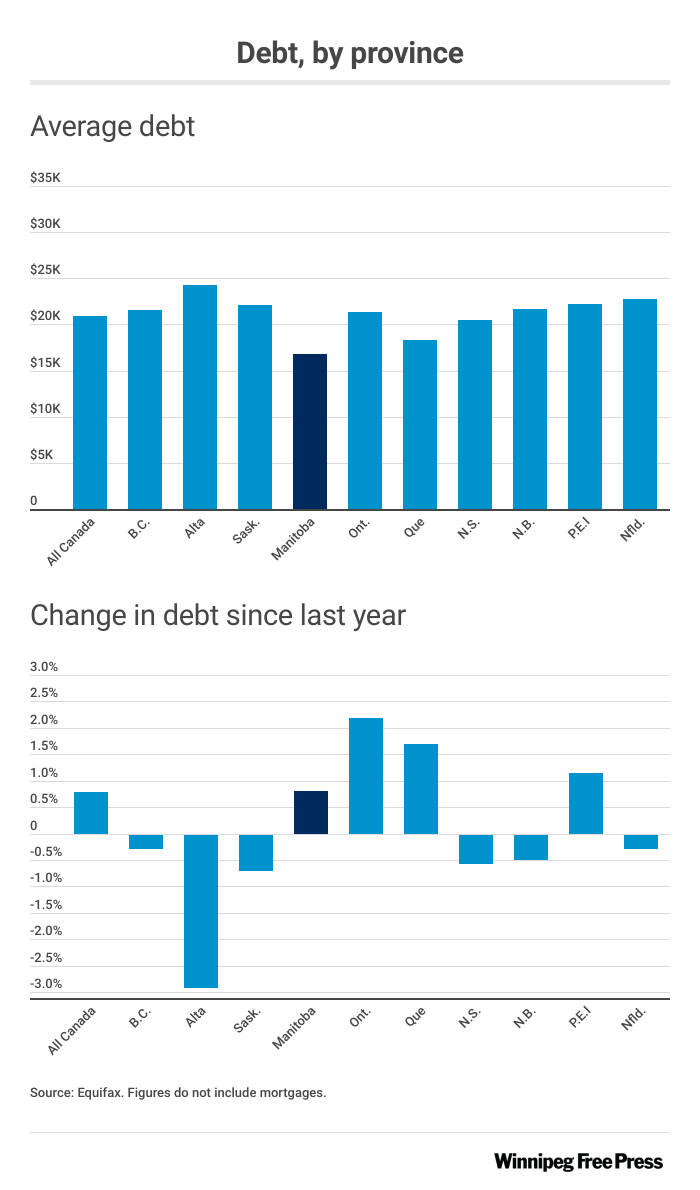
The average Manitoba account carried $16,805 of debt, excluding mortgages, in the first three months of 2023, Equifax reported Monday.
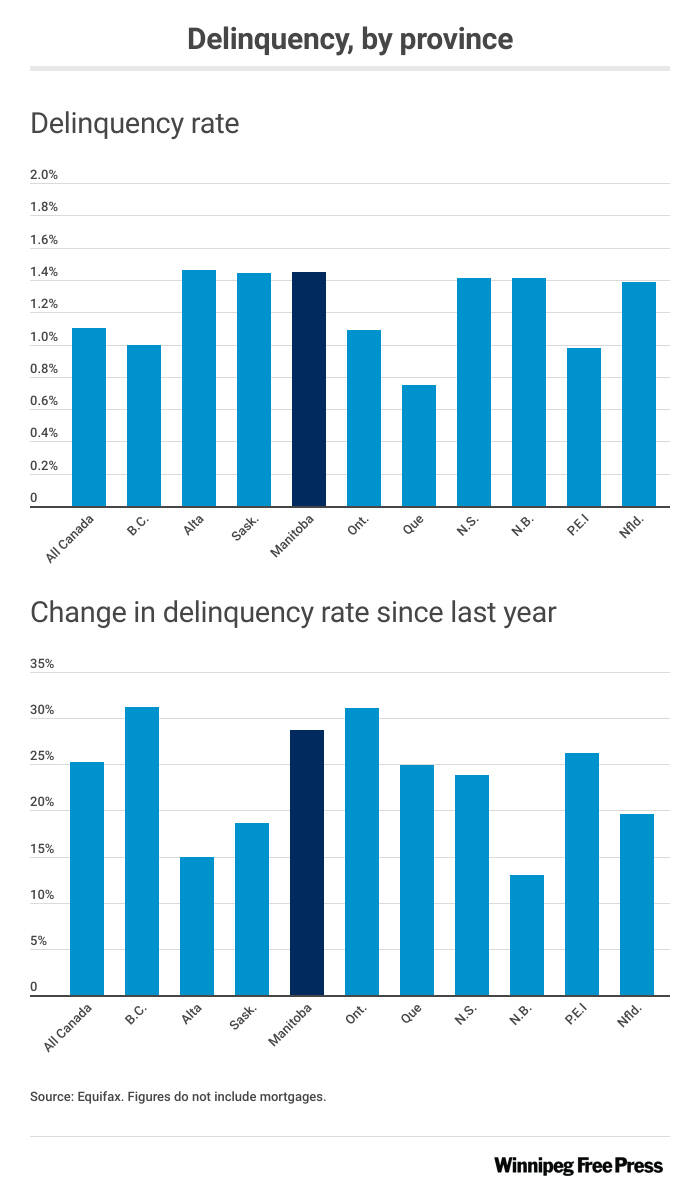
The debt load increased less than one per cent when compared to the year prior. However, the delinquency rate — where someone misses payments for at least three months — has shot up nearly 30 per cent this year compared to last.
“(It’s) what we call severe financial difficulty,” said Rebecca Oakes, Equifax Canada’s vice-president of advanced analytics.
About 1.45 per cent of Manitoba accounts have delinquent debt, according to Equifax data. The number doesn’t include mortgages and covers personal and business accounts.
Only Alberta exceeds Manitoba’s delinquency rate —at 1.46 per cent — across Canadian provinces.
At the end of 2022, young people and those with lower incomes made up a majority of delinquent debt holders. Now, the group is increasingly comprised of mortgagers, Oakes said.
“If your mortgage is going up a significant amount, in terms of monthly payments… then you tend to prioritize your mortgage,” she said. “The other debt commitments you have, they tend to be lower priority.”
Manitobans mainly miss payments on credit cards, instalment loans and automobile loans. Missed car payments are more frequent now than pre-pandemic, Oakes said.
“Consumers should be looking at their finances and… thinking about what happens if (the Bank of Canada’s key interest rate) goes up another quarter per cent,” she added.
The central bank has raised its key rate 4.25 per cent, to 4.5 per cent, since March of 2022 in a bid to slow spending and tame inflation.
However, economists have speculated the bank isn’t done — it’s set to make an announcement Wednesday, which could result in another rate hike.
Meantime, one-third of Manitobans are struggling financially, an Angus Reid Institute poll released Monday found. Another 20 per cent of the 376 Manitoba respondents said they’re financially uncomfortable.
“It’s impossible to predict the future, what it’s going to do,” Olly Tirtoprodjo said of his mortgage.

JESSICA LEE / WINNIPEG FREE PRESS
“Years ago, I did lots of mortgages for one person buying a house,” said Laurie Boudreau, a mortgage specialist with Castle Mortgage Group. “Now, it pretty much takes two unless you earn six figures.”
He’s had a variable mortgage for several years; it’s up for renewal next month. Roughly two years ago, he was paying $1,250 a month. Now, his mortgage costs more than $1,700 each month, he said.
“I think it’s important for people to find extra sources of income,” Tirtoprodjo said.
Dog-sitting and keeping a roommate are his picks.
“Groceries are definitely way too expensive, gas is really expensive,” said Claudia Prinsloo-Rempel. “I’m seeing a lot of luxury condos and apartment buildings popping up, and it’s like, ‘I can’t afford this.’”
The 32-year-old has been a renter for a decade. She doesn’t believe she’ll be able to afford a house in the next five years.
“Years ago, I did lots of mortgages for one person buying a house,” said Laurie Boudreau, a mortgage specialist with Castle Mortgage Group. “Now, it pretty much takes two unless you earn six figures.”
She gave the example of a $300,000 home with a $15,000 down payment. Now, a home buyer might need an income of at least $75,000 to qualify, Boudreau said. She calculated using a five per cent interest rate.
When interest rates dropped to two per cent, as they did during the pandemic, the same house and situation could be bought by someone with an income of roughly $60,000, Boudreau said.
“They were artificially low (rates),” she noted.
She keeps a graph of fixed mortgage rates over the last 40 years. The average rate is about six per cent, so the current rate isn’t actually far from the norm, she said.
“The sky is not falling,” Boudreau said. “(But) with everything costing so much more, it’s that much harder to also make a higher mortgage payment.”
People struggling with their mortgage have options, she added. Some lenders allow for a lengthening of mortgages and lessening of monthly bill costs. Refinancing might be an option, or taking in a roommate.
“My advice would be to pay off those other debts if you can, to reduce those payments,” Boudreau added, highlighting car loans.
Forty-five per cent of Canadian mortgage holders surveyed for the recent Angus Reid Institute poll said their mortgage was very difficult to manage. A year earlier, the number was 34 per cent.
Twenty-four per cent of Canadian renters answered they’re having a very difficult time paying rent, up from 19 per cent a year earlier.
Angus Reid Institute ran its online survey from May 30 to June 2 with 2,808 Canadian adults. As the survey was not conducted with a random sample of Canadians, no margin of error can be ascribed to the results.
gabrielle.piche@winnipegfreepress.com
Gabrielle Piché reports on business for the Free Press. She interned at the Free Press and worked for its sister outlet, Canstar Community News, before entering the business beat in 2021. Read more about Gabrielle.
Every piece of reporting Gabrielle produces is reviewed by an editing team before it is posted online or published in print — part of the Free Press‘s tradition, since 1872, of producing reliable independent journalism. Read more about Free Press’s history and mandate, and learn how our newsroom operates.
Our newsroom depends on a growing audience of readers to power our journalism. If you are not a paid reader, please consider becoming a subscriber.
Our newsroom depends on its audience of readers to power our journalism. Thank you for your support.
Gabrielle Piché reports on business for the Free Press. She interned at the Free Press and worked for its sister outlet, Canstar Community News, before entering the business beat in 2021. Read more about Gabrielle.
Every piece of reporting Gabrielle produces is reviewed by an editing team before it is posted online or published in print — part of the Free Press‘s tradition, since 1872, of producing reliable independent journalism. Read more about Free Press’s history and mandate, and learn how our newsroom operates.
Our newsroom depends on a growing audience of readers to power our journalism. If you are not a paid reader, please consider becoming a subscriber.
Our newsroom depends on its audience of readers to power our journalism. Thank you for your support.
Related Articles
BoC may have to raise rates again, economists say






Advertisement Advertise With Us
Advertisement Advertise With Us
History
Updated on Tuesday, June 6, 2023 4:30 PM CDT: Photo changed.