

Canada has failed to address homelessness
Advertisement
Read this article for free:
or
Already have an account? Log in here »
To continue reading, please subscribe:
Digital Subscription
One year of digital access for only $75*
- Enjoy unlimited reading on winnipegfreepress.com
- Read the E-Edition, our digital replica newspaper
- Access News Break, our award-winning app
- Play interactive puzzles
*Billed as $5.77 plus GST every four weeks. After 52 weeks, price increases to the regular rate of $19.95 plus GST every four weeks. Offer available to new and qualified returning subscribers only. Cancel any time.
Monthly Digital Subscription
$4.99/week*
- Enjoy unlimited reading on winnipegfreepress.com
- Read the E-Edition, our digital replica newspaper
- Access News Break, our award-winning app
- Play interactive puzzles
*Billed as $19.95 plus GST every four weeks. Cancel any time.
To continue reading, please subscribe:
Add Free Press access to your Brandon Sun subscription for only an additional
$1 for the first 4 weeks*
- Enjoy unlimited reading on winnipegfreepress.com
- Read the E-Edition, our digital replica newspaper
- Access News Break, our award-winning app
- Play interactive puzzles
*Your next Brandon Sun subscription payment will increase by $1.00 and you will be charged $17.95 plus GST for four weeks. After four weeks, your payment will increase to $24.95 plus GST every four weeks.
Read unlimited articles for free today:
or
Already have an account? Log in here »
Hey there, time traveller!
This article was published 12/12/2022 (1389 days ago), so information in it may no longer be current.
Last month, the auditor general released a damning report on the federal government’s lack of progress toward reducing chronic homelessness among the 35,000 Canadians who struggle to find housing. In particular, the AG took aim at the billions of dollars invested in the Reaching Home Strategy, which will not meet its goal of reducing chronic homelessness by 50 per cent by 2027-28.
Why has little progress been achieved, and what does this mean for Winnipeg?
In Winnipeg, federally mandated counts have not shown a significant reduction in the number of persons experiencing homelessness over the last five years. The reality is that shelters are bursting at the seams, even as they brace for another cold, busy winter.
MIKE DEAL / WINNIPEG FREE PRESS
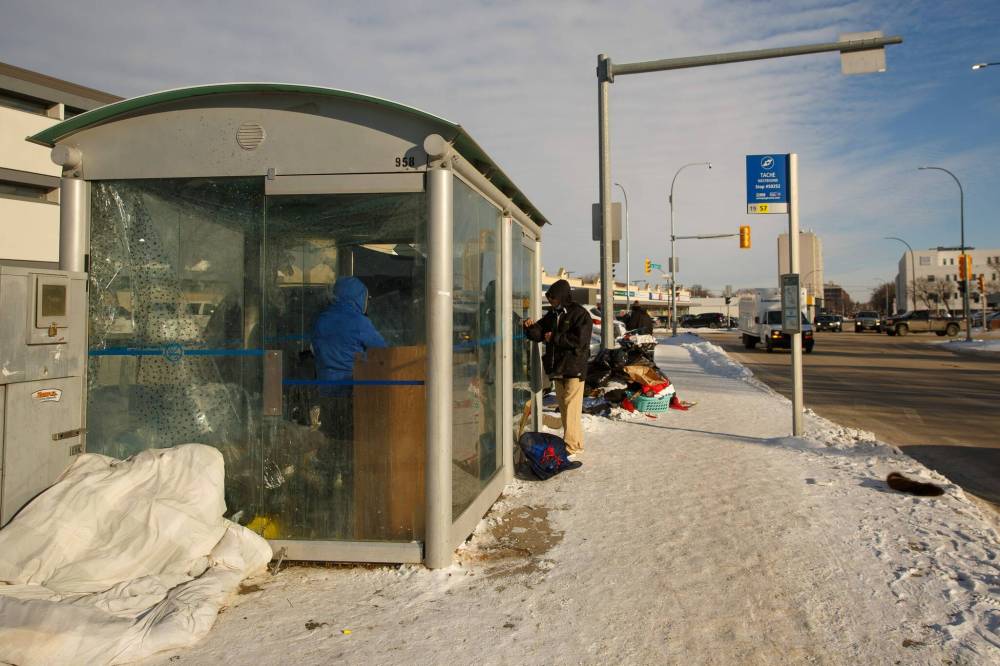
Outreach workers found an unresponsive woman in the bus shelter at Goulet Street and Tache Avenue on Dec. 5. It was later confirmed she had died.
At the same time, outside my office at the University of Winnipeg, a bus shelter serves as a daily reminder of this failure. On most days, persons experiencing homelessness gather; during the same day, a range of police, fire, paramedic and transit-authority personnel work to usher persons out of the shelter.
This approach does little to address underlying issues, yet it places an enormous toll on the system.
In Canada, a person experiencing homelessness can cost as much as $60,000 annually for these types of interventions. But such actions do not lead to stable housing or recovery, nor to they address root causes such as addictions, mental-health issues and systemic racism.
Not surprisingly, almost as fast as the transit shelter is cleared, more people arrive, and so goes the cycle. Last week, a woman died in a shelter in St. Boniface while seeking to use the heated structure to escape the cold. In Winnipeg, the annual cost of homelessness is estimated to exceed $100 million, but the numbers of people struggling does not decline.
Just over a decade ago, Winnipeg joined Moncton, N.B., Montreal, Toronto and Vancouver in the world’s largest demonstration project to end chronic homelessness. Over a four-year period, the At Home/Chez Soi project found that a “Housing First” approach, when delivered appropriately, was highly effective in reducing chronic homelessness.
This was evident after seeing 1,000 Canadians transitioned into stable housing within 18 months of the launch of the program, without any new housing being built.
In Winnipeg, local teams developed Indigenous-led approaches that have since influenced Australia’s and New Zealand’s incorporation of Housing First. Additionally, hundreds of cities continue to develop and expand Housing First, yet Canada has not leveraged the momentum and knowledge that were developed.
Recently, Winnipeg looked to the Housing First approaches of Finland and Houston, Texas, despite our strong local history. What Finland learned is you can continue to police the “problem” by expending $60,000 or more on the wrong approaches, or you can spend $20,000 per person to deliver Housing First.
I was surprised the AG did not call out government for failing to offer guidelines on implementing evidence-based solutions such as Housing First.
As its name implies, Housing First uses housing as the first step in a comprehensive treatment plan. With stable housing in place, teams then take a recovery-oriented approach involving case management and access to the right sets of services and supports.
A critical part of Housing First is that it works with existing housing and service providers while embedding individualized supports. This is delivered in an organized and efficient manner, but with manageable caseloads. For example, Housing First teams often have caseloads of less than 100, which allows for relationship-building.
While Housing First does not work for all experiencing homelessness, it remains the most effective and studied program. It results in the rapid reduction of chronic homelessness. Perhaps the most important factor is the inclusion of street outreach.
For example, with regard to the bus shelter in Winnipeg, instead of dispatching firefighters and paramedics, an outreach team would instead meet with these persons and work individually to get them into stable housing, which in some instances can occur the same day.
Ending homelessness is not about billions of dollars; it comes down to building relationships and trust while meeting people where they are, with the backing of a team that cares about them and their well-being. Without a strengthened Housing First framework, the daily dance of chasing people out of bus shelters and encampments will do nothing to end the cycle many find themselves part of.
Jino Distasio is a professor of geography at the University of Winnipeg and was a member of the Winnipeg and national At Home/Chez Soi project.
Related Articles
Number of fires at homeless camps rising
Advertisement Advertise With Us
Advertisement Advertise With Us