

Rights and wrong
Museum's failed, antithetical management distressing, but voices of hope, change echo outside its walls

Advertisement
Read this article for free:
or
Already have an account? Log in here »
To continue reading, please subscribe:
Digital Subscription
One year of digital access for only $75*
- Enjoy unlimited reading on winnipegfreepress.com
- Read the E-Edition, our digital replica newspaper
- Access News Break, our award-winning app
- Play interactive puzzles
*Billed as $5.77 plus GST every four weeks. After 52 weeks, price increases to the regular rate of $19.95 plus GST every four weeks. Offer available to new and qualified returning subscribers only. Cancel any time.
Monthly Digital Subscription
$4.99/week*
- Enjoy unlimited reading on winnipegfreepress.com
- Read the E-Edition, our digital replica newspaper
- Access News Break, our award-winning app
- Play interactive puzzles
*Billed as $19.95 plus GST every four weeks. Cancel any time.
To continue reading, please subscribe:
Add Free Press access to your Brandon Sun subscription for only an additional
$1 for the first 4 weeks*
- Enjoy unlimited reading on winnipegfreepress.com
- Read the E-Edition, our digital replica newspaper
- Access News Break, our award-winning app
- Play interactive puzzles
*Your next Brandon Sun subscription payment will increase by $1.00 and you will be charged $17.95 plus GST for four weeks. After four weeks, your payment will increase to $24.95 plus GST every four weeks.
Read unlimited articles for free today:
or
Already have an account? Log in here »
Hey there, time traveller!
This article was published 08/08/2020 (2238 days ago), so information in it may no longer be current.
On that Friday evening in early June, protests flowed over the world, and through the streets of Winnipeg, too. After the speeches at the legislature were over, the marchers filled up downtown, their chants echoing off the stoic faces of office towers that loomed all around, a ribbon of life undulating over silent concrete.
When the marchers reached the juncture of Broadway and Main, they hooked a left, and then a right, flowing under the train tracks that mark the boundary of The Forks, cheering as they passed cocktail-sipping patrons on a nearby patio lounge. Then, in the lap of the great glass cloud that rises near the Red River, the protesters stopped.
They began to rise there, by the thousands. They surrounded the Canadian Museum for Human Rights, raising up signs declaring that Black Lives Matter. They lined the sidewalks and parking lots all around the museum, and then they surged upwards, bodies filling up the rolling grassy swells that embrace the museum’s structure.
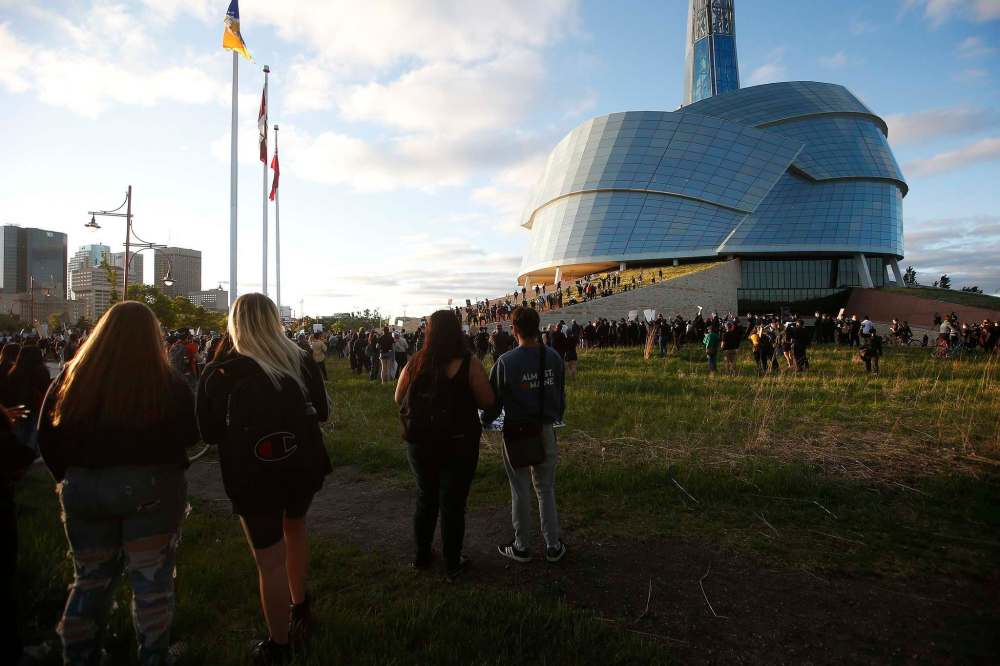
It was an astonishing scene, powerful, beautiful in the way that great gatherings of people for just cause can be. It hummed with a righteous energy. The crowd, mostly young, had come to the CMHR not to stand in its shadow, but rather to engulf it, to claim the site as their own, from its base to the highest point they could go.
“There’s the image,” I said to a colleague, though I did not take a photo. “That’s the picture that tells it all.”
This was not the only time that a march for justice, or for rights, ended up in front of the CMHR. Ever since the thing was built, it has become a destination for those calling for a better future, an easy landmark and a natural rally point where it stands near the confluence of the rivers, but also a place that hums with a deeper resonance.
From the start, it seems, the symbolism of the CMHR and its loftier aspirations has been better understood by the people of Winnipeg than by its own management. The museum may have struggled to express the same values enshrined within its walls, but those who marched to and around it, never forgot.
That effect became more starkly clear this week, when lawyer Laurelle Harris released the first phase of her report into allegations of systemic racism and oppression at the CMHR. In late June, Harris, who has expertise in matters involving race and gender justice, was hired by the CMHR board to conduct a third-party review.
The first phase of the report, released Wednesday, describes how that June 6 Justice 4 Black Lives Winnipeg rally helped touch off a series of events that saw a wave of former employees step forward with stories of systemic oppression and even, on some occasions, censorship of the museum’s own LGBTTQ+ content.
The report is alarming. While careful to protect the anonymity of most participants, including 13 former staff and 12 still with the museum, the 79-page document describes a disastrous workplace culture, filled with “pervasive” oppression, one in which largely white management often neglected the concerns of non-white staff.
The report describes instances where members of the public made racist comments to Indigenous staff, while the museum dragged its heels on instituting policies to better support them; instances where non-white job applicants were passed over in favour of less-qualified white applicants; and other discriminatory practices.
Among the most alarming claims — previously reported in media — were that on seven instances between 2015 and 2017, a middle manager, who is no longer with the museum, allowed LGBTTQ+ exhibits to be censored for religious tour groups, though that practice was finally suspended after an outcry from staff.
While it may no longer happen, the fact that it ever did reinforces the need for a full accounting of the problems within the CMHR’s culture. If a museum dedicated to human rights agrees to silence some rights when others are uncomfortable, then the very concept of the museum is made meaningless.
But therein lies one of the central problems of the CMHR, and the tension between its self-professed vision and its more practical mission. The CMHR itself does not like to court controversy. As an institution, it has largely stuck to narratives of human rights that are most palatable to the mainstream, and to its donors.
Yet we still live in a world where to name some rights as human rights remains a radical act. To do so requires the willingness and the courage to draw hard lines in the sand, even where it may alienate some who claim to want to hear the message. We cannot name human rights without also being ready to stand to defend them.
To defend them, we have to first understand them. And therein lies another problem for the CMHR: despite having issued a public statement pledging accountability in early June, the now-former CEO John Young appeared not to grasp the heart of the problem in an interview for the Harris report.
“At no point during the discussion did the former CEO express any appreciation of the gravity of concerns raised with respect to racism,” the report states. “He did not acknowledge the validity of any of the claims and accepted no personal responsibility for the environment at the Museum which harmed his employees.”
This is, perhaps, not surprising. The fight for rights has always been thus. It has always welled from the ground up, sometimes met with hostility but just as often with a sort of stubborn indifference, a lip service paid without a real comprehension. In this way, the culture at the CMHR is not so different than the culture writ large.
Yet, in a way, perhaps all of this shows that there is hope for the CMHR yet. As the museum seeks to revamp its own culture, it can look to the very outcry around its own actions and see a light to show the path forward. In speaking up and allowing the scrutiny and critiques of this very debate, current and former staff have led the way.
And if the museum’s leadership ever needs a reminder of what it must aspire to, what it must become, then it need not search very far. It can simply look back to the image of that night in early June, when thousands of youth surged up over its slopes and raised their voices for justice, for dignity, for a better world.
The artifacts of human rights may reside in the museum, but their light shines brightest outside.
melissa.martin@freepress.mb.ca
Melissa Martin
Reporter-at-large
Melissa Martin reports and opines for the Winnipeg Free Press.
Every piece of reporting Melissa produces is reviewed by an editing team before it is posted online or published in print — part of the Free Press‘s tradition, since 1872, of producing reliable independent journalism. Read more about Free Press’s history and mandate, and learn how our newsroom operates.
Our newsroom depends on a growing audience of readers to power our journalism. If you are not a paid reader, please consider becoming a subscriber.
Our newsroom depends on its audience of readers to power our journalism. Thank you for your support.
Melissa Martin
Reporter-at-large
Melissa Martin reports and opines for the Winnipeg Free Press.
Every piece of reporting Melissa produces is reviewed by an editing team before it is posted online or published in print — part of the Free Press‘s tradition, since 1872, of producing reliable independent journalism. Read more about Free Press’s history and mandate, and learn how our newsroom operates.
Our newsroom depends on a growing audience of readers to power our journalism. If you are not a paid reader, please consider becoming a subscriber.
Our newsroom depends on its audience of readers to power our journalism. Thank you for your support.
Related Articles
'Systemic oppressions' persist at CMHR: report
Advertisement Advertise With Us
Advertisement Advertise With Us